Dalio, Bridgewater: What are the rules of global rise and fall?
Times change, countries rise and fall.
The rise and fall of a country is driven by long-term factors as well as accidental events. At present, during the epidemic period we are experiencing, the performance of the United States lacks global leadership, and the over-issuance of the US dollar has once again made people question its status as an issuer of abuse reserve currency. The newly released International Monetary Fund (IMF) data shows that the proportion of US dollars in global foreign exchange reserves continues to decline, and it fell to 60.89% at the end of 2019, the lowest in recent years, and the proportion of RMB is 1.96%.
We often follow Bridgewater Dario’s point of view. He believes that in the "great cycle" of national strength, the status change of reserve currency is the slowest. Before that, the change of national strength was already taking place. By studying the long-term history of many countries, we can reveal the most important influencing factors of the great cycle of national strength.
What are these factors? We share with you Dario’s recent articles published in LinkedIn.
This article will explain the essential motivation behind the rise and decline of the strongest country in history. This is the essence of the law that I showed when I studied the dynasty changes of the past three reserve currency countries: the Netherlands, Britain and the United States, and six other important powers: Germany, France, Russia, India, Japan and China in the past 500 years. Besides, I also specially studied all the generational changes in China since the Tang Dynasty. In addition to seeing the transfer of wealth and power, we have also seen changes in all aspects of daily life such as science and technology, culture and art. These individual case studies will be elaborated in detail in Part 2. When we switch back and forth between historical cases and the underlying paradigm, we can see how these cases show the underlying paradigm (Fit the archetype) and how the paradigm I summarized can describe the actual situation of these historical cases well (the law reflected by the paradigm will be exactly the sum average of historical events).
As I mentioned above, the most important task of this article is to show you the eternal and universal operation law behind the world as much as possible and use it for me. For me, this process makes me feel obligated and full of energy. As I mentioned in my previous article, my curiosity and anxiety about the world prompted me to uncover the law behind it, but when I really did research, the whole process brought me a much grander picture of the world than I expected. In my opinion, all this reveals more clearly how people and countries have risen and weakened for thousands of years. Behind these ups and downs, there is a huge cycle that goes hand in hand, but I never realized all this before.
Although the grand picture I will show you is my independent view, readers, I also need to declare to you that I can’t show you this picture without help from all sides. It comes not only from my hard study in the past 18 months, but also from my deep discussion with top scholars and doers, a lot of hard reading of historical works with profound insights in the past, and the hard research of top research teams, combined with my investment experience in the global scope in the past 50 years. With so much help, it takes courage, humility and continuous efforts to explain the law of the rise and fall of great powers in history, and there is no guarantee that everything I say is correct. However, I am sure that most of what I said is right, and I also understand that this law gives me a strong ability to predict the future, and I can predict scenes that we have never seen in my life, because these things have been happening repeatedly in the historical process of social development. My goal is to make all this clear to you after my hard research and practice, so that it can be used by you.
01
Study the screening principles of countries
Let me make it clear first that the big country we study is not necessarily the country with the best living standard. There are two reasons: first, although wealth and power are what most people pursue, some people and some countries do not think these things are the most important and will not consider fighting for them. For example, some people think that having a peaceful and fulfilling life is more important than having a lot of wealth and power. They don’t pursue wealth and power constantly, so they are not the object of study. Secondly, the countries studied do not include the so-called "boutique countries" (such as Switzerland and Singapore), which have high wealth and living standards, but are not large enough to become big countries.
How do people acquire wealth and power?
Let’s look at the big picture. Throughout the well-documented history, various forms of people (such as tribes, kingdoms, countries) have either created themselves or obtained wealth and power from others. When they gather more forces than any other organization, they become the world’s leading forces and then determine the world order. When they lost that power (as every big country did in the past), wealth, power and world order changed greatly, which had a great impact on economy, market and all aspects of life. In this chapter, we will study how many forces jointly determine the ups and downs of this cycle, so as to regularly make the wealth and power of big countries rise first, then maintain, and then decline (Causing the archetypal empire’s wealth and power to rise, be sustained, and then decline).
With the passage of time, the development of society and the improvement of productivity, the world’s total wealth, total rights and living standards have been continuously improved. In the whole human society, the gains from learning always outweigh the losses. Although due to the differences in education level, work ability and scientific and technological development level, different people’s learning productivity has increased at different speeds. Knowing this, those in power can make better policies and make the country develop better; Investors and company managers can therefore decide how to make better investments. Although the improvement of learning ability and productivity level is of great significance, they are constantly innovating, so they are not the cause of major changes in people with wealth and power.
The sharp fluctuation of wealth and power is caused by many factors, although I have identified 17 influencing factors, the most important of which is the currency and credit cycle. These powerful forces usually come together in classical cycles, which tend to form a very large ups and downs cycle in a complementary way and appear repeatedly throughout history. This huge archetypical cycle controls the rise and fall of empires, which affects everything, including their currencies and markets. Like the archetypical debt cycle I outlined in Debt Crisis-My Coping Principles, this cycle paradigm represents a typical debt cycle that we can compare with other debtors, including the debt cycle we are in now. Knowing this, we can try to get a glimpse of the future through the gap.
At the time of writing this article, we see that all these 17 forces are at work, and the most important ones are the debt cycle, the gap between the rich and the poor cycle and the global geopolitical cycle. As mentioned in the previous article, we recently lowered the interest rate to 0% during the economic downturn, and at the same time carried a lot of debts. This has led to a large number of government debts, and central banks are printing money for monetization. At the same time, there is a huge gap in politics and values between countries, and the emerging world power (China) is challenging the current world power (the United States). Although this situation has never happened in our life, it has happened many times in history (the most recent one happened in 1930-45). I will explain to you in this article that we are now experiencing an archetypal big shift in relative wealth and power, and with this change, we will witness the profound changes in the world order that have affected all countries.
The reason why the transfer of wealth and power between countries is often overlooked is that although it is rapidly forming, it has not suddenly appeared. This neglected but obvious thing shocked us. Most people don’t pay attention to the laws of history, so they can’t accurately understand our current situation. Therefore, in this article, I will describe in a very concise way how I view the archetypical mechanics behind the rise and fall of big countries and their market operations.
In order to see the whole picture of historical changes, you can’t get too entangled in details.
If I want to show you all this huge picture called "the changes of human history", then I can’t concentrate on presenting every detail. Similarly, as an appreciation of the scroll, please understand this and try to look at it from a macro and divergent perspective. This is because we are trying to understand and appreciate the evolution and changes that span a long period of history. In order to see these changes, we have to ignore some details. Of course, when we should stop and pay attention to the details (some specific details are very, very important), I will switch from macro narrative to micro-description, so that we can take a closer look at these details.
Examining what happened in the past from the grand perspective of human historical changes will fundamentally change the way we look at things. For example, many things we take for granted, many words we blurt out, did not exist in most historical periods. Therefore, I will try my best to present the whole historical picture to you vividly, but I won’t get entangled in all the details of history. However, in the cases we studied, I will present you with relatively complete details.
For example, we should carefully understand the differences between different countries, kingdoms, nations, nations, tribes, empires and dynasties. Nowadays, we mostly talk about (sovereign) countries, but it is well known that sovereign countries did not appear until the 17th century after the Thirty Years’ War in Europe. Generally speaking, there was no modern country before that, only the kingdom could be seen. But in some places today, the kingdom still exists, and the boundaries with sovereign countries are unclear, and some places have both. Generally speaking, the kingdom is the smallest, the country is the second, and the empire is the largest, and the relationship between them is not clear. Britain was a kingdom at first, then evolved into a sovereign country, and finally became an empire whose borders extended beyond England, so that its leaders could control a vast area and many non-Anglo-Saxon people.
Similarly, each type of political entity (such as country, kingdom, tribe and empire) controls population in different ways, which puzzles those researchers who strive for perfection. In some cases, empire refers to the area occupied by the ruling power; Sometimes it refers to those areas that are influenced by the ruling power through threats and inducements. The British empire occupied the territory of the empire in general, while the United States controlled more countries by relying on the "carrot+stick" strategy. Although this is not entirely correct, at the time of writing, the United States has military bases in 70 countries, so it is obvious that there is an "American empire", but what it refers to is controversial. Anyway, I hope readers understand what I mean: trying to be precise in words may hinder me from conveying more important information. So in this article, you will have to put up with my ubiquitous uncertainty. You also need to understand why I collectively refer to these political entities as countries, even if it is not technically the case.
Some people may think that it is impossible for me to compare different countries and different systems at different times. I can understand this view, but I assure you that I will try my best to explain any differences, but the similarities between eternity and universality in history far outweigh the differences. It is extremely sad to let differences prevent us from seeing the laws of history clearly.
03 historical change and the cycle that goes hand in hand.
As mentioned above, the long-term progress of mankind depends on constantly doing things better, that is, improving productivity. In the long run, learning and constantly improving productivity is the most important force; Although economic cycle fluctuation is also important in the short term, it cannot change the long-term trend. The chart below shows the changes of global per capita production value (estimated real GDP) in the past 500 years, which can also illustrate this point.
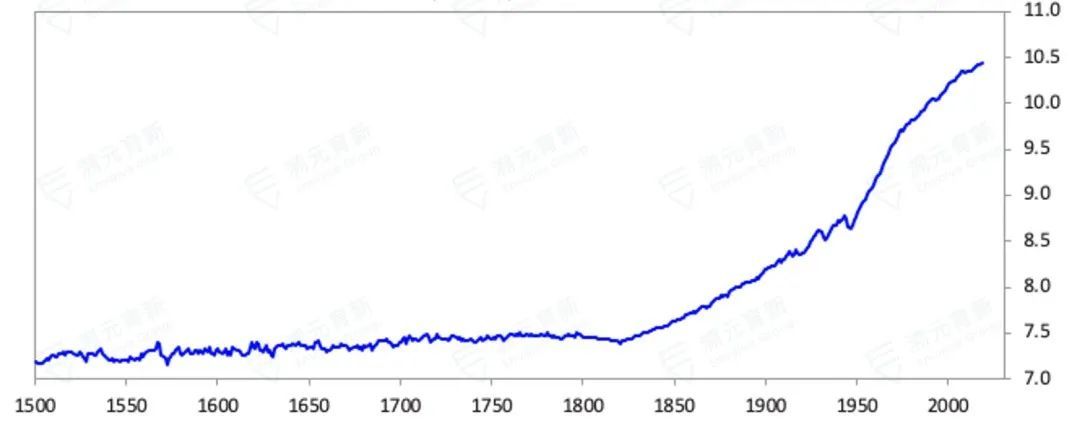
Estimates of global GDP per capita in the past 500 years (based on 2017 US dollars, taking logarithm)
From this top-down perspective, we can observe that the growth rate of global per capita output was very slow in the early days, but the slope of the growth curve suddenly became steep around 1800, reflecting the rapid improvement of production efficiency. Such changes have benefited from the improvement of the education level of the whole people and the transformation of educational achievements into productive forces. This change is caused by many factors, which can be traced back to the invention of the printing press in Europe in the mid-15th century (China used it very early), which improved the knowledge and education level of more people and contributed to the Renaissance, the scientific revolution, the Enlightenment and the first industrial revolution in Britain.
The popularization of education has also shifted wealth and power from the agricultural economy to the industrial economy. In the agricultural economy, monarchs, nobles and churches jointly own land and make profits from it; In the industrial economy, capitalists create and own the means of production, and together with the (secular) government, they maintain a system that enables them to make profits and take power for a long time. In other words, this system has been operating since the industrial revolution; In this system, wealth and power come from the combination of educational resources, innovative ability and capitalist system, and are controlled by those in power and those who control capital and educational resources.
However, behind the track of relatively steady increase in productivity, it is a turbulent era that witnessed prosperity and depression and experienced revolution and war. However, these turbulent periods are still weak relative to the long-term progress trend, so they only show a weak swing in the chart. These swings seem intense to us as individuals, but only because our lives are short and small.
Take the Great Depression and the war between 1929 and 1945 as an example. For us, these 17 years have been long and full of shock. The following chart reflects this period (economic situation), which is taken from the above line chart (reflecting the 200-year change). As you can see, GDP per capita fell by about 10% during the Great Depression, and then recovered, while the US stock market fell by 85%. The Great Depression was followed by World War II, which increased the production of munitions. However, due to the destruction of a large number of means of production, it is inaccurate to call this period "the era of mass production", even on a per capita basis. At the end of the war, the global per capita GDP dropped by about 12%, a large part of which was caused by the economic collapse of the defeated countries.
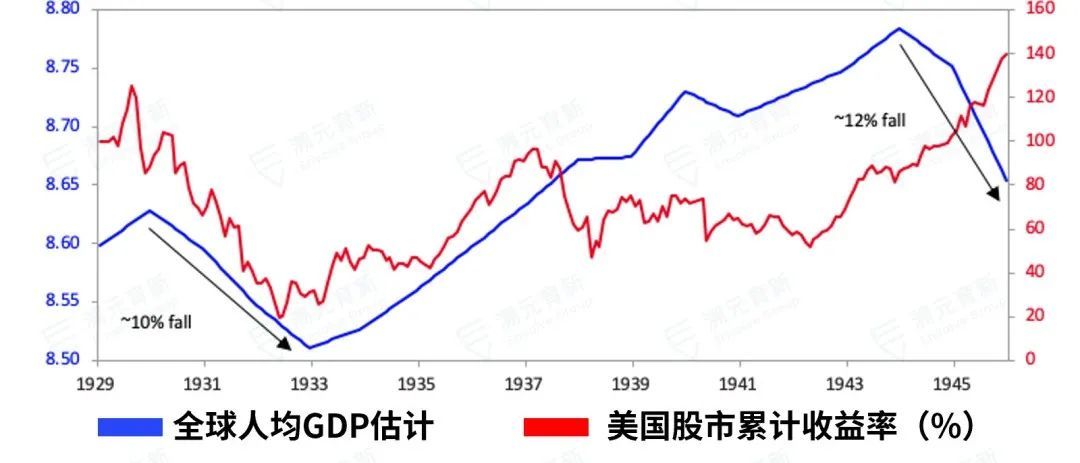
It can be seen that between 1929-1933 and 1944-46, the global per capita GDP dropped by 10% and 12% respectively.
Although the first chart I showed reflects the productivity of the world (to the best of our ability), it does not show the transfer of wealth and power between countries. The chart below shows the relative wealth and national strength of 11 world powers in the past 500 years. This wealth and power index is calculated by eight indicators, which I will introduce in detail later. Even though these data are not accurate due to the age, they still perfectly reflect the macro trend. As you can see, almost all big countries have experienced a period of rise and decline. Thick lines are the four most important big countries: the Netherlands, Britain, the United States and China, which have respectively mastered the three recent reserve currencies in history. It is the present tense for the United States, the past tense for Britain, and earlier for the Netherlands. I mention China because it has grown into the second most powerful country and remained so powerful for most of the time before 1850.
Medium-short period evolution
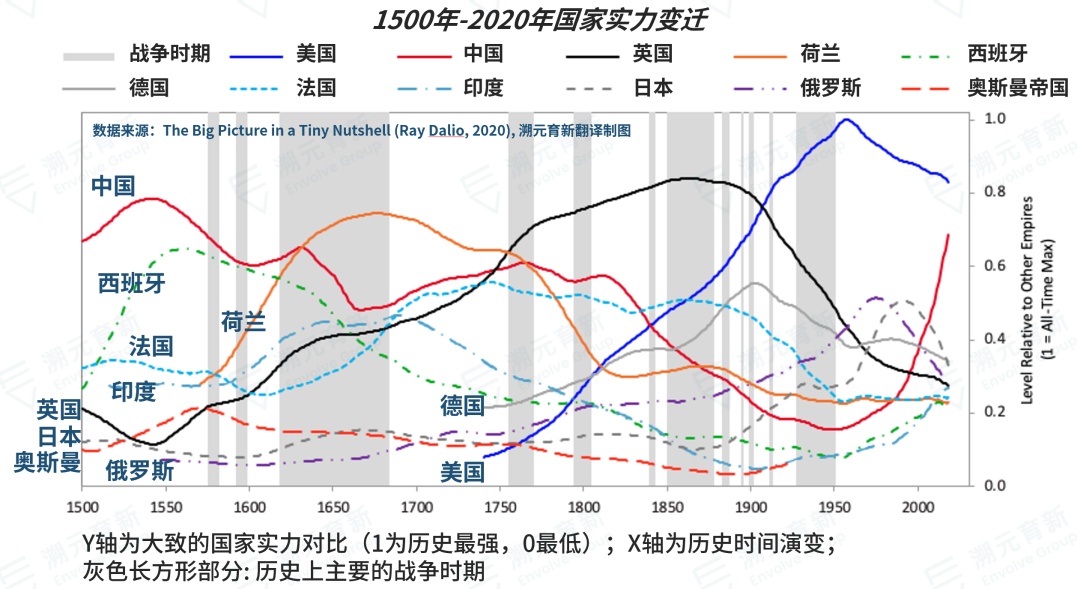
The chart shows: 1. Although China’s position declined sharply after the 19th century, it has been in a dominant position for centuries (always surpassing Europe in commodity trade); 2. As a relatively small country, the Netherlands became the greatest empire in the world in the 17th century. 3. Britain followed the Dutch model and reached the peak of its national strength in the 19th century; 4. In the end, the United States surpassed several countries and remained a world power for 150 years, especially after World War II and the war. Today, China is catching up.
The next chart dates back to 600 AD. In order to make the chart look simple, I included 500 years in the above chart. Although 11 countries, 12 major wars and a long history of 500 years can hardly be described as "simple". Long-period evolution
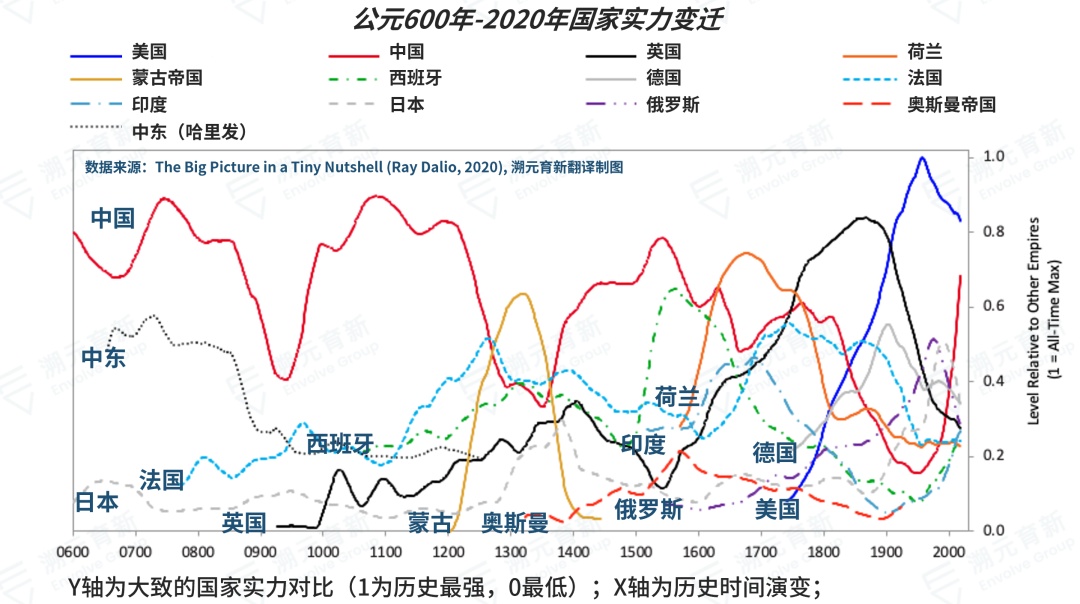
As the picture shows, 1500 years ago, China was almost always the most powerful, although the Arab Empire, French Empire, Mongolian Empire, Spanish Empire and Ottoman Empire also rose.
How do we measure the wealth and power level of a country?
In the first two charts, I measure the wealth and national strength of countries, which is basically obtained by averaging eight indicators. They are 1. Education; 2. Competitiveness; 3. the level of science and technology; 4. Economic output; 5. Trade share; 6. Military strength; 7. Strength of financial center and 8. Reserve currency. We will further discuss the measure of power later, but let’s focus on these eight key elements first.
Taking the year when China became the world’s largest country as the origin, we list the changes of various indicators in each of the 120 years before and after. The following table is the average data of many countries, but most of the weights are given to three countries with reserve currencies (namely, the United States, Britain and the Netherlands).
Paradigm law
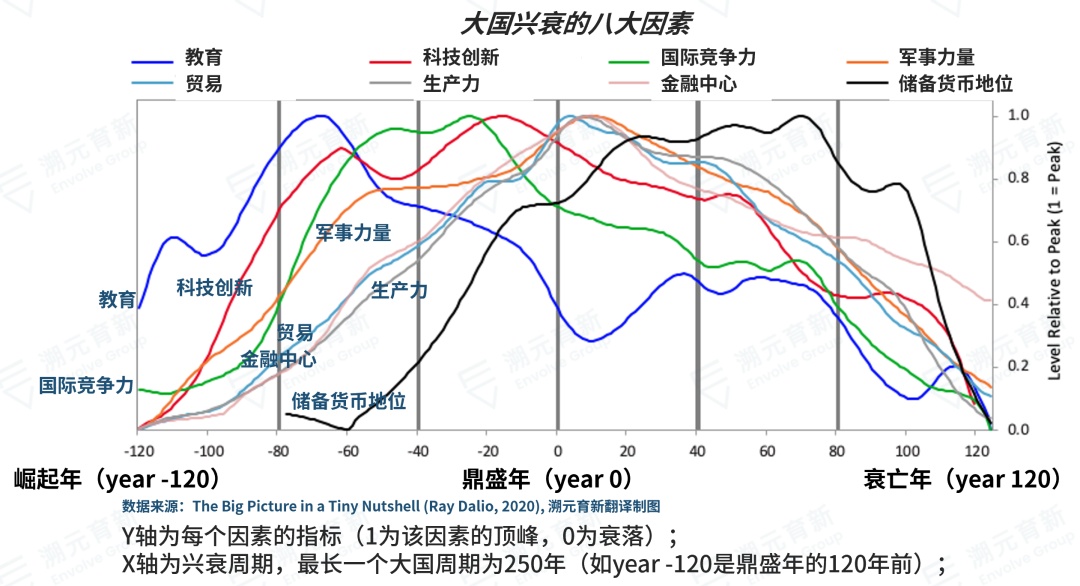
These charts tell a good story about how great powers rise and fall. I will introduce other factors later, but before I do, let me briefly introduce the cycle. The first thing to note is that all these indicators are curved before and after the rise of great powers, because these indicators always complement each other. That is, the advantages and disadvantages in education, competitiveness, economic output and world trade share can be logically transformed into other advantages or disadvantages. For example, well-educated people will create a more innovative, competitive and productive society.
I call this up-and-down swing of national strength "the great cycle". Please pay attention to the order in which these factors influence each other, because it reflects the process of the rise and fall of big countries. For example, education is always the leading indicator, but the change of reserve currency status is long overdue. This is because a strong education will bring advantages to most fields, including creating the most widely circulated currency in the world. Like the common language in the world, habit will amplify the strength of money itself and make it circulate more permanently.
04 great cycle
Broadly speaking, we can divide the rise and decline of empire into three stages: 1. The rise stage is characterized by gaining competitive advantage; 2. In its heyday, the country maintained its strong strength, but gradually laid a bitter fruit for losing its competitive advantage; And 3. In the weak stage, the self-strengthening mechanism in all aspects of the country has declined.
In short, a country can only go uphill when it has the following characteristics:
1. Strong and promising leadership: the premise of all successful elements.
2. Good education: including teaching knowledge and skills.
3. Rock-solid virtues, civic literacy and strong professional ethics: they are passed down through school and family education, and help civil society achieve the following achievements, such as:
Low corruption rate and high respect for social rules such as the rule of law.
People can not only unite, but also have a consensus on why they need to unite: when a group of people with abundant knowledge, advanced skills, good virtues and good civic literacy unite, they will create:
4. A good resource allocation system, and can …
Attracting the best talents in the world is the most important condition for a country to succeed, and then, this country will …
6. gain strong competitiveness in the international market, so that the national income far exceeds the expenditure, which contributes to
7. Strong income growth helps …
8. Increase investment in infrastructure, education and research and development, so as to obtain
9. Higher production efficiency: the improvement of production efficiency means the simultaneous improvement of productivity and wealth level. When the country’s production efficiency is high enough, they can invest and exhibit:
10. New technologies: These new technologies will have commercial or military value; As these countries become more competitive with the above factors, they will
11. Take more shares in the national trading system: this makes it necessary for them to establish:
12. Powerful military force: protect trade routes and expand its influence on other countries. With their economic advantages, they have developed into the world’s leading …
13. financial center, which can gather and finance capital: (Amsterdam was the world financial center when the Dutch empire dominated the world; After Britain replaced it, London became a financial center; And new york’s status now comes from the hegemony of the United States. But China is also developing its financial system with Shanghai as the center.) These expanding empires have …
14. Strong stock, currency and credit markets: The currencies of countries that dominate trade and capital flows naturally become the first choice for trading media and wealth reserves, and develop into reserve currencies. According to this logic, when the Dutch empire dominated, the Dutch guilder was the global reserve currency; During the British Empire, the pound inherited this status. When the US dollar became the global reserve currency in 1944, the United States was only one step away from winning World War II, and it was obviously in a leading position in economy, finance and military affairs. Using a country’s currency as a reserve currency will naturally give the country stronger borrowing and purchasing power. As shown in the above figure, the opportunity for a country to gain or lose its status as a global reserve currency is much later than its other strengths.
Through unremitting efforts and other complementary factors, the empires achieved their rise and maintained their national strength. The founders of those empires coordinated economic, political and military strength, and built an economic-political-military system that constantly benefited from the international community. The Dutch founded the Dutch East India Company, Britain founded the British East India Company, and the United States had a military-industrial complex. Facts have proved that this kind of economic, political and military cooperation is essential to the expansion of the empire.
However, the development of the empire always has its platform period, which is because behind the success of the country’s rise, it also lays the groundwork for future weakness. Specifically, it includes:
During the boom, people’s income increased, making labor more expensive; Compared with countries with lower wages for the same job, competitiveness naturally declines.
The development model of the most successful countries will be imitated by emerging competitors, and shine on you is often superior to Blue, which makes the leaders lose their competitive advantage. During the British-Dutch hegemony, the labor cost of British shipyards was lower than that of the Netherlands; Therefore, the former chose to hire Dutch engineers to design ships with higher cost performance than the Netherlands. Because the cost of time and money required for copying is less than that of invention and creation, other things being equal, emerging empires hitchhike in mature countries through copying.
In those countries that are born rich, people will reduce their workload and engage in more leisure and low-productivity activities; In extreme cases, it becomes decadent and incompetent. Especially when the backbone of society changes from a generation that must work hard to succeed to a generation that inherits wealth, the younger generation is often fragile and inexperienced, and it is more likely to be defeated when confronted with challenges. As time goes by, people in these prosperous societies are more eager to pursue a leisurely and luxurious life, so they do not hesitate to lose their strength, create bubbles, and finally become more vulnerable.
The richest and most powerful countries have the status of global reserve currency, which gives them the privilege of borrowing a lot, so that they are caught in a debt trap. A large number of loans have enhanced the consumption power of hegemonic countries in the short term, but in the long run it is just the opposite. In other words, when lending and consumption are strong, hegemonic countries seem to be strong, but their financial strength is eroded. This lending model enables domestic people to over-consume, and provides funds for expanding the army and launching wars to enhance forces other than basic national strength. This model can be maintained for a period of time, even self-strengthening, thus increasing the interest return of creditor countries, thus enhancing the status of reserve currency.
When rich countries borrow money from developing countries, it is also one of the early signs of wealth transfer. In the 1980s, the per capita income of the United States was 40 times that of China, but at that time, China had begun to buy US Treasury bonds because the US dollar was the global reserve currency. At the same time, it also became the starting point for China to catch up with the United States. Similarly, Britain borrowed heavily from much poorer colonies during World War II; The Netherlands did something similar before its national strength went downhill, but when the creditors refused to hold and sell the Dutch guilder, the Dutch debt structure collapsed instantly, and its monetary status and economic situation plummeted. The United States has also borrowed a lot of money and reduced its debt by issuing more money, but this has not shaken the status of the dollar and the US debt for the time being.
When the number one power keeps "expanding its territory" until it is no longer worthwhile to maintain it, the cost of maintaining the system becomes higher than the income. The unprofitable global power system will further hit its financial situation, as is the case in the United States today.
Because of unequal distribution, the success of economic development naturally widens the gap between the rich and the poor. Those who have wealth and power (such as those who profit from business activities or those in the government) take care of each other and maintain a system that is beneficial to them, while ordinary people lag far behind until the polarization between the rich and the poor has become intolerable injustice. The same is true in the United States today.
The foreshadowing of decline is always buried in the golden age, and the prosperous country will gradually decline in the downward trend. This decline is due to the fact that when the country is going downhill, the power that can compete with it has developed relatively in the above-mentioned fields.
When the national debt is high, the central bank can only make ends meet in the face of a weak economy, and the downward state leads to more debt and economic problems, the country has to print a lot of money and devalue its currency.
If the gap between the rich and the poor widens infinitely, social values are polarized, and economic pressure (no matter where the pressure comes from) cannot be released, it will be easy for the rich and the poor to fight, and the initial conflicts will intensify later. This usually encourages political extremism, that is, populism of reformists (people who try to redistribute wealth) and conservatives (people who want wealth to be in the hands of rich people such as capitalists). Both democratic and centralized countries may become the soil of populism.
When the rich are worried that their wealth will be taken away, or they will become the target of public criticism, they will transfer their wealth and life to places, assets or currencies that they think are safer. If this transfer is not explicitly prohibited, it will erode the tax and income of the place where the assets are transferred out, making it experience a typical vicious circle of asset hollowing out. Shrinking tax revenue is even worse, aggravating the tense situation, increasing tax revenue, forcing more rich people to leave, and other worse consequences. For example, we now observe that the root of some social problems is that the rich have fled the state with higher taxes because they don’t want to face the financial pressure and the gap between the rich and the poor. When the hollowing out of assets is too serious, the government will come forward to stop it-it is forbidden to continuously collect funds from the lost places to their new places, assets or currencies, and people who want to protect themselves will feel panic.
Events that shake the foundation will devour the country’s productive forces. The size of the wealth cake is a little smaller, and people are fighting for shrinking resources; The cake is drying up day by day, and people are fighting over how to distribute it. Populist leaders of different camps are clamoring hard in the wrestling, hoping to control the situation and reorganize the order. At this time, democracy is particularly precarious compared with centralization. This is why in the 1920s and 1930s, Germany, Japan, Italy and Spain (as well as some small countries) were all centralized and pulled out the flag of the democratic camp, while the major democratic countries (the United States, Britain and France) also had the shadow of centralization. It is generally believed that in chaotic times, centralized and rapid decision-making is preferable to democratic decision-making based on discussion. Therefore, when the mass struggle against discipline and resorting to violence appears, the movement is not without merit.
If a country has strong enough economic, geopolitical and military forces to challenge the existing dominant forces, then there are many potential conflicts between these competing powers. Because there is no system for peaceful adjudication of such disputes, conflicts have to be resolved through a head-on contest.
When the cost of maintaining the image of a big country is greater than the income it brings, the economic strength of the country is hollowed out. At the same time, other countries are on the rise, and the big countries that are already strong in the outside world do not want to give away their interests. This state will make a strong country face economic and military threats. In order to maintain its status as a big country, military spending has been expanding again and again, but the domestic economy has been depressed, making it more difficult for leaders to collect taxes and making them need more domestic support. Seeing this dilemma, the enemy countries have chosen to strike at the beginning of the signs of the decline of great powers. Then, the big countries will face the difficult choice of facing or retreating economically and militarily.
If other external shocks, such as natural disasters (plague, drought or flood), occur in a fragile period when big countries are struggling to cope with internal and external troubles, it is tantamount to injecting another destructive force into the process of national decline.
It is also a problem when the number of people in a country who are vegetarian is not enough for the country to win in this cycle. Of course, since each leader is only responsible for a short part of this cycle, they can only solve problems on the basis left by their predecessors, which means that the National Games can control everything better than the leaders.
In a word, due to the improvement of productivity, cakes are constantly expanding, and some cycles have emerged.
The construction period of the country’s peak. Due to:
1. Relatively low debt level
2. Relatively small wealth, value and political views gap.
3. People work together to create prosperity.
4. Good education and infrastructure
5. Competent leadership.
6. A peaceful world order led by one or more major powers.
When it flourished and declined, the country went to a period of deconstruction and reorganization. The reason for the country’s prosperity has gone to the opposite side and turned into a fatal weakness:
1. High debt
2. A huge gap in wealth, value and political views.
3. The cooperation between nationals broke down and they turned to attack each other.
4. Backward education and infrastructure
In order to maintain the state of over-expansion, great powers have gone through a painful period of struggle, destruction and reorganization under the challenge of new rising forces, which has given birth to a new order and laid the foundation for the coming of a new era.
Generally speaking, the 17 characteristic indicators in the figure below are the main forces driving the rise and fall of a country. For any country, the more each feature deviates to the left, the greater the possibility of its rise; The more you shift to the right, the greater the possibility of weakness. World powers tend to show more left-leaning characteristics, and under a virtuous circle, they continue to become stronger; However, if the management is not good, each characteristic index will shift to the right, and the country will go weak. At this time, new competitors can take the opportunity to rise, properly manage each characteristic index, and gradually the situation of strength has changed.
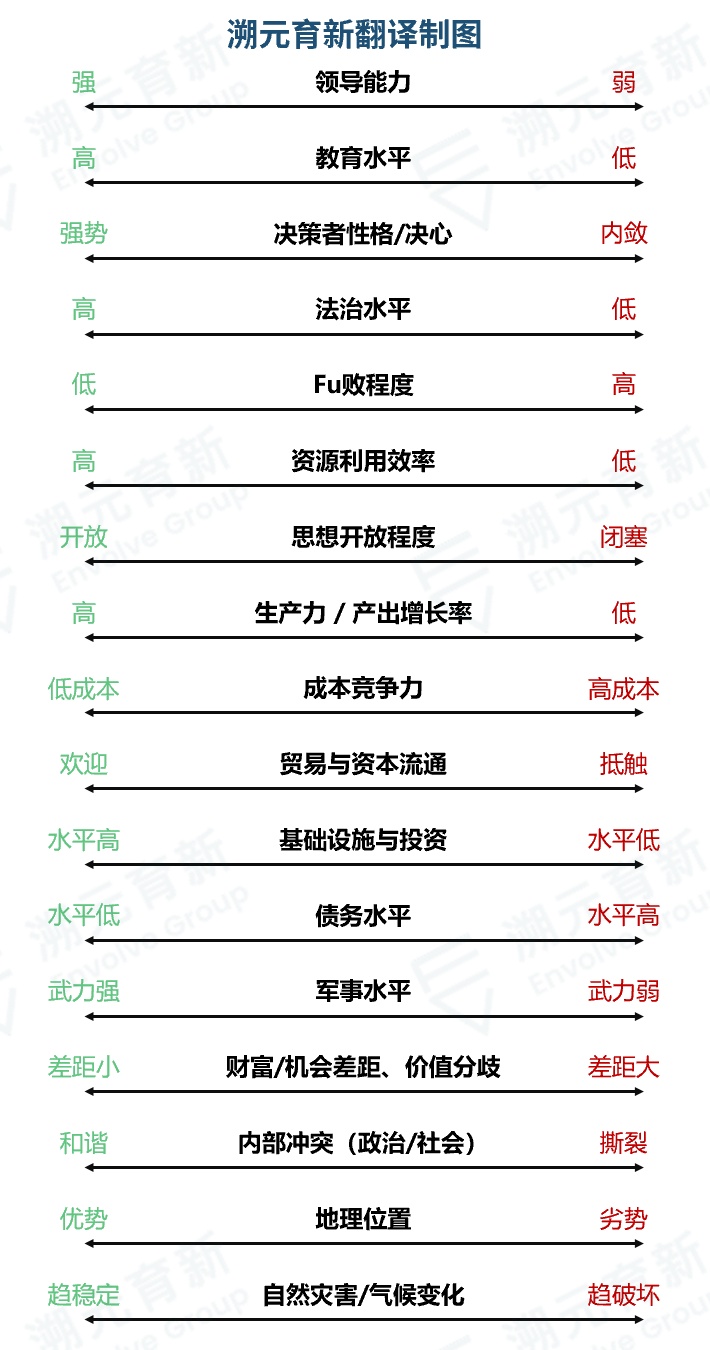
17 factors affecting the rise and fall of a country
In short, this is the reason why the rise and decline of great powers occur periodically. Now, I want you to do a little exercise: think carefully about whether the position of each characteristic index is to the left or to the right for the country/region you are interested in. What about the United States and China? What other countries are there? Make a judgment based on your intuition and compare it with my idea later. I will make a more systematic analysis of the characteristic indicators of these big countries later.
These positive and negative factors are actually intertwined and affect each other, bringing great changes to society. It is no coincidence that the huge gap between the rich and the poor, the debt crisis, the revolution, the war and the changes in the world pattern almost happened at the same time. The following picture outlines the history of the rise and fall of every big country very clearly. As shown in the shaded area in the figure below, the destruction and reorganization caused by depression, revolution and war have largely destroyed the old system and laid the foundation for the emergence of new systems. These great depressions often occur every 10 to 20 years, but there may be more variables in this time period. Followed by a beautiful new world, no country is willing to compete with the world hegemon for the top spot, and well-behaved people begin to work and develop harmoniously. Usually, these beautiful periods can last for 40 to 80 years, but there will be great fluctuations. In the above two big cycles, there are also some small cycles, such as short-term debt crisis/business cycle, which last for 7 to 10 years.
Reserve currency cycle
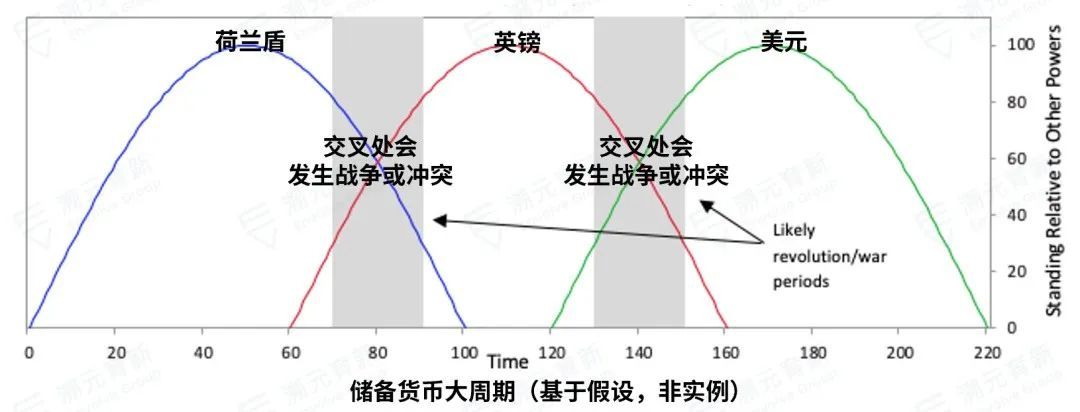
For example, the decline of a Dutch power gives way to a British power, or Britain gives way to the United States. Most of the following things will happen in this process:
Debt restructuring and debt crisis are internal conflicts in countries, which eventually lead to the redistribution of wealth, the collapse of the status of foreign war reserve currency and the collapse of a new generation of domestic and international order
The last Great Depression occurred in 1930-45, which promoted the reconstruction period that began in 1945. More specifically, the collapse and reorganization of the monetary and credit system led to the depression in 1930-45, which led to the establishment of a new global monetary system (Bretton Woods system) based on the dollar in 1944. The huge gap between the rich and the poor in the Roaring 20s narrowed due to depression and war, which led to a fundamental change in the distribution of wealth and rights, and the global war also changed the world pattern. After 1945, everything has undergone earth-shaking changes. The United States became the world hegemon, the gold standard shifted, and a global monetary and credit system based on the dollar was established.
Translator’s Note: This refers to the 1920s in the western context, which was a period of sustained economic prosperity. In the past ten years, it covered countless exciting events, so some people called it "the most colorful era in history".
In this new world dominated by the United States, the United States has taken the lead in wealth, economic strength and military strength. It is the richest country with 80% of the world’s gold reserves; It is a country with the highest economic strength in the world, and its production capacity accounts for half of the world’s output; It is also a military power with absolute advantages, monopolizing nuclear weapons and having the most powerful conventional forces. However, after 75 years, the world pattern has also undergone fundamental changes, which we will discuss further in the following chapters. At that time, we will also try to predict and interpret the possible future development direction.
Next, we will study each indicator more carefully. In the last chapter, I will summarize all these indicators and carefully infer how to make our future better in view of our current situation. In the second part, I will make a detailed interpretation of each country’s case.
[1] Short-term cycle evolution chart
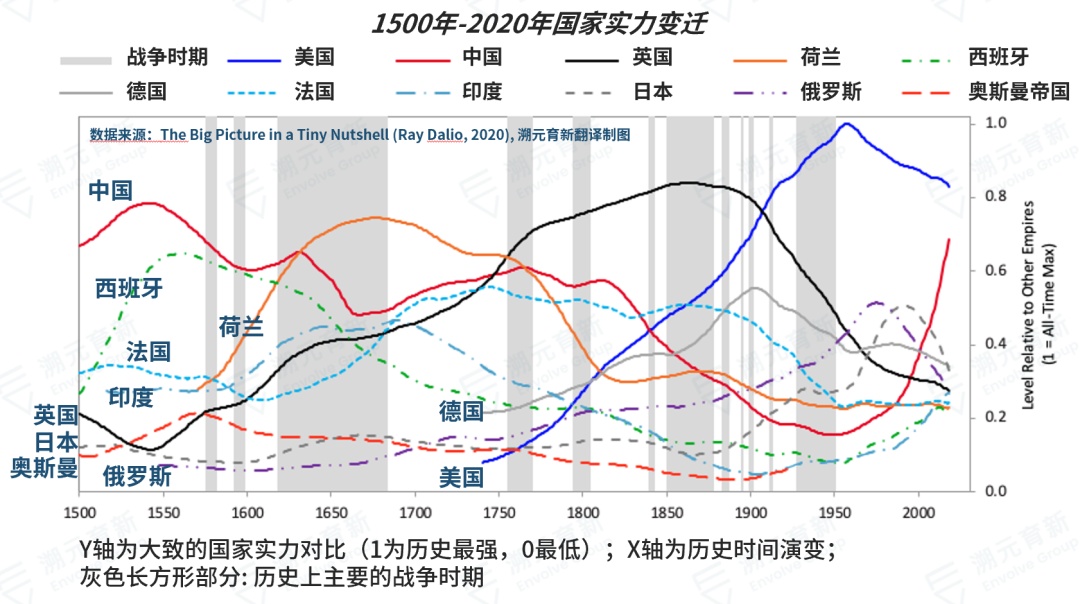
As for the above figure, these indexes consist of many different statistical data, some of which can be directly compared, while others are only an estimate. The data in some countries are always discontinuous, so different data need to be spliced together. It should be noted that the line shown on the chart is the 30-year moving average of these indexes, and I have adjusted it, so there will be no lag. The moving average is chosen because it is less volatile and can filter out a lot of noise, making the direction of the big period clearer. For a longer-term interpretation, I will use these curves smoothed by the moving average; On the contrary, for some more detailed interpretations, the unprocessed curve may contain more information.
[2] Chart of Paradigm Law
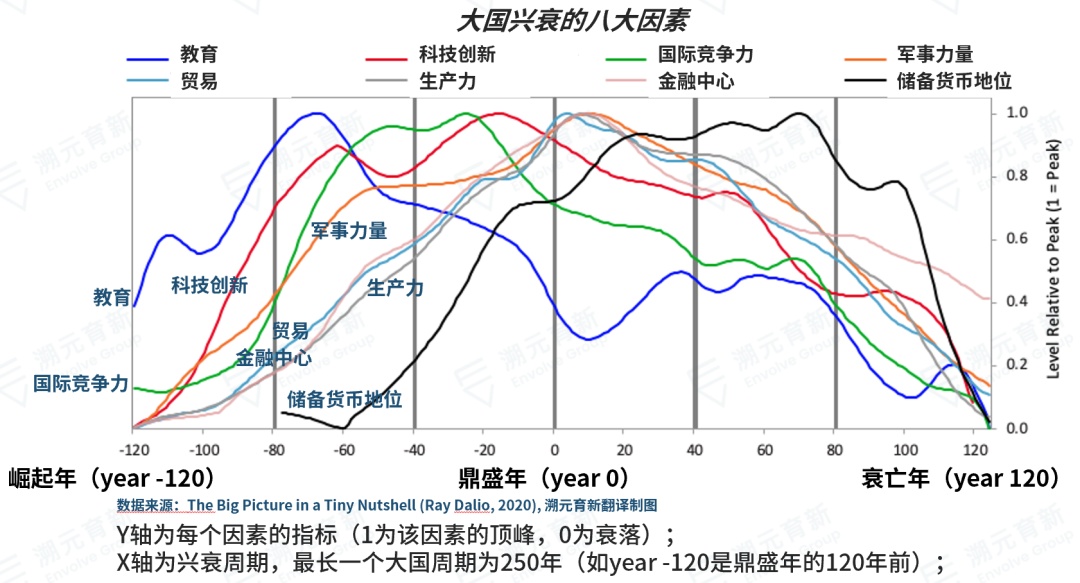
Regarding the above figure, we show the relationship between these key indicators and history by anchoring specific time periods in history. The value "1" on the Y axis represents the peak value of this indicator relative to history, and "0" represents the bottom. The X-axis, that is, the time axis, is displayed in units of years, where "0" roughly represents the time when many indicators of the country reach the peak. In the rest of this section, we will introduce the stages of paradigm law in more detail. As for the indicator of global reserve currency, we will focus on China. Although it has been a big country for centuries, its currency has never become a global reserve currency. The reasons behind this are worthy of our further study.
(A global M&A investment transaction information manager at your fingertips)
This article first appeared on WeChat WeChat official account: Yijie DealGlobe. The content of the article belongs to the author’s personal opinion and does not represent Hexun.com’s position. Investors should operate accordingly, at their own risk.