What is stock and flow?
Stock and flow are two kinds of indicators reflecting the economic situation, which are widely used in statistics and national economic accounting. There is a close relationship between stock and flow, and there are some differences.
First, the basic concepts of stock and flow
Stock is the amount of balance at a certain time, which reflects the economic value or quantity held at a certain time; Flow is the cumulative amount in a period of time, which reflects the generation, conversion, exchange, transfer and disappearance of economic value or volume in a period of time, and reflects the changes of economic value or volume in a period of time.
Second, the relationship between stock and flow
The relationship between inventory and flow can be summarized as follows: the sum of the initial inventory and the corresponding flow in this period forms the final inventory. Many flows in the process of economic operation have direct corresponding stocks, such as deposits and deposit balances in the current period, loans and loan balances in the current period, but some flows do not have direct corresponding stocks, such as imports, exports and workers’ remuneration.
Three, the stock and flow in statistics and national economic accounting
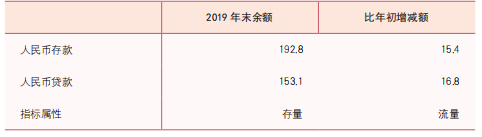
Among various statistical indicators, the stock indicators include the balance of government debt, foreign exchange reserves, total population, deposit balance, loan balance, etc. Flow indicators include total retail sales of consumer goods, investment in fixed assets of the whole society, passenger volume, freight volume, import volume, export volume, etc. Taking RMB deposit and loan indicators as an example, at the end of 2019, the balance of RMB deposits nationwide was 192.8 trillion yuan, and RMB deposits increased by 15.4 trillion yuan that year; The balance of RMB loans nationwide was 153.1 trillion yuan, and RMB loans increased by 16.8 trillion yuan that year. Among them, the balance of RMB deposits is 192.8 trillion yuan and the balance of RMB loans is 153.1 trillion yuan. In that year, RMB deposits increased by 15.4 trillion yuan and RMB loans increased by 16.8 trillion yuan, which are flow data.
RMB deposits and loans in 2019
Unit: trillion yuan
In national economic accounting, gross domestic product accounting, input-output accounting, capital flow accounting and balance of payments accounting belong to flow accounting; The international investment position table in asset-liability accounting and balance of payments accounting includes both stock accounting and flow accounting. Among them, GDP accounting describes the formation and use of the final results of production activities in a certain period of time. Input-output accounting describes the source of inputs and the destination of outputs used in production activities in various sectors of the national economy in a certain period of time, and reveals the quantitative relationship between the various sectors of the national economy. Capital flow accounting takes income distribution and capital movement as accounting objects, and describes the distribution and use of income and the collection and use of funds in various institutions and departments in a certain period. Balance of payments accounting describes the economic relationship between permanent units and non-permanent units in China, and the balance of payments table reflects the foreign economic balance of payments that occurred in a certain period; The international investment position table reflects the stock of external assets and liabilities and its changes at a specific time. Asset-liability accounting describes the stock and structure of assets and liabilities at a specific time, as well as the changes of assets and liabilities from the beginning to the end.
(Written by Zhao Tonglu and Li Xianglong)