Dalio, Bridgewater: What are the rules of global rise and fall?

  Times change, countries rise and fall.

  The rise and fall of a country is driven by long-term factors as well as accidental events. At present, during the epidemic period we are experiencing, the performance of the United States lacks global leadership, and the over-issuance of the US dollar has once again made people question its status as an issuer of abuse reserve currency. The newly released International Monetary Fund (IMF) data shows that the proportion of US dollars in global foreign exchange reserves continues to decline, and it fell to 60.89% at the end of 2019, the lowest in recent years, and the proportion of RMB is 1.96%.

  We often follow Bridgewater Dario’s point of view. He believes that in the "great cycle" of national strength, the status change of reserve currency is the slowest. Before that, the change of national strength was already taking place. By studying the long-term history of many countries, we can reveal the most important influencing factors of the great cycle of national strength.

  What are these factors? We share with you Dario’s recent articles published in LinkedIn.

  This article will explain the essential motivation behind the rise and decline of the strongest country in history. This is the essence of the law that I showed when I studied the dynasty changes of the past three reserve currency countries: the Netherlands, Britain and the United States, and six other important powers: Germany, France, Russia, India, Japan and China in the past 500 years. Besides, I also specially studied all the generational changes in China since the Tang Dynasty. In addition to seeing the transfer of wealth and power, we have also seen changes in all aspects of daily life such as science and technology, culture and art. These individual case studies will be elaborated in detail in Part 2. When we switch back and forth between historical cases and the underlying paradigm, we can see how these cases show the underlying paradigm (Fit the archetype) and how the paradigm I summarized can describe the actual situation of these historical cases well (the law reflected by the paradigm will be exactly the sum average of historical events).

  As I mentioned above, the most important task of this article is to show you the eternal and universal operation law behind the world as much as possible and use it for me. For me, this process makes me feel obligated and full of energy. As I mentioned in my previous article, my curiosity and anxiety about the world prompted me to uncover the law behind it, but when I really did research, the whole process brought me a much grander picture of the world than I expected. In my opinion, all this reveals more clearly how people and countries have risen and weakened for thousands of years. Behind these ups and downs, there is a huge cycle that goes hand in hand, but I never realized all this before.

  Although the grand picture I will show you is my independent view, readers, I also need to declare to you that I can’t show you this picture without help from all sides. It comes not only from my hard study in the past 18 months, but also from my deep discussion with top scholars and doers, a lot of hard reading of historical works with profound insights in the past, and the hard research of top research teams, combined with my investment experience in the global scope in the past 50 years. With so much help, it takes courage, humility and continuous efforts to explain the law of the rise and fall of great powers in history, and there is no guarantee that everything I say is correct. However, I am sure that most of what I said is right, and I also understand that this law gives me a strong ability to predict the future, and I can predict scenes that we have never seen in my life, because these things have been happening repeatedly in the historical process of social development. My goal is to make all this clear to you after my hard research and practice, so that it can be used by you.

  01

  Study the screening principles of countries

  Let me make it clear first that the big country we study is not necessarily the country with the best living standard. There are two reasons: first, although wealth and power are what most people pursue, some people and some countries do not think these things are the most important and will not consider fighting for them. For example, some people think that having a peaceful and fulfilling life is more important than having a lot of wealth and power. They don’t pursue wealth and power constantly, so they are not the object of study. Secondly, the countries studied do not include the so-called "boutique countries" (such as Switzerland and Singapore), which have high wealth and living standards, but are not large enough to become big countries.

  How do people acquire wealth and power?

  Let’s look at the big picture. Throughout the well-documented history, various forms of people (such as tribes, kingdoms, countries) have either created themselves or obtained wealth and power from others. When they gather more forces than any other organization, they become the world’s leading forces and then determine the world order. When they lost that power (as every big country did in the past), wealth, power and world order changed greatly, which had a great impact on economy, market and all aspects of life. In this chapter, we will study how many forces jointly determine the ups and downs of this cycle, so as to regularly make the wealth and power of big countries rise first, then maintain, and then decline (Causing the archetypal empire’s wealth and power to rise, be sustained, and then decline).

  With the passage of time, the development of society and the improvement of productivity, the world’s total wealth, total rights and living standards have been continuously improved. In the whole human society, the gains from learning always outweigh the losses. Although due to the differences in education level, work ability and scientific and technological development level, different people’s learning productivity has increased at different speeds. Knowing this, those in power can make better policies and make the country develop better; Investors and company managers can therefore decide how to make better investments. Although the improvement of learning ability and productivity level is of great significance, they are constantly innovating, so they are not the cause of major changes in people with wealth and power.

  The sharp fluctuation of wealth and power is caused by many factors, although I have identified 17 influencing factors, the most important of which is the currency and credit cycle. These powerful forces usually come together in classical cycles, which tend to form a very large ups and downs cycle in a complementary way and appear repeatedly throughout history. This huge archetypical cycle controls the rise and fall of empires, which affects everything, including their currencies and markets. Like the archetypical debt cycle I outlined in Debt Crisis-My Coping Principles, this cycle paradigm represents a typical debt cycle that we can compare with other debtors, including the debt cycle we are in now. Knowing this, we can try to get a glimpse of the future through the gap.

  At the time of writing this article, we see that all these 17 forces are at work, and the most important ones are the debt cycle, the gap between the rich and the poor cycle and the global geopolitical cycle. As mentioned in the previous article, we recently lowered the interest rate to 0% during the economic downturn, and at the same time carried a lot of debts. This has led to a large number of government debts, and central banks are printing money for monetization. At the same time, there is a huge gap in politics and values between countries, and the emerging world power (China) is challenging the current world power (the United States). Although this situation has never happened in our life, it has happened many times in history (the most recent one happened in 1930-45). I will explain to you in this article that we are now experiencing an archetypal big shift in relative wealth and power, and with this change, we will witness the profound changes in the world order that have affected all countries.

  The reason why the transfer of wealth and power between countries is often overlooked is that although it is rapidly forming, it has not suddenly appeared. This neglected but obvious thing shocked us. Most people don’t pay attention to the laws of history, so they can’t accurately understand our current situation. Therefore, in this article, I will describe in a very concise way how I view the archetypical mechanics behind the rise and fall of big countries and their market operations.

  In order to see the whole picture of historical changes, you can’t get too entangled in details.

  If I want to show you all this huge picture called "the changes of human history", then I can’t concentrate on presenting every detail. Similarly, as an appreciation of the scroll, please understand this and try to look at it from a macro and divergent perspective. This is because we are trying to understand and appreciate the evolution and changes that span a long period of history. In order to see these changes, we have to ignore some details. Of course, when we should stop and pay attention to the details (some specific details are very, very important), I will switch from macro narrative to micro-description, so that we can take a closer look at these details.

  Examining what happened in the past from the grand perspective of human historical changes will fundamentally change the way we look at things. For example, many things we take for granted, many words we blurt out, did not exist in most historical periods. Therefore, I will try my best to present the whole historical picture to you vividly, but I won’t get entangled in all the details of history. However, in the cases we studied, I will present you with relatively complete details.

  For example, we should carefully understand the differences between different countries, kingdoms, nations, nations, tribes, empires and dynasties. Nowadays, we mostly talk about (sovereign) countries, but it is well known that sovereign countries did not appear until the 17th century after the Thirty Years’ War in Europe. Generally speaking, there was no modern country before that, only the kingdom could be seen. But in some places today, the kingdom still exists, and the boundaries with sovereign countries are unclear, and some places have both. Generally speaking, the kingdom is the smallest, the country is the second, and the empire is the largest, and the relationship between them is not clear. Britain was a kingdom at first, then evolved into a sovereign country, and finally became an empire whose borders extended beyond England, so that its leaders could control a vast area and many non-Anglo-Saxon people.

  Similarly, each type of political entity (such as country, kingdom, tribe and empire) controls population in different ways, which puzzles those researchers who strive for perfection. In some cases, empire refers to the area occupied by the ruling power; Sometimes it refers to those areas that are influenced by the ruling power through threats and inducements. The British empire occupied the territory of the empire in general, while the United States controlled more countries by relying on the "carrot+stick" strategy. Although this is not entirely correct, at the time of writing, the United States has military bases in 70 countries, so it is obvious that there is an "American empire", but what it refers to is controversial. Anyway, I hope readers understand what I mean: trying to be precise in words may hinder me from conveying more important information. So in this article, you will have to put up with my ubiquitous uncertainty. You also need to understand why I collectively refer to these political entities as countries, even if it is not technically the case.

  Some people may think that it is impossible for me to compare different countries and different systems at different times. I can understand this view, but I assure you that I will try my best to explain any differences, but the similarities between eternity and universality in history far outweigh the differences. It is extremely sad to let differences prevent us from seeing the laws of history clearly.

  03 historical change and the cycle that goes hand in hand.

  As mentioned above, the long-term progress of mankind depends on constantly doing things better, that is, improving productivity. In the long run, learning and constantly improving productivity is the most important force; Although economic cycle fluctuation is also important in the short term, it cannot change the long-term trend. The chart below shows the changes of global per capita production value (estimated real GDP) in the past 500 years, which can also illustrate this point.
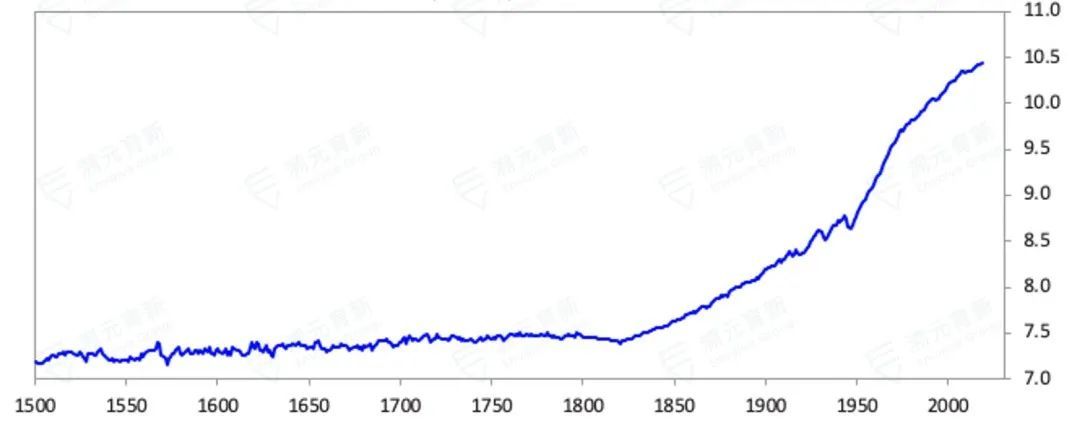
  Estimates of global GDP per capita in the past 500 years (based on 2017 US dollars, taking logarithm)

  From this top-down perspective, we can observe that the growth rate of global per capita output was very slow in the early days, but the slope of the growth curve suddenly became steep around 1800, reflecting the rapid improvement of production efficiency. Such changes have benefited from the improvement of the education level of the whole people and the transformation of educational achievements into productive forces. This change is caused by many factors, which can be traced back to the invention of the printing press in Europe in the mid-15th century (China used it very early), which improved the knowledge and education level of more people and contributed to the Renaissance, the scientific revolution, the Enlightenment and the first industrial revolution in Britain.

  The popularization of education has also shifted wealth and power from the agricultural economy to the industrial economy. In the agricultural economy, monarchs, nobles and churches jointly own land and make profits from it; In the industrial economy, capitalists create and own the means of production, and together with the (secular) government, they maintain a system that enables them to make profits and take power for a long time. In other words, this system has been operating since the industrial revolution; In this system, wealth and power come from the combination of educational resources, innovative ability and capitalist system, and are controlled by those in power and those who control capital and educational resources.

  However, behind the track of relatively steady increase in productivity, it is a turbulent era that witnessed prosperity and depression and experienced revolution and war. However, these turbulent periods are still weak relative to the long-term progress trend, so they only show a weak swing in the chart. These swings seem intense to us as individuals, but only because our lives are short and small.

  Take the Great Depression and the war between 1929 and 1945 as an example. For us, these 17 years have been long and full of shock. The following chart reflects this period (economic situation), which is taken from the above line chart (reflecting the 200-year change). As you can see, GDP per capita fell by about 10% during the Great Depression, and then recovered, while the US stock market fell by 85%. The Great Depression was followed by World War II, which increased the production of munitions. However, due to the destruction of a large number of means of production, it is inaccurate to call this period "the era of mass production", even on a per capita basis. At the end of the war, the global per capita GDP dropped by about 12%, a large part of which was caused by the economic collapse of the defeated countries.
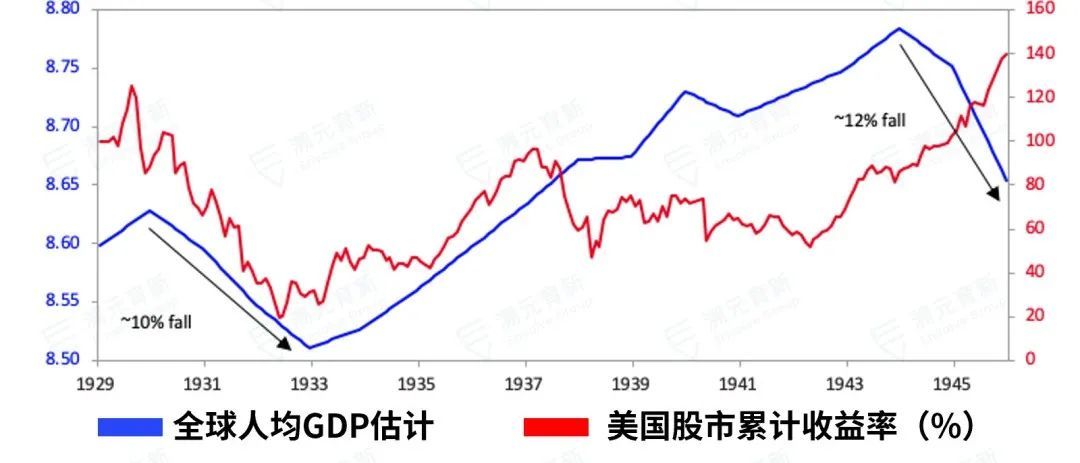
  It can be seen that between 1929-1933 and 1944-46, the global per capita GDP dropped by 10% and 12% respectively.

  Although the first chart I showed reflects the productivity of the world (to the best of our ability), it does not show the transfer of wealth and power between countries. The chart below shows the relative wealth and national strength of 11 world powers in the past 500 years. This wealth and power index is calculated by eight indicators, which I will introduce in detail later. Even though these data are not accurate due to the age, they still perfectly reflect the macro trend. As you can see, almost all big countries have experienced a period of rise and decline. Thick lines are the four most important big countries: the Netherlands, Britain, the United States and China, which have respectively mastered the three recent reserve currencies in history. It is the present tense for the United States, the past tense for Britain, and earlier for the Netherlands. I mention China because it has grown into the second most powerful country and remained so powerful for most of the time before 1850.

  Medium-short period evolution
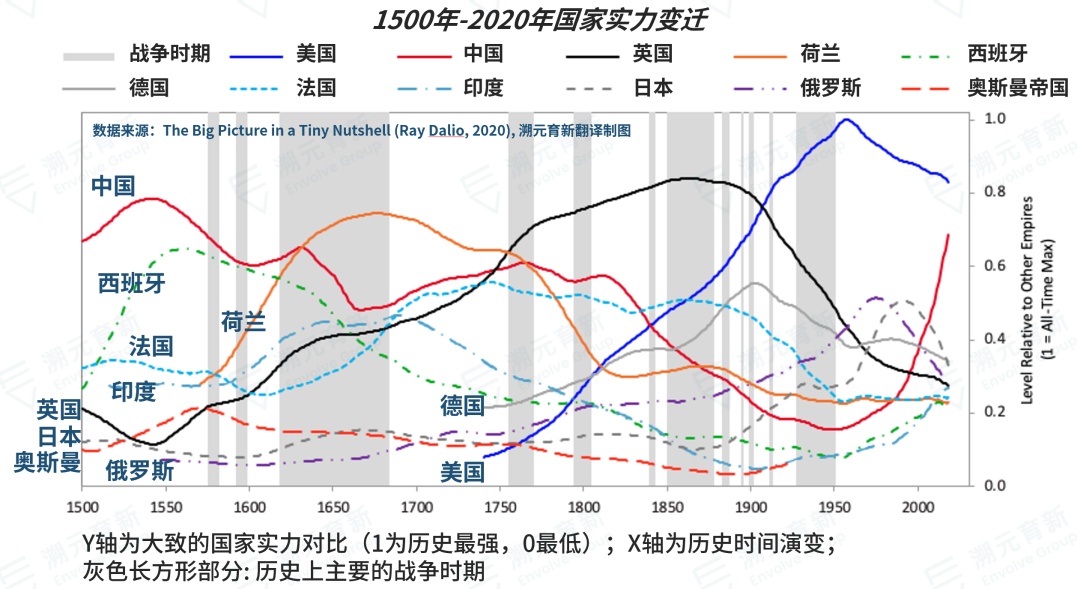
  The chart shows: 1. Although China’s position declined sharply after the 19th century, it has been in a dominant position for centuries (always surpassing Europe in commodity trade); 2. As a relatively small country, the Netherlands became the greatest empire in the world in the 17th century. 3. Britain followed the Dutch model and reached the peak of its national strength in the 19th century; 4. In the end, the United States surpassed several countries and remained a world power for 150 years, especially after World War II and the war. Today, China is catching up.

  The next chart dates back to 600 AD. In order to make the chart look simple, I included 500 years in the above chart. Although 11 countries, 12 major wars and a long history of 500 years can hardly be described as "simple". Long-period evolution
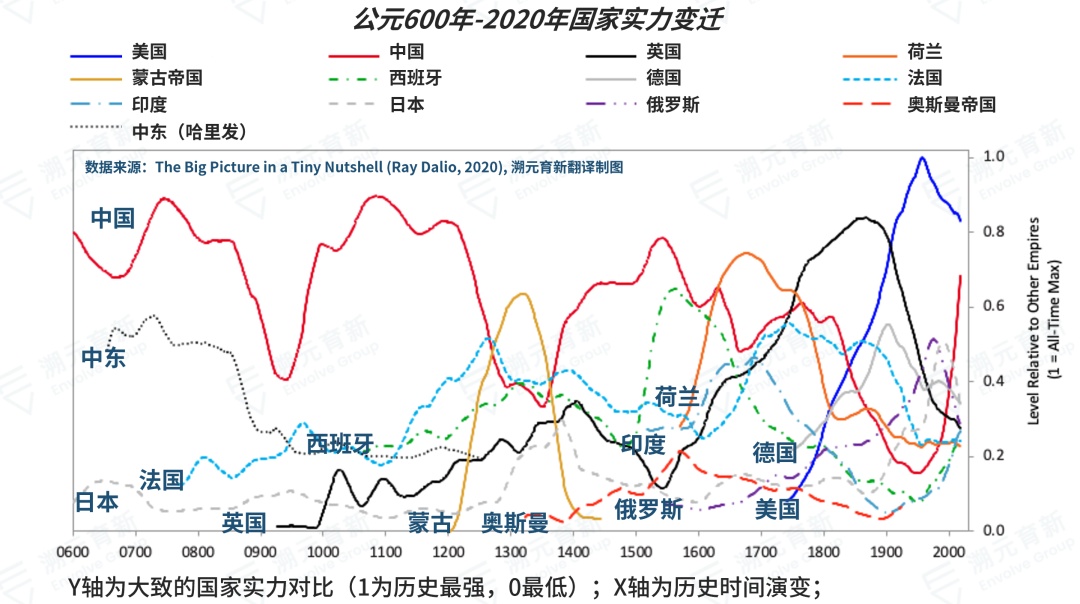
  As the picture shows, 1500 years ago, China was almost always the most powerful, although the Arab Empire, French Empire, Mongolian Empire, Spanish Empire and Ottoman Empire also rose.

  How do we measure the wealth and power level of a country?

  In the first two charts, I measure the wealth and national strength of countries, which is basically obtained by averaging eight indicators. They are 1. Education; 2. Competitiveness; 3. the level of science and technology; 4. Economic output; 5. Trade share; 6. Military strength; 7. Strength of financial center and 8. Reserve currency. We will further discuss the measure of power later, but let’s focus on these eight key elements first.

  Taking the year when China became the world’s largest country as the origin, we list the changes of various indicators in each of the 120 years before and after. The following table is the average data of many countries, but most of the weights are given to three countries with reserve currencies (namely, the United States, Britain and the Netherlands).

  Paradigm law
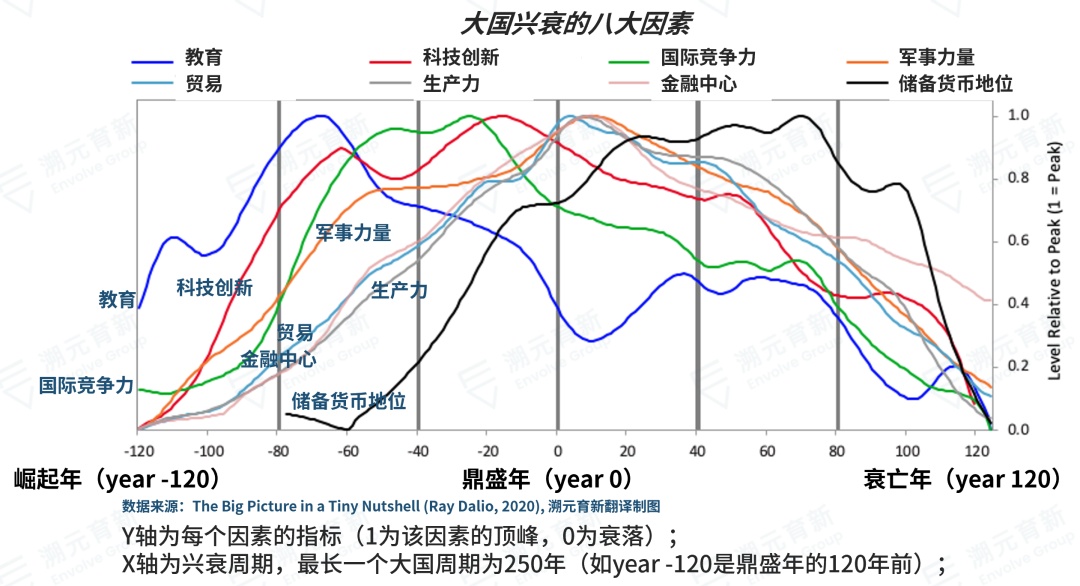
  These charts tell a good story about how great powers rise and fall. I will introduce other factors later, but before I do, let me briefly introduce the cycle. The first thing to note is that all these indicators are curved before and after the rise of great powers, because these indicators always complement each other. That is, the advantages and disadvantages in education, competitiveness, economic output and world trade share can be logically transformed into other advantages or disadvantages. For example, well-educated people will create a more innovative, competitive and productive society.

  I call this up-and-down swing of national strength "the great cycle". Please pay attention to the order in which these factors influence each other, because it reflects the process of the rise and fall of big countries. For example, education is always the leading indicator, but the change of reserve currency status is long overdue. This is because a strong education will bring advantages to most fields, including creating the most widely circulated currency in the world. Like the common language in the world, habit will amplify the strength of money itself and make it circulate more permanently.

  04 great cycle

  Broadly speaking, we can divide the rise and decline of empire into three stages: 1. The rise stage is characterized by gaining competitive advantage; 2. In its heyday, the country maintained its strong strength, but gradually laid a bitter fruit for losing its competitive advantage; And 3. In the weak stage, the self-strengthening mechanism in all aspects of the country has declined.

  In short, a country can only go uphill when it has the following characteristics:

  1. Strong and promising leadership: the premise of all successful elements.

  2. Good education: including teaching knowledge and skills.

  3. Rock-solid virtues, civic literacy and strong professional ethics: they are passed down through school and family education, and help civil society achieve the following achievements, such as:

  Low corruption rate and high respect for social rules such as the rule of law.

  People can not only unite, but also have a consensus on why they need to unite: when a group of people with abundant knowledge, advanced skills, good virtues and good civic literacy unite, they will create:

  4. A good resource allocation system, and can …

  Attracting the best talents in the world is the most important condition for a country to succeed, and then, this country will …

  6. gain strong competitiveness in the international market, so that the national income far exceeds the expenditure, which contributes to

  7. Strong income growth helps …

  8. Increase investment in infrastructure, education and research and development, so as to obtain

  9. Higher production efficiency: the improvement of production efficiency means the simultaneous improvement of productivity and wealth level. When the country’s production efficiency is high enough, they can invest and exhibit:

  10. New technologies: These new technologies will have commercial or military value; As these countries become more competitive with the above factors, they will

  11. Take more shares in the national trading system: this makes it necessary for them to establish:

  12. Powerful military force: protect trade routes and expand its influence on other countries. With their economic advantages, they have developed into the world’s leading …

  13. financial center, which can gather and finance capital: (Amsterdam was the world financial center when the Dutch empire dominated the world; After Britain replaced it, London became a financial center; And new york’s status now comes from the hegemony of the United States. But China is also developing its financial system with Shanghai as the center.) These expanding empires have …

  14. Strong stock, currency and credit markets: The currencies of countries that dominate trade and capital flows naturally become the first choice for trading media and wealth reserves, and develop into reserve currencies. According to this logic, when the Dutch empire dominated, the Dutch guilder was the global reserve currency; During the British Empire, the pound inherited this status. When the US dollar became the global reserve currency in 1944, the United States was only one step away from winning World War II, and it was obviously in a leading position in economy, finance and military affairs. Using a country’s currency as a reserve currency will naturally give the country stronger borrowing and purchasing power. As shown in the above figure, the opportunity for a country to gain or lose its status as a global reserve currency is much later than its other strengths.

  Through unremitting efforts and other complementary factors, the empires achieved their rise and maintained their national strength. The founders of those empires coordinated economic, political and military strength, and built an economic-political-military system that constantly benefited from the international community. The Dutch founded the Dutch East India Company, Britain founded the British East India Company, and the United States had a military-industrial complex. Facts have proved that this kind of economic, political and military cooperation is essential to the expansion of the empire.

  However, the development of the empire always has its platform period, which is because behind the success of the country’s rise, it also lays the groundwork for future weakness. Specifically, it includes:

  During the boom, people’s income increased, making labor more expensive; Compared with countries with lower wages for the same job, competitiveness naturally declines.

  The development model of the most successful countries will be imitated by emerging competitors, and shine on you is often superior to Blue, which makes the leaders lose their competitive advantage. During the British-Dutch hegemony, the labor cost of British shipyards was lower than that of the Netherlands; Therefore, the former chose to hire Dutch engineers to design ships with higher cost performance than the Netherlands. Because the cost of time and money required for copying is less than that of invention and creation, other things being equal, emerging empires hitchhike in mature countries through copying.

  In those countries that are born rich, people will reduce their workload and engage in more leisure and low-productivity activities; In extreme cases, it becomes decadent and incompetent. Especially when the backbone of society changes from a generation that must work hard to succeed to a generation that inherits wealth, the younger generation is often fragile and inexperienced, and it is more likely to be defeated when confronted with challenges. As time goes by, people in these prosperous societies are more eager to pursue a leisurely and luxurious life, so they do not hesitate to lose their strength, create bubbles, and finally become more vulnerable.

  The richest and most powerful countries have the status of global reserve currency, which gives them the privilege of borrowing a lot, so that they are caught in a debt trap. A large number of loans have enhanced the consumption power of hegemonic countries in the short term, but in the long run it is just the opposite. In other words, when lending and consumption are strong, hegemonic countries seem to be strong, but their financial strength is eroded. This lending model enables domestic people to over-consume, and provides funds for expanding the army and launching wars to enhance forces other than basic national strength. This model can be maintained for a period of time, even self-strengthening, thus increasing the interest return of creditor countries, thus enhancing the status of reserve currency.

  When rich countries borrow money from developing countries, it is also one of the early signs of wealth transfer. In the 1980s, the per capita income of the United States was 40 times that of China, but at that time, China had begun to buy US Treasury bonds because the US dollar was the global reserve currency. At the same time, it also became the starting point for China to catch up with the United States. Similarly, Britain borrowed heavily from much poorer colonies during World War II; The Netherlands did something similar before its national strength went downhill, but when the creditors refused to hold and sell the Dutch guilder, the Dutch debt structure collapsed instantly, and its monetary status and economic situation plummeted. The United States has also borrowed a lot of money and reduced its debt by issuing more money, but this has not shaken the status of the dollar and the US debt for the time being.

  When the number one power keeps "expanding its territory" until it is no longer worthwhile to maintain it, the cost of maintaining the system becomes higher than the income. The unprofitable global power system will further hit its financial situation, as is the case in the United States today.

  Because of unequal distribution, the success of economic development naturally widens the gap between the rich and the poor. Those who have wealth and power (such as those who profit from business activities or those in the government) take care of each other and maintain a system that is beneficial to them, while ordinary people lag far behind until the polarization between the rich and the poor has become intolerable injustice. The same is true in the United States today.

  The foreshadowing of decline is always buried in the golden age, and the prosperous country will gradually decline in the downward trend. This decline is due to the fact that when the country is going downhill, the power that can compete with it has developed relatively in the above-mentioned fields.

  When the national debt is high, the central bank can only make ends meet in the face of a weak economy, and the downward state leads to more debt and economic problems, the country has to print a lot of money and devalue its currency.

  If the gap between the rich and the poor widens infinitely, social values are polarized, and economic pressure (no matter where the pressure comes from) cannot be released, it will be easy for the rich and the poor to fight, and the initial conflicts will intensify later. This usually encourages political extremism, that is, populism of reformists (people who try to redistribute wealth) and conservatives (people who want wealth to be in the hands of rich people such as capitalists). Both democratic and centralized countries may become the soil of populism.

  When the rich are worried that their wealth will be taken away, or they will become the target of public criticism, they will transfer their wealth and life to places, assets or currencies that they think are safer. If this transfer is not explicitly prohibited, it will erode the tax and income of the place where the assets are transferred out, making it experience a typical vicious circle of asset hollowing out. Shrinking tax revenue is even worse, aggravating the tense situation, increasing tax revenue, forcing more rich people to leave, and other worse consequences. For example, we now observe that the root of some social problems is that the rich have fled the state with higher taxes because they don’t want to face the financial pressure and the gap between the rich and the poor. When the hollowing out of assets is too serious, the government will come forward to stop it-it is forbidden to continuously collect funds from the lost places to their new places, assets or currencies, and people who want to protect themselves will feel panic.

  Events that shake the foundation will devour the country’s productive forces. The size of the wealth cake is a little smaller, and people are fighting for shrinking resources; The cake is drying up day by day, and people are fighting over how to distribute it. Populist leaders of different camps are clamoring hard in the wrestling, hoping to control the situation and reorganize the order. At this time, democracy is particularly precarious compared with centralization. This is why in the 1920s and 1930s, Germany, Japan, Italy and Spain (as well as some small countries) were all centralized and pulled out the flag of the democratic camp, while the major democratic countries (the United States, Britain and France) also had the shadow of centralization. It is generally believed that in chaotic times, centralized and rapid decision-making is preferable to democratic decision-making based on discussion. Therefore, when the mass struggle against discipline and resorting to violence appears, the movement is not without merit.

  If a country has strong enough economic, geopolitical and military forces to challenge the existing dominant forces, then there are many potential conflicts between these competing powers. Because there is no system for peaceful adjudication of such disputes, conflicts have to be resolved through a head-on contest.

  When the cost of maintaining the image of a big country is greater than the income it brings, the economic strength of the country is hollowed out. At the same time, other countries are on the rise, and the big countries that are already strong in the outside world do not want to give away their interests. This state will make a strong country face economic and military threats. In order to maintain its status as a big country, military spending has been expanding again and again, but the domestic economy has been depressed, making it more difficult for leaders to collect taxes and making them need more domestic support. Seeing this dilemma, the enemy countries have chosen to strike at the beginning of the signs of the decline of great powers. Then, the big countries will face the difficult choice of facing or retreating economically and militarily.

  If other external shocks, such as natural disasters (plague, drought or flood), occur in a fragile period when big countries are struggling to cope with internal and external troubles, it is tantamount to injecting another destructive force into the process of national decline.

  It is also a problem when the number of people in a country who are vegetarian is not enough for the country to win in this cycle. Of course, since each leader is only responsible for a short part of this cycle, they can only solve problems on the basis left by their predecessors, which means that the National Games can control everything better than the leaders.

  In a word, due to the improvement of productivity, cakes are constantly expanding, and some cycles have emerged.

  The construction period of the country’s peak. Due to:

  1. Relatively low debt level

  2. Relatively small wealth, value and political views gap.

  3. People work together to create prosperity.

  4. Good education and infrastructure

  5. Competent leadership.

  6. A peaceful world order led by one or more major powers.

  When it flourished and declined, the country went to a period of deconstruction and reorganization. The reason for the country’s prosperity has gone to the opposite side and turned into a fatal weakness:

  1. High debt

  2. A huge gap in wealth, value and political views.

  3. The cooperation between nationals broke down and they turned to attack each other.

  4. Backward education and infrastructure

  In order to maintain the state of over-expansion, great powers have gone through a painful period of struggle, destruction and reorganization under the challenge of new rising forces, which has given birth to a new order and laid the foundation for the coming of a new era.

  Generally speaking, the 17 characteristic indicators in the figure below are the main forces driving the rise and fall of a country. For any country, the more each feature deviates to the left, the greater the possibility of its rise; The more you shift to the right, the greater the possibility of weakness. World powers tend to show more left-leaning characteristics, and under a virtuous circle, they continue to become stronger; However, if the management is not good, each characteristic index will shift to the right, and the country will go weak. At this time, new competitors can take the opportunity to rise, properly manage each characteristic index, and gradually the situation of strength has changed.
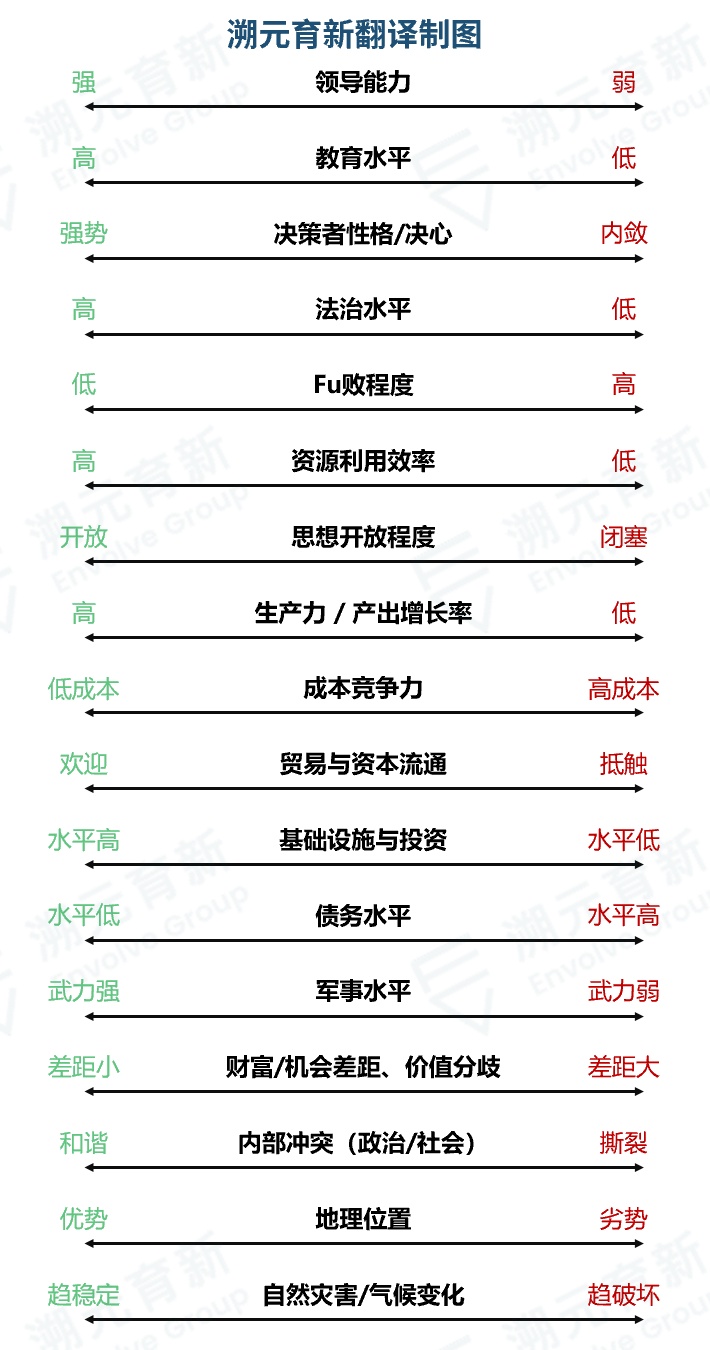
  17 factors affecting the rise and fall of a country

  In short, this is the reason why the rise and decline of great powers occur periodically. Now, I want you to do a little exercise: think carefully about whether the position of each characteristic index is to the left or to the right for the country/region you are interested in. What about the United States and China? What other countries are there? Make a judgment based on your intuition and compare it with my idea later. I will make a more systematic analysis of the characteristic indicators of these big countries later.

  These positive and negative factors are actually intertwined and affect each other, bringing great changes to society. It is no coincidence that the huge gap between the rich and the poor, the debt crisis, the revolution, the war and the changes in the world pattern almost happened at the same time. The following picture outlines the history of the rise and fall of every big country very clearly. As shown in the shaded area in the figure below, the destruction and reorganization caused by depression, revolution and war have largely destroyed the old system and laid the foundation for the emergence of new systems. These great depressions often occur every 10 to 20 years, but there may be more variables in this time period. Followed by a beautiful new world, no country is willing to compete with the world hegemon for the top spot, and well-behaved people begin to work and develop harmoniously. Usually, these beautiful periods can last for 40 to 80 years, but there will be great fluctuations. In the above two big cycles, there are also some small cycles, such as short-term debt crisis/business cycle, which last for 7 to 10 years.

  Reserve currency cycle
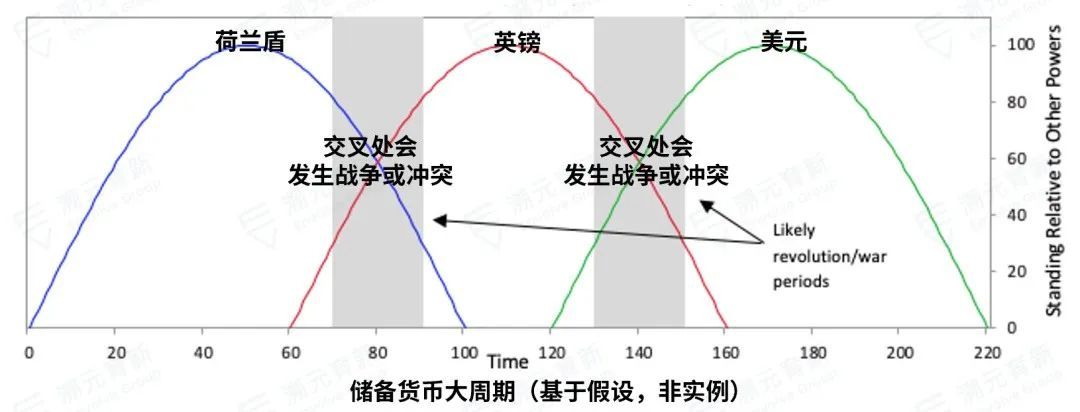
  For example, the decline of a Dutch power gives way to a British power, or Britain gives way to the United States. Most of the following things will happen in this process:

  Debt restructuring and debt crisis are internal conflicts in countries, which eventually lead to the redistribution of wealth, the collapse of the status of foreign war reserve currency and the collapse of a new generation of domestic and international order

  The last Great Depression occurred in 1930-45, which promoted the reconstruction period that began in 1945. More specifically, the collapse and reorganization of the monetary and credit system led to the depression in 1930-45, which led to the establishment of a new global monetary system (Bretton Woods system) based on the dollar in 1944. The huge gap between the rich and the poor in the Roaring 20s narrowed due to depression and war, which led to a fundamental change in the distribution of wealth and rights, and the global war also changed the world pattern. After 1945, everything has undergone earth-shaking changes. The United States became the world hegemon, the gold standard shifted, and a global monetary and credit system based on the dollar was established.

  Translator’s Note: This refers to the 1920s in the western context, which was a period of sustained economic prosperity. In the past ten years, it covered countless exciting events, so some people called it "the most colorful era in history".

  In this new world dominated by the United States, the United States has taken the lead in wealth, economic strength and military strength. It is the richest country with 80% of the world’s gold reserves; It is a country with the highest economic strength in the world, and its production capacity accounts for half of the world’s output; It is also a military power with absolute advantages, monopolizing nuclear weapons and having the most powerful conventional forces. However, after 75 years, the world pattern has also undergone fundamental changes, which we will discuss further in the following chapters. At that time, we will also try to predict and interpret the possible future development direction.

  Next, we will study each indicator more carefully. In the last chapter, I will summarize all these indicators and carefully infer how to make our future better in view of our current situation. In the second part, I will make a detailed interpretation of each country’s case.

  [1] Short-term cycle evolution chart
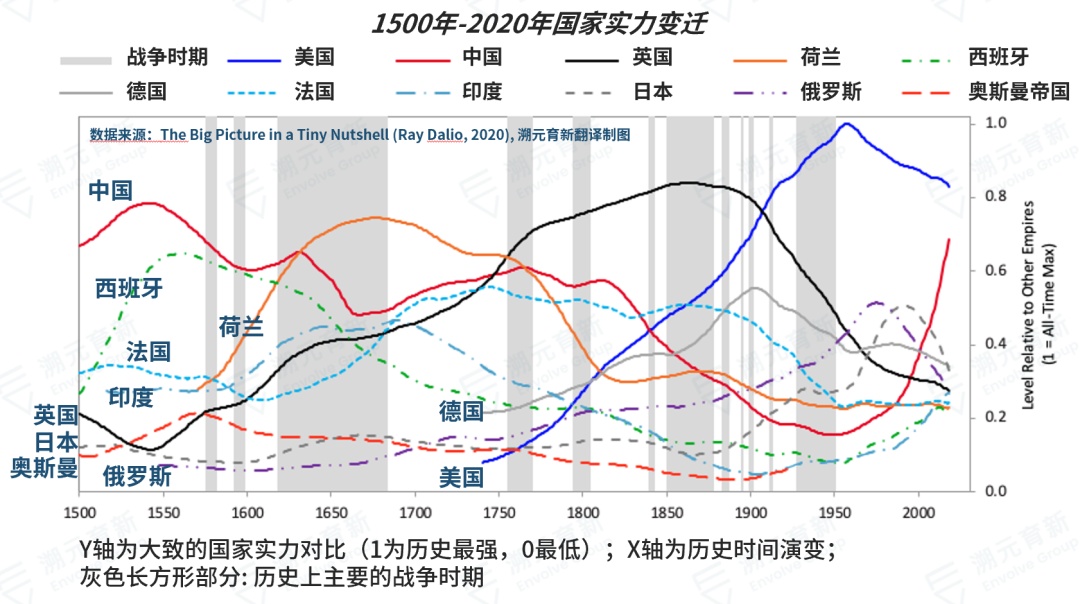
  As for the above figure, these indexes consist of many different statistical data, some of which can be directly compared, while others are only an estimate. The data in some countries are always discontinuous, so different data need to be spliced together. It should be noted that the line shown on the chart is the 30-year moving average of these indexes, and I have adjusted it, so there will be no lag. The moving average is chosen because it is less volatile and can filter out a lot of noise, making the direction of the big period clearer. For a longer-term interpretation, I will use these curves smoothed by the moving average; On the contrary, for some more detailed interpretations, the unprocessed curve may contain more information.

  [2] Chart of Paradigm Law
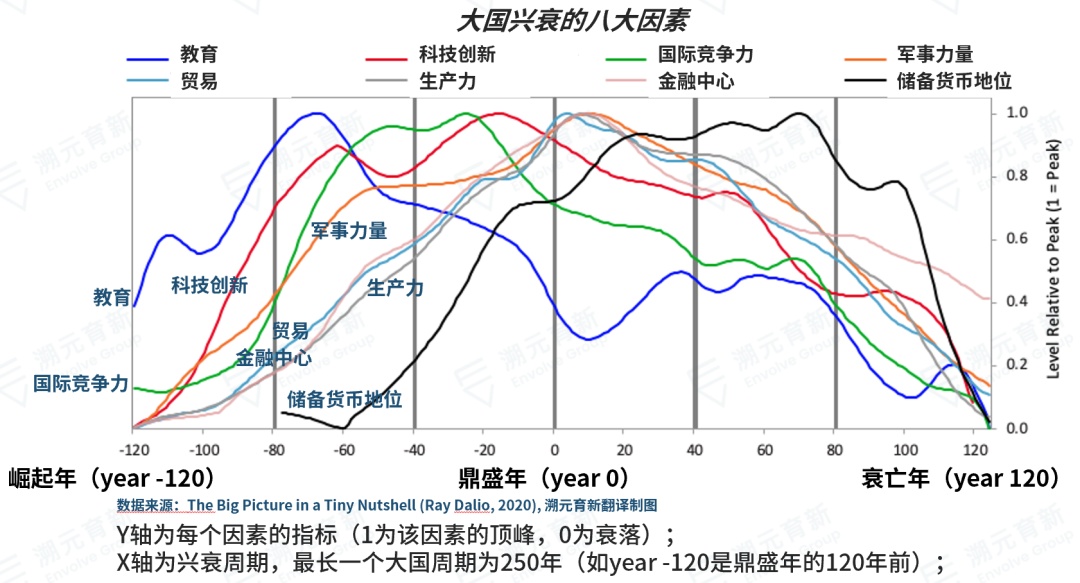
  Regarding the above figure, we show the relationship between these key indicators and history by anchoring specific time periods in history. The value "1" on the Y axis represents the peak value of this indicator relative to history, and "0" represents the bottom. The X-axis, that is, the time axis, is displayed in units of years, where "0" roughly represents the time when many indicators of the country reach the peak. In the rest of this section, we will introduce the stages of paradigm law in more detail. As for the indicator of global reserve currency, we will focus on China. Although it has been a big country for centuries, its currency has never become a global reserve currency. The reasons behind this are worthy of our further study.

  (A global M&A investment transaction information manager at your fingertips)

This article first appeared on WeChat WeChat official account: Yijie DealGlobe. The content of the article belongs to the author’s personal opinion and does not represent Hexun.com’s position. Investors should operate accordingly, at their own risk.

(Editor: Ji Liya HN003)

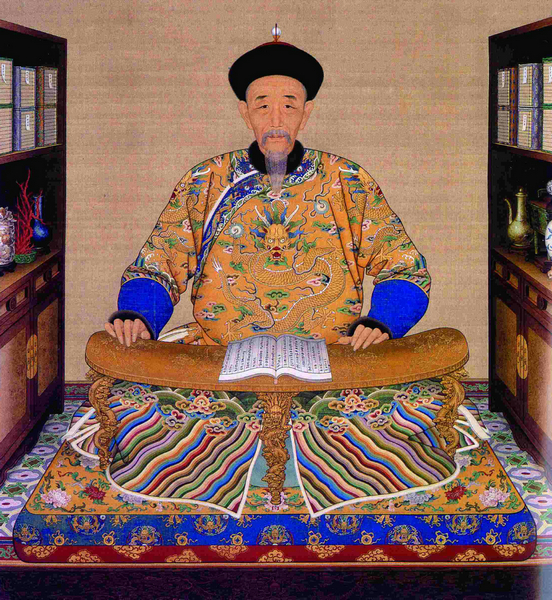
Kangxi and Changchun Garden

Portrait of Emperor Kangxi

  Since February 22nd, 26th year of Kangxi (April 3rd, 1687), Emperor Xuanye of Kangxi lived in Changchun Garden for the first time, he loved this beautiful imperial garden very much. I came to the park for 44 days that year. According to the statistics of relevant scholars, Xuanye has lived in Changchun Garden every year since then, with the least year being the thirty-fifth year of Kangxi (1696) and 29 days. The most is the forty-seven years of Kangxi, which lasted for 202 days. Most of him came to the suburban garden after handling the important ceremonial banquet in the first half of the first month, and he lived in Changchun Garden eight times on the second day of the first month. Usually, I have to stay in November or even late December before I leave the park and return to the palace. Among them, I left the park for eight times from the 25th to 28th of the twelfth lunar month. Of course, quite a lot of time was spent visiting Jiangsu and Zhejiang in the south, paying homage to the ancestral tombs in the east, visiting Wutai in the west and the paddock in the north, and not all of them lived in Dianyuan. Xuanye’s birthday is March 18th, and he spent the Wanshou Festival in Changchun Garden for 24 times. Until he died of illness in Qingxi Bookstore in Changchun Garden, he lived in Changchun Garden for 257 times in 36 years, totaling more than 3,870 days.

  The main content of Xuanye’s life in Changchun Garden is to avoid noise and listen to politics, to support himself and enjoy the scenery in summer. In addition, there are festivals to celebrate, banquets to give food, trees to spread the world, and parents to teach children.

  Avoid noise and listen to politics

  Daily government affairs include selecting officials, introducing people, reading and approving books, summoning ministers, and discussing orders. During his stay in Chang Chun Garden, Emperor Kangxi spent almost every day in Lian Ning’s residence listening to political directors and handling all kinds of government affairs. For example, Emperor Kangxi was stationed in Changchunyuan for the first time in the 26th year of Kangxi, and he went to the inner gate of Changchunyuan three times in nine days, that is, he took charge of the government inside and outside the Hall of Nine Classics and Three Events. Another example is: Around 30 to 36 years of Kangxi, many political affairs of personal expedition to Junggar were agreed in Changchun Garden. Another example is: I lived in the Imperial Garden for thirteen days from the first day to the thirteenth day of December in the fifty-fourth year of Kangxi (1715), and lived in the court for six days, and handled dozens of matters that needed to be decided. On the first day of junior high school, nine urgent problems were solved in succession. The last one is about Cao Yin and Li Xu’s debt to silver.

  And meet foreign envoys. For example, in the forty-fourth year of Emperor Kangxi (1705), Emperor Kangxi received the special envoy of the Holy See, Dorothy, in Changchun Garden, without kneeling and giving him a seat. He also ordered people to take gifts from the imperial court and go to Rome to answer for employment. On the Mid-Autumn Festival the following year, Kangxi called the Roman special envoy Doro into the garden to give food and watch the lights. Please invite Doro to visit Changchun Garden in five months. Another example is: In the fifty-ninth year of Kangxi (1720), the envoy of the Western countries (Portugal) Pei Lali came to the DPRK, and Xuanye received and gave tea in the Hall of the Nine Classics and Three Events. Another example is: In the month of December 59, Kangxi received Karoku, the special envoy of the Holy See, eight times in Qingxi Bookstore in Changchun Garden, and received gifts from the Pope and presented gifts to the Pope and the Portuguese king. In the meantime, Karoku was also given a sable gown, snuff bottle, sable crown, blue robe, enamel bowl and other things and given a banquet.

  And watch martial arts. Since the forty-fifth year of Kangxi (1706), Emperor Kangxi has been able to watch the martial arts players riding and shooting in the West Factory in Changchun Garden in October or November. Sometimes, a ceremony of biography is held in the park, and the first place of Jinshi, such as Wu Zhuangyuan, is promulgated. For example, in the fifty-fourth year of Kangxi (1715), from November 13th to 16th, Emperor Kangxi came to Changchunyuan West Factory to read the martial arts. Leading the guards’ ministers, reading officials, university students’ loose columns, etc., arranged in a row, and the emperor rose to sit down. Before the assistant minister of the Ministry of War Jue and others entered, 170 people, including Xu Slow, who played martial arts, were divided into 11 classes to test their riding and shooting. The emperor ordered the ministers to sit down. So read Xu Shu and others, ride and shoot in turn, and remember the best. After reading the test, the emperor ordered the princes to ride and shoot. The next day, I continued to read and try to shoot with steps, pull hard work, dance knives and throw stones. On the third day, we continued to test fire in the West Factory. Select 15 best candidates from the martial arts and repeat them, and divide them into different grades. Ministers will select the top three of the 15 people as A, the other 12 as Dimethyl and the rest as Top Three, and present the papers of 15 people.

  study science

  During the Ming and Qing Dynasties, it was the first climax of cultural exchanges between China and the West, also known as the first spread of Western learning to the East. During this period, Emperor Kangxi came into contact with some missionaries who were familiar with western science and technology, and he began to have a strong interest in western science and technology. Bai Jin, a French Jesuit, recalled in his book: "Kangxi studied western science with great interest, spending several hours with us every day, and spending more time on self-study during the day and night." At this time, Emperor Kangxi had dimly realized the importance of natural science. In order to cultivate talents specializing in astronomical observation and natural science and compile large-scale scientific and technological works, he set up a Mongolian-supported vegetarian and mathematical museum in Changchun Garden. This was called "Royal Academy of Sciences" by French missionaries.

  Emperor Kangxi studied very hard and had a wide range of knowledge. He dabbled in human geography, calendar, arithmetic, hundred schools of thought, medicine, natural science, Buddhism, Confucian classics and Taoist books, and was a generalist. There are three sources of knowledge in Kangxi: First, Manchu culture. As the emperor of Manchu, learning the culture of his own nation is a basic accomplishment. Kangxi followed the Manchu master to speak Manchu, learn Manchu and practice riding and shooting. The second is the Han culture. As a minority ruler who entered the Central Plains, in order to gain the recognition of the Han people, Kangxi studied Confucian classics with the Han master, read a lot of historical books, became familiar with the Confucian "study of emperors" and was influenced by Confucian culture. The third is western technology. European Catholic Jesuits came to China to preach, bringing advanced western science, technology and knowledge. Emperor Kangxi, with an open mind, invited Zhang Cheng, Bai Jin and others to Changchun Garden many times to teach western science: mathematics, astronomy, engineering, surveying, medicine and even human anatomy. For example, on the eighth day of March in the 28th year of Kangxi (1689), Emperor Kangxi called Zhang Cheng, a French missionary, to teach geometry at Qingxi Bookstore in Changchun Garden. Looking for Zhang Chengfu to teach in the park many times.

  The establishment time of Mengyangzhai Mathematics Museum was the second day of June in the fifty-second year of Kangxi (1713). It is clearly recorded in Records of the Holy Father of Qing Dynasty that in June, Ding Chou "ordered Prince Yin Zhi of Shuocheng to set up a museum in the palace". However, the research scope of Meng Yangzhai is not limited to mathematics, but also calendar and music. In September of the fifty-second year of Kangxi, Emperor Kangxi issued another decree: "Yu and Prince Yin Zhi of Shuocheng, etc., compiled books on the algorithm of Lu and Lv, wrote a library in Mengyangzhai, and tested the musical instruments in the temple and palace." In October of the 58th year of Kangxi (1719), Wang Lansheng, a juren from Mengyangzhai, was ordered to write "Positive Rhyme".

  Mengyangzhai Mathematics Museum has translated more than a dozen Manchu-Chinese mathematics books, such as Geometry Original, Proportion Solution, Usage of Measuring High Instruments, Eight-line Table Roots, Method of Pythagorean Seeking, Excerpt of Borrowing Roots Algorithm, Record of Western Mirrors, etc., and has also completed works such as The Origin of Laws and Calendars, and trained a number of people such as Mei Juecheng, Minggatu and He Guozong. It also promoted the almanac and geographical mapping of the whole country.

  As early as the first day of October in the fifty-first year of Kangxi (1712), Emperor Kangxi "instructed the third son of Emperor Huang and Prince Yin Zhi of Shuocheng, etc.: the height of the North Pole and the distance from Huang Chi are the most important in the calendar, and they should be measured daily after living in Lianning". And immediately got a few princes to play back. In November of the same year, Prince Ying Cheng invited him to send someone to Guangdong, Yunnan, Sichuan, Shaanxi, Henan, Jiangnan and Zhejiang provinces for surveying and mapping.

  Unfortunately, out of the need of rule, Emperor Kangxi only recruited students from the Mongolian Institute of Arithmetic in a small area such as the palace, which was not popularized among the people, and the advanced western science and technology failed to play its due role in the whole country. With the end of the Kangxi Dynasty, the study of Sino-Western communication also ended, and China missed a historical opportunity of innovation in science and technology.

  Editing and editing books

  Kangxi loved not only reading books, but also compiling books. It can be said that the compilation and publication of books is a major feature of Kangxi’s Wen Zhi, and Kangxi paid special attention to China’s traditional culture. When he lived in Jingxi Garden, he presided over or organized the compilation of many series of books, which made great contributions to the construction of Chinese traditional culture.

  Compile the hadith. On the 10th day of August in the 21st year of Kangxi (1682), when Kangxi was stationed in Yuquan Mountain, he approved the invitation of Dai Wangyu, an imperial historian of Fujian Road, to compile the sacred instruction of Emperor Taizong Gao, Emperor Taizong Wen and Emperor Sezuzhang, and thought: "The sacred instruction of Taizu, Taizong and Sezuzhang is of great significance and should be compiled." In the twenty-fifth and twenty-sixth years of Kangxi, four volumes of the Hadith of Emperor Taizong Gao, six volumes of the Hadith of Emperor Taizong Wen and six volumes of the Hadith of Emperor Shizuzhang were successively completed.

  Yuanjianzhai is the place where Emperor Kangxi advocated and guided the compilation of vast ancient books in Changchun Garden. Here, Emperor Kangxi ordered Xu Qianxue to compile and annotate Yuan Jian, and organized Zhang Ying, Wang Shi and others to compile a large-scale book, Yuan Jian Lei Han.

  Yuan Jian of Imperial Selection of Ancient Chinese Literature is an anthology of ancient Chinese literature. Among them, there are more than 1300 articles by nearly 800 authors from the Spring and Autumn Period to the Song Dynasty. Each article is printed on the top of the book, and the ministers are attached to it. The capital of each article has Xuanye’s royal approval, and each article has the emperor’s introduction and comments on the article. There is a preface written by Xuanye in front of the book.

  Yuan Jian lei Han is a kind of book that focuses on checking the rhetoric of articles. Zhang Ying, Wang Shi and others further expanded the scope of collection on the basis of the book Tang Lei Han in the Ming Dynasty, making the book more comprehensive and complete in time. The book, with 445 volumes, was published in 1710 by Xuanye himself.

  Peiwenzhai is the hall where Emperor Kangxi collects ancient and modern books and paintings, the painting and calligraphy room where he reads, appreciates paintings and calligraphy, learns books and practices calligraphy, and the workshop where he compiles books and paintings. Based on Peiwenzhai, Emperor Kangxi carried out a large-scale and continuous compilation of poetry, calligraphy and painting. Among them, the books with the title of "Pei Wenzhai" include Selected Poems about Objects of Pei Wenzhai, Prose of Guang Qun of Pei Wenzhai, Prose of Paintings and Calligraphy of Pei Wenzhai and Pei Wenyun House.

  Be nurtured by others

  Kangxi once said: "When I was in the womb, I told the Pope Prince that I was alert to the classics, diligent in raising my life, studying the classics every day, making me recite them, and reuniting with my relatives to explain them. I never stopped asking questions." Wang Shizhen’s "Continuation of Juyi" also records: "When I was in the palace, I taught the four books and five classics for the East Palace. Before I served the imperial gate every day, I had to recite and repeat the books I had given the day before, so that I could get through be adept at." It was not until June, the 26th year of Kangxi (1687) that Xuanye chose three masters for the princes: Shang Shu Da Hata, Tang Bin and Shao Zhan Shi Geng Jie, and obtained the approval and support of the scholars Mingzhu and Wang Xi. Xuanye’s selection of teachers is very strict, which requires both profound knowledge and noble morality. He also selected Brinton, Xiong Cilv, Li Guangdi, Xu Yuanmeng, Gu Eight Dynasties, Fahai and others as the master of the Prince, all of whom lived in Confucianism.

  On the seventh day of June, the 26th year of Kangxi, Xuanye summoned three masters, namely Dahata, Tang Bin and Geng Jie, while the Crown Prince and the Prince were on standby, and the ministers, guards and residence officials were left and right. The emperor issued a decree: "Since ancient times, emperors have always taken pre-education and saving two as the foundation of their country. I am afraid that the Crown Prince will not be knowledgeable, that is, he will not be able to understand the body, but will be diligent in teaching and training since childhood, so as not to make a day of leisure … The Crown Prince never knows anything but reading and playing. ….. You are well-known abroad, and we hereby order you to discipline the East Palace. " Regarding the subjects of study, he said: "I sincerely know the family precepts of my ancestors, and the civil and military affairs are in parallel, and I dare not neglect riding and shooting. Therefore, the crown prince and the prince are taught poetry books, and they are also taught to ride and shoot." Although Tang Bin repeatedly refused to say that he could not shoulder this heavy responsibility, he still failed to change the emperor’s decision.

  From the ninth day of the ninth lunar month, the Crown Prince and the princes began to study in Wuyizhai under the guidance of three masters. Degele and Peng Sunqi, officials of Juju Notes, wrote down the learning situation of the princes in Wuyizhai: In the early morning, the Crown Prince and the princes were studying in Wuyizhai, reading several sections and a chapter on the classics. Tang Bin held a book and listened to the Crown Prince recite it without leaving a word. Read a new book again. The crown prince wrote a piece of regular script, about hundreds of words. At dawn, the emperor arrived and rose to the throne. Ask the Juzhu official: How does the prince study? Yes, "the prince is rich in quality and profound in knowledge." Xuanye made a comment: "If you can’t read, you think you can read, you can’t talk, but you think you can talk. If this person is not human." After the emperor returned to the palace, the Crown Prince wrote another piece of regular script. After lunch, the Crown Prince wrote a piece of paper in full, that is, reviewed the Book of Rites and the classics, and read them one hundred and twenty times each. At this time, the emperor came to Wuyizhai again, and the Crown Prince Yun Wan, the eldest son Yun Wan, the third son Yun Zhi, the fourth son Yin Zhen, the fifth son Yun Qi, the seventh son Yun You and the eighth son Yun You? Stand by. The emperor took out ten Yu Ben from the case and handed it to Tang Bin, saying, "You can take it out by hand and let the princes read it." Tang Bin opened the scriptures, and Yun Zhi, Yin Zhen, Yun You, and Yun Yu went in first, and each reading was loud and clear. He also ordered me to explain the chapters of "Knowing the Things" and "The Analects of Confucius", which were word for word and integrated with the righteousness. The emperor ordered Yunqi to read a Manchu article with clear paragraphs and bright sentences. The emperor said: "I must study at the rate of 120 times when I was young. If I don’t cover it like this, I can’t be overwhelmed. Therefore, it is the same for teaching princes and princes to study." He also said,He often erases the words of the Crown Prince, adding few words and never adding circles. The emperor asked the master and the near minister to write, and the handwriting of Tang Bin and Geng Jie was very common. The emperor personally sprinkled Chen Han, and wrote a seven-character poem by Song Rucheng and a piece of paper with the words "Cun Cheng". The beautiful silk characters, vigorous Chinese characters, all have statutes, and all the ministers are full of praise. Later, the emperor led all the scholars to practice archery, and personally pulled the bow and arrow, and all the shots were successful; I also ordered the ministers and guards to learn to shoot. At this time, it was dusk, and the all-day study of the Crown Prince and the princes came to an end. The emperor also went back to Qingxi Bookstore. After such continuous study, the Crown Prince and the princes have a high level of culture and Manchu language and writing, and they are not only familiar with ancient China classics, but also have a high level of painting, calligraphy and riding. Later, the Crown Prince moved to the West Garden to live and study, and the princes also moved to No.4 Lotus Pond in the south of the West Garden.

  Planting rice for rain

  In the Qing dynasty, the rulers attached great importance to agricultural production, which was regarded as the foundation of national stability. Kangxi once planted imperial rice in Changchun Garden and promoted it vigorously. The rulers also paid special attention to the rainfall situation that directly affected agricultural output, and carried out rain-seeking activities in Haidian area.

  As a spring-rich place in the west of Beijing, Haidian has a long tradition of planting rice. In the early years of Kangxi, Prince Dan Zhen, the owner of the garden in tsinghua campus, changed the lotus pond in the garden into a paddy field, and the annual profit could reach hundreds of taels of silver. Kangxi’s earliest activity in the western suburbs was to watch the growth of rice in the west of Beijing. During the construction of Changchun Garden, Emperor Kangxi set aside a paddy field in the west wall of Changchun Garden to test and cultivate excellent rice seeds himself. From Wuyizhai Tushan to the north, until Daximen, located in the northwest of the garden, there are about hundreds of acres of fields, which is the "experimental field" for Kangxi to plant imperial rice. According to "Kangxi’s Collection of Leisure Things", rice seeds are early rice selected and cultivated by Kangxi himself, named "Imperial Rice". It is also called "rouge rice" because its rice awn is lavender, its rice grains are reddish and long, its smell is fragrant and its taste is poor, and it can be cooked twice a year. This is also the originator of "Jingxi Rice" in Haidian District.

  In the fifty-third year of Kangxi (1714), the imperial rice at the foot of Yuquan Mountain grew to 600 mu, plus Liulangzhuang, Wanquanzhuang, Heilongtan, Gaoliangqiao, Shijingshan and Nanyuan, totaling nearly 10,000 mu. The planting range of imperial rice has not only been further expanded, but also the area has increased several times, and it has become the main source of imperial rice in the court. In order to ensure the production of royal rice, in the same year, Fengchenyuan, the Ministry of Internal Affairs, set up a "rice field factory" in Qinglong Bridge to manage royal rice fields.

  There are sixty-four rice paddies, which are government offices, warehouses and mills. At the same time, there are two official places, one in Gongde Temple and the other in Liulangzhuang. "Yongxian Record" said: When Kangxi was in Kangxi, "it served imperial meals, saying that it served imperial rice and went out to the western hills of the capital", and Changping Prefecture produced rice everywhere, but Yuquan Mountain was better than Yuquan Spring, so rice was needed. The "Qing Hui Dian" also records: "The jade grains above are taken from the rice fields of Yuquan Mountain."

  In the later period of Kangxi’s rule, the society was stable and the population began to increase sharply. Kangxi was deeply worried about this population expansion: "Since the unification of the area, in 678 this year, all the people have enjoyed peace, and the fertility has increased day by day. Although the registered permanent residence has increased, the land has not increased. If one person’s property is used by several families, how can he make a living?" The rapid population growth and predatory development have brought great pressure to the surrounding environment of Gyeonggi. The ecological environment has become extremely fragile, and floods and droughts have started to break out frequently. Therefore, in the middle and late period of Kangxi’s rule, emperors were more concerned about sunny and rainy days, and more and more words were found in historical materials. For example, on June 25th, the 45th year of Kangxi (1706), during Emperor Kangxi’s tour to the north, Yin Zhi, the third son of Emperor Huang, invited the emperor to pay his respects, and made a special presentation on the rainy situation in the capital area: "There has been a lot of rain in the capital area, Changchun Garden, Cirja Camp and other places recently. Yu: There is enough rain here. " The feeling of concern is on the paper.

  The belief in praying for rain and sunshine by the dragon gods, which was valued by the rulers of past dynasties, was also maintained in the Kangxi Dynasty. As the most common measure to resist disasters, praying for rain was valued by Emperor Kangxi and included in the national sacrifice code. When Changchun Garden was built, Kangxi built the Longwang Temple in the garden as a special place to pray for rain. In case of drought, Kangxi often sent princes, county kings, Baylor, Beizi and ministers to the Longwang Temple to pray for rain. Each rain praying ceremony is very grand and has established procedures. For example, on May 13th, the forty-ninth year of Emperor Kangxi (1710), Yin Zhi, the third son of the Emperor, and others gave orders: At Longwang Temple in Changchun Garden, pray for rain as the twelve sons of the Emperor prayed for rain.

  The history of rice in the west of Beijing has a long history. According to historical records, Haidian, which is fertile and beautiful, began to build canals to grow rice during the Cao and Wei Dynasties in the Three Kingdoms, and it has a history of more than 1,700 years. According to the Records of the Three Kingdoms, in the second year of Cao Fangjiaping, the king of Wei Qi, Jing Liu stopped water to build a dam on the Luohe River (now Yongding River) and built a carriage canal. "Irrigation thistle (city) north and south, planting rice in the third night, and benefiting the border people." It was not until Guo Shoujing, a water conservancy scientist in Yuan Dynasty, opened Tonghui River, and sufficient water ensured the growth of rice, that farmers on both sides of the strait began to plant rice on a large scale.

  Kangxi was the emperor who really turned Jingxi rice into "Imperial Rice". Emperor Kangxi skillfully integrated the "pastoral scenery" shown by intensive cultivation into the garden landscape, which not only provided materials for life, but also created the artistic conception of pastoral life, so that garden dwellers could experience the seclusion interest of pro-farming. Emperor Kangxi attached great importance to agriculture, and with his support, the cultivation of rice in western Beijing was further developed. He also personally experimented, compared the rice between the north and the south, and cultivated excellent varieties as royal royal rice, and vigorously promoted planting. Even set up a rice field factory to manage these royal imperial rice.

  Kangxi once experimented with rice on the side of Fengze Garden in Zhongnanhai, Beijing, and sent people to plant a small experimental field under Yuquan Mountain, which was successful and later called "Jingxi Rice". In his poem "Early Imperial Rice", he wrote: "The purple awn is half a hectare of green and shady, and I love the early imperial rice. If you make the prescriptions more widely distributed, you may see the needles twice. " (Lu Qin’s Song of the Dragon-Poems of the Emperors in China) Here he expressed his heartfelt joy after watching the rice fields, and he longed for the rice area to expand constantly and strive to harvest twice a year.

  The whole story is like this: One day in June, when Kangxi was patrolling the rice fields in Fengzeyuan, he came across a rice that was "above the rice" and the grain was ripe. Originally, Yutian rice was planted here, and it will not mature until September of the lunar calendar, but this rice in front of us is two months ahead of schedule, which is beyond Kangxi’s expectation. He used it as a seed to try planting in the next year, and it really matured in June. This early-maturing new rice has reddish color and long grains, and tastes delicious. (See Kangxi’s Faulty Style) Because it was discovered and cultivated by Kangxi himself, it is called Imperial Rice. Later, people called it Jingdao.

  Kangxi’s poem "On the 11th of July when he was watching rice in Changchun Garden" also wrote: "In July, the purple mountain is fragrant with five miles, and the near-garden remains a species of Zhu Zhenxiang. Yan Fang and Saibei are all called Rui, and they are happy and happy. " July in the lunar calendar is equivalent to August in the solar calendar. Seeing the purple awn in the rice field is associated with the fragrance of a grain, which shows that he attaches great importance to rice. People in both the hot places in the south and the colder places in the north of Saibei praised the transplantation of this cereal crop as a good omen. In particular, it is a great wish to plant rice in the northern part of the Great Wall, which has become a reality through hard work.

  According to relevant documents, in the 42nd year of Kangxi, the Qing government built chengde mountain resort, and imperial rice seeds were first transplanted here, which was located in the north of the Great Wall. Generally, rice could not mature after the Millennium, but the imperial rice seeds matured before the Millennium, so the experiment was successful. So it opened a new record of planting rice north of the Great Wall. Kangxi once said: "The rice fields in the villa still have a surplus for summer use every year."

  Kangxi’s cultivation of rice can be said to be affectionate. Therefore, he has a specific description of the whole process of rice breeding, seedling pulling, transplanting, harvesting and ear picking, and all of them have persistent pursuit and deep desire. There is a detailed description in his group poem titled Farming Map:

  The first seedling: "A year’s farming is in the depth of spring, and the family is looking forward to the new year." I love the clear weather, and the green fields are thousands of hectares. " Pulling out the seedlings: "The green onions are full of water, and the transplanting of Xichou is even more furious. The order of the festival is shocking, and the seedlings must be divided into early summer days. " Transplanting: "There are thousands of beds in Shui Ze, and the competition for transplanting new seedlings is afraid of the future. The Asian brigade is happy to work together, and it is not too late to go home in the next month. " Harvesting: "Huang Yun is full of dew, and the waist sickle is blessed with rice. Children collect the ears everywhere, and every family in the village bears the burden. " Holding the ear: "Nanmu Qiu Lai celebrates Fucheng, but Qu Qu has not released the old peasants’ feelings. The frost rises from the neighborhood and listens to the sound of rice in the village. "

  Here is a series of scenes of farmers growing rice, with vivid language. Early seedling, describing farmers’ hard work in order to seize the farming season, "green fields are thousands of hectares", the scene is huge and quite imposing. Pull out the seedlings and describe the busy scene of rice transplanting. The paddy fields are full of thick green, showing a vibrant scene. Transplanting rice seedlings describes the scene of "Yalv" (small officials and village officials) working with farmers in the vast farmland, and the moon rises before returning home without complaint. The purpose of this hard work in Dai Yue is to get a good harvest. Harvesting depicts reaping with sickle, young and old doing their best, children picking up the ears of rice skillfully, and farmers returning with great strength, which sets off a jubilant atmosphere after a bumper harvest. Holding the ear outlines the scene of rice harvesting in the countryside, highlighting the feeling of hearing, and the joy of harvest is stirring everywhere in the village. Kangxi had personal experience in growing rice. His poems are not extraordinary masterpieces, but they are close to life and smell of earth. They are more lively and interesting than some literati who write poems by imagination in their study.

  In a word, Kangxi had a close relationship with Jingdao, which was unparalleled among hundreds of emperors in ancient China. His contribution is to promote the transplanting of rice to the north of the Great Wall and advocate the promotion of double-cropping rice in the south. The descendants of Kangxi, namely Yongzheng and Qianlong, also attached great importance to agricultural production. At the beginning of spring ploughing, Yongzheng and Qianlong held the ceremony of "borrowing farmland" in the small experimental field of "Fengzeyuan" successively, and demonstrated by themselves to help farmers. Yongzheng’s poem "Tillage" wrote: "Spring turns in Yuanji, and it is warm and comfortable in Jutz. The green dove cries for rain, and the yellow calf drives the plow at the beginning. There is no escape for every mu of people, and they dare to work hard. Care about the lessons and help the village market. " This poem expresses sincere desire for the hard work of farmers in the busy season of spring ploughing. There is a poem "Fengze Garden" in Qianlong: "After gardening, I will farm the fields, and the name of the garden is Fengze, Myanmar and Yaonian." Here, the layout of rice fields and vegetable gardens in Fengze Garden is described, and his concept of attaching importance to agriculture is expressed, which is quite meaningful to Sun Jizhu’s career.

  Dinner banquet

  In ancient China, a fine ethical concept of respecting the elderly and caring for the young was formed very early, and the older people are, the more respected they are by the society. Therefore, it often attracted the attention of feudal emperors in the past dynasties. In the "King System", there is a ritual system of respecting the elderly by emperors who "give sticks" to the elderly. Ren Fang (460-508), a famous litterateur in the Southern Dynasties, who was Cheng in the imperial history and the prefect of Yixing, once left a famous sentence: "Laojun still cares about his teeth, but he regrets this staff’s nostalgia" (see Answer to Jian ‘an Pay Staff). During the reign of Kangxi and Qianlong in the Qing Dynasty, the national strength was strong, which was called "the prosperous time of Kanggan" in history. The activities of respecting, respecting and loving the elderly were paid special attention to by Emperor Kangxi and Emperor Qianlong, so there were four grand and spectacular "thousand banquets" in history. In the fifty-second year of Kangxi, the sixty-first year of Kangxi, the fifty years of Qianlong and the first year of Jiaqing, respectively, two thousand banquets during the reign of Kangxi were held in Changchun Garden.

  In March of the fifty-second year of Kangxi (AD 1713), the 60th birthday of Emperor Kangxi, the holy ancestor of Qing Dynasty (also known as Wanshou Festival), he thought: "Since the Qin and Han Dynasties, there have been 190 emperors, and they have enjoyed a long time, and there is no one like me." Therefore, we decided to hold a grand and ostentatious celebration of Wanshou. (See Record of Kangxi, Volume 254) In Beijing, the colorful shed set up for the celebration extends from Xizhimen to Changchun Garden for 20 miles. The Ministry of Rites has made a special provision: "It is unusual to meet anniversary who is 60 years old this year." From the first day of March to the end of the month, Beijing officials have to wear embroidered robes and make up their gowns, breaking the routine of wearing only royal clothes for seven days. The most striking thing is that Emperor Kangxi announced that in aged person, people over 65 years old, regardless of government or people, can get to Beijing on time to attend the banquet in Changchun Garden.

  On March 25th, Emperor Kangxi hosted the first banquet for ministers, officials and scholars of Han nationality in front of the main gate of Changchun Garden. There were 33 people over 90 years old, 538 people over 80 years old, 1823 people over 70 years old and 1846 people over 65 years old. All the princes, grandchildren and descendants of the imperial clan who were over 10 years old and under 20 years old came out to toast the old people, distribute food, help the old people over 80 years old to drink in front of Emperor Kangxi to show their favor, and reward them with silver.

  On this day, the scene of the Imperial Palace was unusually solemn and grand. Under the eaves of the Imperial Palace, there is a display of Zhonghe Shaole; In Ningshou Gate, there is Dan Bi Da Le. Inside the temple, there are seats for princes and ministers. Under the temple, the envoys of North Korea and other vassal countries were arranged; The seats with the banquet are under the steps outside the temple.

  On March 27th, in front of the main entrance of Changchun Garden, a wine banquet was held to entertain ministers, officers and soldiers of the Eight Banners and idlers, including 7 people over 90 years old, 192 people over 80 years old, 1,394 people over 70 years old, and 1,012 people over 65 years old. On March 28th, in front of the Empress Dowager Palace in Changchun Garden, a banquet was held for the Eight Banners old women over 70 years old. Those over 90 years old were seated at the palace gate, those over 80 years old were seated at Xidan Gate, and the rest were outside the palace gate. More than 6,600 people attended the banquet in aged person, Manchu, and an unknown number of eight banners old women, certainly no less than 7,000 people, and its grand occasion was passed down as a much-told story.

  In the first lunar month of the sixty-first year of Kangxi (1722), Emperor Kangxi was 69 years old. In order to celebrate his 70th birthday, he held a second banquet in Ganqing Palace. At that time, 12-year-old Hongli attended the banquet as the emperor’s grandson. This year is the last year of Emperor Kangxi’s life journey.

  On the first day of the first month of the first month, the palace held a New Year’s gift to the DPRK. The old emperor, who had weathered the storm and was quite satisfied with his sixty-year imperial career, wrote the poem "Sixty-one Spring Fasting Book", which said: the nature is towering, and the classics assist the DPRK. Don’t do your best, don’t make the vulgar atmosphere noisy. Don’t miss farming and mulberry, you must be timid inside and outside. The wind is high and the birds are quiet, and the rain is enough and the road is clear. How can the inspection be hidden, and how can the loose-packed be shaken? Although it is dusk in Sang Yu, the pine and cypress wither with frost. Long-term cultivation of spring is prosperous, and it is lenient and strict. Tiredness should be unavoidable, and the more ashamed you are, the more obvious you are.

  The reason for this banquet is that the world is peaceful and the people’s livelihood is rich. On the second day of the first month, in front of the Forbidden City, a banquet was held to entertain 680 civil and military ministers, officials and officials of the Eight Banners, who were over 65 years old and retired. Kings and idle imperial clan members came out to confer titles on the old people to persuade them to drink and distribute food. On the fifth day of the fifth lunar month, another banquet was held for 340 ministers of civil and military affairs and officials of the Han nationality who were over 65 years old.

  Records in Zhang Cheng Diary

  On the 15th day of the first month of the 30th year of Kangxi (1691), Xuanye hosted a banquet for Zhang Cheng and other foreign teachers in the bedroom. The emperor ordered the imperial court to prepare horses, gave them a ride into Changchun Garden, and then was introduced to Qingxi Bookstore. They saw "cold dishes, fruits, pastries and sweets on the table". After the meal, Zhang Cheng also witnessed Xuanye’s banquet for the clan here. "Zhang Cheng Diary" recorded the grand banquet in detail: after we ate, the internal supervisor arranged for the emperor to have a banquet with 12 to 15 relatives in the imperial palace today. Tea and food used on the table are placed at the other end of the hall. There is a big square table in the center of the temple, covered with red lacquer and gold, and decorated with dragon flowers. Tatars and Han Chinese don’t use tablecloths and napkins. They only spread yellow satin embroidered with golden dragons on the table. There are two tables around the front of the table, and the edges are decorated with colored stone beads inlaid with silver wire. These are all made of ordinary stones with no luster. On both sides of the hall, a ruler is set for the pro-expensive ministers, and the cushions are placed on the floor. They took their seats here for dinner. There are pyramids of cold meat in the food, and cold dishes made of aspic, beans, cauliflower or Chinese cabbage. The imperial table is full of colorful flowers, and flowers and trees are planted in large porcelain pots or painted wooden barrels all winter, which are displayed in the emperor’s bedroom. This is the main decoration in his inner bedroom. Other than that, everything is plain. The corner of the hall is separated by a screen, and a band is set here. A group of 10-to 12-year-old eunuchs, dressed as clowns, performed various martial arts in front of the table. Two of them bent their heads backward, almost touching their heels, and then stood upright at the beginning, without moving their positions or using their hands or feet …

  On the Lantern Festival in the 30th year of Kangxi (1691), Xuanye invited his foreign teacher Zhang Cheng and others to watch the fireworks with him. Zhang Cheng Diary wrote: In the evening, we went to watch fireworks. The fire was set up opposite the queen’s bedroom. The emperor led the princes to watch in person. There are more than 20 pro-expensive ministers in the audience. Our seats are right next to them. There is nothing special about fireworks, only a string of lamps lit by artillery in series, which are soaring and dazzling, like many planets. The rest are just spray flowers, rain stars, tube explosions, rockets and so on. The first rocket was launched before the emperor arrived, and they said that he lit it himself. This rocket, like a sharp arrow off the bowstring, hit and ignited another fireworks 30 or 40 paces away. In this fireworks, a second rocket flew out, triggering a third fireworks and shooting a third rocket. Several fireworks are like a series of machines. The fireworks lasted for an hour.

  Kangxi died in Changchun Garden.

  Xuanye is a wise monarch, and he can handle a lot of difficult government affairs with ease, but the matter of abolishing the crown prince has caused him a lot of trouble and broken his heart, which seriously damaged his health. In the fifty-sixth year of Kangxi (1717), on November 21st, Xuanye, who was seriously ill, summoned the princes, Manchu and Han university students, etc.Palace of Heavenly PurityDongnuange, issued a long and sincere message. He claims that he has been ill recently, his mind is in a trance, and his body is very tired. It is difficult to get up and walk without support. He also said that he is now seriously ill and forgetful, and he is very afraid of doing things right and wrong and doing something wrong. In 1957, Xuanye said that when he got up a little early, he "shook his hands and looked indecent, or his face suddenly changed when his heart beat." In April, 1958, he said that his "qi and blood are gradually declining, his spirit is gradually decreasing, he feels tired in doing things, and his writing hands are trembling". In the spring of 1961, I visited Jidian, and the provincial party asked the customs and inspected the officials and the people; In the summer, I toured the northern part of the Great Wall. After returning to Beijing at the end of September, I was busy with various government affairs. His hard work is running out.

  On October 21, 61, Kangxi, Xuanye rushed to Nanyuan Hangwei again. Being tired for many days in a row, I feel even weaker, and it is the middle of winter, so I feel cold. On the seventh day of November, Xuanye returned to Changchun Garden to treat his illness. Traditionally, on the Winter Solstice Festival on November 15th, the emperor had to go to the southern suburbs to hold a ceremony to worship heaven. Because of illness, Yin Zhen, the fourth son of Emperor Yong, made sacrifices on his behalf and ordered him to fast in advance. On the 10th, 11th and 12th of this month, during his fast, Yin Zhen sent eunuchs and guards several times to greet his father’s illness, and Xuanye only replied casually: "I feel a little better." Late at night on the 12th, Xuanye’s condition deteriorated sharply. Just after midnight, Yin Zhen, the fourth son of the Emperor, was summoned to the lent house, and he was ordered to return to Changchun Garden quickly. The Southern Suburb Sacrifice Code was reassigned to Wu Erzhan. At the same time, we also called Prince Yun Zhi of the Third Son of the Emperor, Wang Yun You of the Seventh Son of the Emperor, Baylor Yun You of the Eighth Son of the Emperor, Bei Zi Yun You of the Ninth Son of the Emperor, and Wang Yun of the Tenth Son of the Emperor. The twelve sons of Emperor Bei Zi Yun, the thirteen sons of Emperor Yun Xiang, and the minister of Li Fan Yuan Long Keduo all came to the side of the royal couch of Qingxi Bookstore and announced the heir to the throne, saying, "The four sons of Emperor are noble in character, and they are deeply humble, so they will be able to form a unified system, and I will be the emperor after them." At that time, the emperor’s five sons allowed Qi to pay homage to Xiao Dongling on the winter solstice and failed to listen to the testamentary edict impromptu. Because of their age and status, the fifteenth son of the Emperor allowed disaster, the sixteenth son of the Emperor allowed Lu, the seventeenth son of the Emperor allowed Li and the twentieth son of the Emperor allowed Yi to wait outside the bedroom, so they could not go in for training. At this time, Yin Zhen, the fourth son of the Emperor, came from the den to greet him. Xuanye also reported his growing illness. Yin Zhen had to comfort the emperor’s father with tears in his eyes.

  Xuanye’s life has come to an end. On the same day (13th) night, this generation of British master died in Qingxi Bookstore in Changchun Garden at the age of 69.

  That night, under the strict guard of the emperors, the ministers of Li Fan Yuan, and the commander of Long Keduo, the emperor’s body was transported from Changchun Garden to Ganqing Palace in the Forbidden City, and later buried in the Qingling Mausoleum of Qing Dynasty. On November 20th, the Royal Hall of Supreme Harmony in Yin Zhen was crowned as the third emperor after the Qing Dynasty entered the customs-Yong Zhengdi.

The latest price of Shanghai BMW i5 car is 349,900 yuan, which is a price reduction promotion and a special discount of 90,000 yuan. If you miss it, you won’t have it.

[car home Shanghai Preferential Promotion Channel] Recently, a car-buying feast is attracting attention in the Shanghai market. As a high-profile luxury electric vehicle, BMW i5 is currently carrying out unprecedented preferential activities, with the highest preferential margin reaching a surprising 90,000 yuan, which means that consumers have the opportunity to start with this high-performance vehicle at a minimum starting price of 349,900 yuan. This is an opportunity not to be missed. If you want to know more specific details of the discount and raise the car price in real time, please be sure to click "Check the car price" in the quotation form, and take action quickly, so that you can enjoy the driving pleasure and grasp this generous car purchase benefit.

上海宝马i5汽车最新价格为34.99万,大降价,报价优惠9万,限时促销!

As a trend-setting electric vehicle, BMW i5 combines modern technology and dynamic aesthetics in its design. In the front part, the BMW family’s iconic kidney-shaped air intake grille is adopted, but in order to adapt to electrification, the grille adopts a closed design, which not only retains the recognition, but also improves the aerodynamic effect. The overall style is exquisite and elegant, and the lines are smooth, showing a futuristic luxury temperament. The side lines of the car body are tough and the proportion is coordinated, which shows the perfect integration of strength and lightness and leaves a deep impression. Whether in city streets or charging stations with a sense of science and technology, BMW i5 can attract a lot of attention.

上海宝马i5汽车最新价格为34.99万,大降价,报价优惠9万,限时促销!

BMW i5 outlines a unique design style with its elegant side lines, with a body size of 5175mm (length) *1900mm (width) *1520mm (height) and a wheelbase of 3105mm, showing a spacious interior space. The front and rear wheel tracks are 1621mm and 1658mm respectively, which ensures the stability and handling performance of the vehicle. On the tyre size, it used 245/45 R19 tires, with exquisite rim design, which not only improved the driving grip, but also gave the i5 a unique visual beauty. On the whole, the side design of BMW i5 not only gives consideration to practicality, but also highlights the combination of luxury and sports.

上海宝马i5汽车最新价格为34.99万,大降价,报价优惠9万,限时促销!

The interior design of BMW i5 embodies the perfect combination of luxury and technology. The exquisite leather steering wheel provides a delicate feel, and supports electric up and down+front and rear adjustment to ensure the driver’s comfortable control. The 14.9-inch central control screen is a highlight in the car, equipped with voice recognition control system, which can easily handle multimedia, navigation, telephone and air conditioning functions. The seat is made of imitation leather, and the main and passenger seats provide multi-directional adjustment, including front and rear, backrest, height and lumbar support, to ensure the comfort of long-term driving. The front seats also have additional heating function, and the driver’s seat is also equipped with electric seat memory function, which brings a more intimate driving experience to the owner. The car is also equipped with a USB/Type-C interface, which is convenient for passengers to connect and charge. At the same time, the wireless charging function of the mobile phone is covered in the front row and the back row to meet the daily travel needs.

上海宝马i5汽车最新价格为34.99万,大降价,报价优惠9万,限时促销!

The engine of BMW i5 is highlighted by its excellent performance, with a maximum power of 210kW, which brings strong power output to drivers. At the same time, its maximum torque reaches 410 Nm, which not only ensures the steady performance of the vehicle during acceleration and driving, but also fully reflects the persistent pursuit of BMW brand for power performance.

Generally speaking, the owner of car home praised the appearance of BMW i5, and he emphasized that this model kept the traditional aesthetics of BMW, even in the field of new energy, it was unique, and people could recognize it at a glance. This design not only won the hearts of car owners, but also showed that BMW found a perfect balance between innovation and tradition.

The first pair of giant panda cubs successfully ate in Ya ‘an after the earthquake (photo)

Special topic: picture channel


    On July 7, 2008, the staff was feeding the eldest brother of the giant panda, who was born with twins on July 6, artificially in the incubator. The little guy stood with white fluff, which was very cute.


    CCTV.com News: On the morning of July 7, 2008, at the Bifengxia Base in Ya ‘an, China Research Center for the Protection of Giant Pandas, the staff was in the incubator, successfully feeding the giant panda’s eldest brother who just gave birth to twins on July 6; At present, the twin’s penis is breast-fed by the giant panda.


    According to Huang Zhi, the director of the base’s dynamic management department, he is 12 years old. On June 24th, he and five other pandas moved from Wolong Research Center, which was seriously damaged in the earthquake, to Bifengxia base in Ya ‘an. At 7: 52 am on July 6, Nao Nao gave birth to her first cub. At 8: 36, the second cub was born smoothly. At present, it has been confirmed that the eldest twin is male and weighs 170 grams. The second child has been held in his arms since he was born, and it is still impossible to weigh it and identify its sex. The staff is going to change the baby and feed it after 3 days.


    Minister Huang Zhi said that on the afternoon of July 6, the breeder began to try to artificially feed the eldest twin, but it never contained a nipple. But at night, probably because he was hungry, he began to open his mouth and learn to suck milk. By the morning of July 7, the boss’s artificial feeding and eating had been very smooth. Because of good food, it not only cries loudly, but also crawls with great strength.


    At the Giant Panda Breeding Farm in Bifengxia Base, Ya ‘an, the reporter saw the giant panda, who was carefully taking care of the twins’ second child in the cage in the delivery room, and from time to time tilted his head and looked at his children carefully.


    Most of the time, it protects the child under its body and bends over to sleep. Li Caiwu, the breeder, said that he was very tired after giving birth, and he needed a rest to recover his strength. At present, the staff monitors them 24 hours a day to ensure the safety of mother and child.
It is understood that this is the first pair of giant pandas born after the May 12th earthquake, and it is also the first panda born in the world this year. Hope and Weiwei, two giant pandas in Wolong, Sichuan, who were fostered in Wuhan Zoo, were transported to Wuhan from here.


Editor: Zhang Toya

Luxury car helps "Transformers 4" exposure vehicle inventory

  [Car Culture Car Life] Although it is nearly a year before the release on June 27th, 2014, the news about the upcoming models in Transformers 4 has already been flying all over the sky. Since Transformers king kong 2, it seems that looking forward to the car model in the next movie has become the "worry" of every movie fan and car fan. After careful counting, 10 car characters in Transformers 4 have been exposed on the Internet one after another. It’s time for them to come out of Xiu Xiu and show off the powerful lineup of autobots in Transformers 4.

Home of the car

The background story of Transformers:

Home of the car

  Tens of millions of years ago, the pentahedron, an intelligent life in the universe, created Cybertron. On this planet, there are two production lines for making autobots. The autobots produced on these two production lines have no thoughts, no distinction between right and wrong, and their fighting ability is far below that of the pentahedron. It is for this reason that thousands of autobots have become slaves of the five-faced monster, living under its rule day and night, and the imprint left on them is the symbol of autobots.

Home of the car

  11 million years ago, the autobots on Cybertron overthrew the rule of the five-faced monster under the leadership of Alpha Trion, but the more brutal killing has just begun. In order to compete for the dominance of Cybertron, military autobots and civilian autobots fought with their lives. Since then, the planet Cybertron has been shrouded in endless wars. It was not until Cybertron’s resources were exhausted that the Decepticons, led by Megatron, brought the war to the earth again. …

Home of the car

  From Optimus Prime, Bumblebee, Megatron to Heng Pao, Tin Sheet and Shock Wave, the autobots on Cybertron have been fighting on the big screen of the earth people for more than six years, but the audience never seem to be tired of the "Transformers" series. Every film will bring fresh characters, the hottest cars at the moment and the overwhelming movie special effects. Without much words, let’s take a closer look at Transformers 4 and see this time.

Synopsis:

Home of the car

  The story of Transformers 4 is followed by Transformers: Dark of the Moon. It has been four years since Chicago was destroyed. Autobots and Decepticons have disappeared from the earth’s surface, and everything seems to be calm.

Home of the car

  However, at this time, a group of powerful businessmen and clever scientists tried to use the technology of Transformers to push human science and technology beyond their control. At the same time, an ancient and powerful transformer force is aiming at the earth, and a war about good and evil, freedom and slavery will start again.

Brief introduction of exposure models of Transformers 4;

  At present, it has been confirmed that there are 10 models that will appear in Transformers 4, five of which have not revealed their true identities, but this does not affect our introduction of the vehicles themselves. If you think these vehicles are more suitable for the image of Transformers, please leave a message to communicate with us, and maybe the truth is in your hands.

Autobots:

Character: Optimus Prime
Model: customized Daimler Western Star semi (Western Star Semitrailer)

Home of the car

  As the leader of Autobots, Optimus Prime has long been the embodiment of justice in people’s minds. Not only that, Optimus Prime’s wisdom, judgment and leadership are also highlighted in the long-term battle with the Decepticons. In addition to sweeping the battlefield, Optimus Prime’s image of a blue-and-red autobot is also deeply rooted in the hearts of the people. Not long ago, Optimus Prime’s image in Transformers 4 was exposed, and the corresponding vehicle information also surfaced.

Home of the car

  In the film, the prototype of Optimus Prime, the leader of Autobots, is Western Star semi, which is one of the subsidiaries of Daimler Group in Germany. The company is located in Portland, Oregon, USA, and mainly produces and operates heavy trucks and semi-trailers.

Home of the car

  As early as 1967, the predecessor of the "Western Star" company was established, then it was called White Western Star, and its factory was located in Cleveland, Ohio, USA. Since then, the Western Star has undergone many changes and was acquired by an Australian businessman named Terry Peabody in 1990. However, the Western Star has gone from bad to worse in the next 10 years, until it was acquired by the North American department of Daimler Group in Germany in 2000. Since then, the Western Star factory has also moved to Portland, Oregon.

Home of the car

  Western Star has four series of models, of which 4700 series is the basic model of the brand, while 6900 series is the largest heavy truck, which is mainly responsible for logging, mining and other infrastructure projects. At present, although we don’t know the specific model of Optimus Prime prototype, the iconic red and blue color scheme will not change. The huge chrome-plated vertical front grille on the front face is matched with six towering exhaust pipes in the front of the car. The image of Optimus Prime is full of domineering.

  In addition, in order to meet the requirements of the role Optimus Prime in the play, the interior and power parts of this Western Star semi-trailer truck have all been customized, and how it performs in the film remains to be seen.

Character: bumblebee
Model: 1967 Chevrolet Camaro SS/ Chevrolet Camaro Concept Car

Home of the car

  Judging from its appearance or ability, Bumblebee is definitely not an eye-catching role in the autobots’ family, but this big guy with a high-profile yellow coat and a silly smile is a household name, and has almost become the most popular autobot in the "Transformers" series. There are not only directors and screenwriters, but also the prototype Chevrolet Camaro SS of Bumblebee.

  It is understood that in Transformers 4, the Bumblebee will continue to cross between the 1960s and the modern era, and the crew had to choose two prototypes for it. In 1967, the Chevrolet Camaro SS was full of retro flavor and muscular style, but the newly launched Camaro concept car was surprising.

Chevrolet Chevrolet (imported) Camaro1967 first generation

  This bumblebee was born in 1967. At that time, in order to seize the market with Ford Mustang, Chevrolet specially created such a Chevrolet Camaro. The retro Camaro is no longer painted in yellow, and the color scheme based on black and gray highlights the sense of strength of the first generation Camaro SS. The wide black front grille on the front of the car is full of wildness. If you don’t look carefully, you will even think that this car is not equipped with headlights. Not only that, this Chevrolet Camaro SS also adopts an exaggerated wide-body design, with a muscular body and wide tires. This 1967 Chevrolet Camaro SS is not only retro, but also very domineering.

Chevrolet Chevrolet (imported) Camaro1967 first generation

  In terms of power, the first generation Chevrolet Camaro has 3.8L and 4.1L six-cylinder engines and 4.9L, 5.0L, 5.4L, 5.7L, 6.5L and 7.0L V8 engines to choose from. The Camaro SS is equipped with 5.7L and 6.5L V8 engines, and its maximum output power is 299 HP, 330 HP, 355 HP and 380 HP respectively.

Home of the car

  Corresponding to this is the latest concept version of Chevrolet Camaro. I believe that everyone has seen this "lazy" shape more than once. It is not so ugly as it seems a little uncoordinated, just like Schwarzenegger’s body with Justin Bieber’s face. Is it a handsome man or a macho man? Maybe I won’t know until I have seen Change of Heart 4.

Person: Inspector (Hound)
Model: Oshkosh defense military tactical armored vehicle

Home of the car

  This autobot named Inspector will make his debut in Transformers 4. In fact, as early as 1984, Inspector appeared in the first Transformers cartoon as a 4×4 military jeep. At that time, Inspector was the shortest among many autobots. But don’t underestimate this military jeep. At that time, it had a missile launcher, a light machine gun and a heavy machine gun with holographic images.

Home of the car

  The detective in the cartoon has a strong tracking ability. He loves the earth and secretly hopes that he will become a human being and stay away from the war between autobots. The detective in the movie Transformers 4 has obviously become a lot taller and more powerful, and his character and fighting ability in the play are undoubtedly the focus of attention.

Home of the car

  The prototype of Inspector Hound, who will make his debut in the movie Transformers 4, is Oshkosh defense medium tactical vehicles. The mention of Oshkosh Company dates back to nearly a century ago. In 1917, Oshkosh Industrial Company, which is responsible for the production and construction of truck vehicles and bodies, was established in the United States. Today, this company, which has experienced nearly a century of development and changes, has a total of 12,300 employees all over the country. Its main business is divided into vehicle sales, production equipment sales, national defense supply and fire-fighting and emergency vehicle production.

  The car in the play belongs to the company’s medium-sized military armored vehicle, which is specially supplied to the army. Although it is not huge, its shape is still fierce. The wide front with heavy all-terrain tires makes it work normally even under bad conditions, and its camouflage painting can better show its identity as a military armored vehicle.

Home of the car

  Judging from the picture, this car should be a 6×6 extended technical armored vehicle, with a maximum payload of 4500kg, a maximum traction load of 9500kg and a maximum output power of 340 HP, using an automatic gearbox. It is worth mentioning that in order to enhance the dynamic performance of vehicles, a special fuel called JP-8 is widely used in the US military, and its performance is similar to that of jet propellant. According to insiders’ prediction, the US military will not phase out this aviation fuel before 2025.

Predictor: Ultra Magnus.
Model: 2014 Folena Argosy heavy truck tractor.

Home of the car

  As the successor of the autobot leader Optimus Prime, ultra magnus has incredible fighting capacity, courage and unparalleled battlefield talent, and is a well-deserved autobot leader after Optimus Prime.

  Ultra magnus himself, however, doesn’t think so. He thinks from the bottom of his heart that he is just a follower, not a commander. He thinks that only executing orders is his most handy thing. Although ultra magnus is very modest and low-key, he still shares some leadership work for Optimus Prime, and fairness, courage and determination are his leadership ideas.

Home of the car

  It is possible to appear as ultra magnus in Transformers 4. Agassi heavy truck produced by Folena Company. Folena Company was founded in 1942, and its main business is to produce and sell heavy trucks and semi-trailers. At present, it is also a subsidiary of Daimler Group, which is its North American branch.

  Agassi series heavy trucks were born around 2000, which was a famous fist product of Folena company in that year. However, due to some unknown reasons, the sales of this heavy truck have been suspended in North America. At present, we can only see real cars in South Africa, Australia and New Zealand markets.

Home of the car

  At present, the 2014 Folena Agassi truck is still in the concept stage. From its sharp front face, it can be seen that there is some connection between it and the autobots. The three-point blue light source above the front windshield is very similar to the detection radar, and the color matching of black and gray in the middle and lower part of the front also reveals a strong mechanical style. In addition, the sharp headlights on this car are quite similar to the half-squinted eyes of autobots.

Character: Leadfoot
Forecast model: Chevrolet Impala Nascar racing car
Note: This model is exposed by some foreign media and has not been officially confirmed.

Home of the car

  In 1994, the role of Leadfoot was first introduced into Transformers comics, in which it belonged to the autobots camp. There is no doubt that its most commendable place is these feet. In the robot state, it can move at a high speed of nearly 290 kilometers per hour, and in the car state, its moving speed is even higher. Not only that, it also has powerful radar artillery, and even the Decepticons with the strongest fighting ability are afraid of his three points.

Home of the car

  The prototype car that will play the role of Shenxing Taibao in the film Transformers 4 is the Chevrolet Impala Nascar. The Chevrolet Antelope series was born in 1958, and has been launched for ten generations now, but its development process is not as smooth as it seems. After 1985, the Antelope went through a production stoppage for nearly ten years, and finally resumed production in 1994, and got back on the right track.

Home of the car

  It is understood that the prototype of Shenxing Taibao in Transformers 4 will still be the Chevrolet Impala version of Nascar racing car. The wide body and excellent aerodynamic design make it extremely stable at high speed. In order to adapt to the competition environment, the car has also redesigned the chassis suspension and braking system, and the rear spoiler is fixed at 70 degrees upwards.

Home of the car

  In order to fit its autobot image in the film, it adds various combat equipment such as machine guns and heavy artillery on the basis of cool painting, and adds exaggerated wide-body encirclement and various mechanical devices around the car body, making the whole car look like an alien visitor. I don’t know if there will be more scenes in the regrouped Shenxing Taibao than in transformers 3.

Unknown role:

Lamborghini Aventador LP 700-4

Lamborghini Lamborghini Aventador2011 LP 700-4

  Aventador LP 700-4, which debuted at the Geneva Motor Show in 2011, borrowed a lot from Reventon’s design ideas and changed the simple and bright design language of Lamborghini flagship sports cars such as Diablo and Murcielago. The LP 700-4 adopts a large number of polygonal designs, and the flat and low body makes it full of strength. The large air intake in front of the car seems to swallow everything, and the introduction of Y-shaped daytime running lights makes it highly recognizable. Different from those "predecessors", the scissor door of LP 700-4 does not open vertically, but tilts slightly outward, which makes it more convenient for passengers to get in and out.

Lamborghini Lamborghini Aventador2011 LP 700-4

  Lamborghini Aventador LP 700-4 adopts a monolithic cockpit made of all-carbon fiber composite material. The chassis is also made of carbon fiber and the frame is made of aluminum alloy. Aventador LP 700-4 adopts horizontal suspension with front and rear transverse pushrods. This suspension type first appeared on Lamborghini mass-produced sports cars, so the suspension structure and the involvement of a large number of electronic auxiliary equipment make LP 700-4 extremely "docile". The LP 700-4 front wheel is also equipped with a hydraulic suspension lifting system, which can raise the front of the vehicle by 40mm to improve its practicability.

Lamborghini Lamborghini Aventador2011 LP 700-4

  Lamborghini Adventor LP 700-4 is equipped with a naturally aspirated V12 engine with a displacement of 6.5 liters, with a maximum power of 700 HP (515 kW)/8,250 rpm and a maximum torque of 690 N m/5,500 rpm. The engine is matched with a 7-speed ISR gearbox (upgraded version of E-Gear gearbox), and the top speed of LP 700-4 can reach 350 km/h. In addition, multi-cylinder closing technology has also been applied to LP 700-4. In economy mode, the V12 engine will close six cylinders in order to achieve higher economy.

2014 Chevrolet Corvette C7 Stingray

  The Chevrolet Corvette C7 Stingray released in north american auto show in 2013 is the 7th generation model of this car series. The first generation Corvette was born in 1953, which has been baptized for 60 years. At the same time, it is the first time that Stingray’s name has returned to the Corvette model after 1976.

Chevrolet Chevrolet (imported) Corvette 2014 C7 Stingray

  The design of Corvette C7 Stingray is very dynamic, and the slender hood is covered with rich lines, which makes it look very muscular. Xenon lamps and LED daytime running lights first appeared on Corvette. The five-spoke double-ribbed rim, the L-shaped air inlet on the side and the exhaust tailpipe with four outlets in the middle show a fierce side. According to different configurations, the new car has 18-20 inches of various rims to choose from.

Chevrolet Chevrolet (imported) Corvette 2014 C7 Stingray

  In addition, the car also uses an aluminum frame body, which reduces the weight of the car body by 45kg and improves the strength of the car body by 57%. At the same time, the application of carbon fiber engine cover and Double bubble removable roof has further reduced the weight of this car by 17kg. The car continues the design of the previous generation, using front and rear double wishbone suspension, and the elastic element of shock absorber is leaf spring. According to the official, the new generation of Corvette Stingray has been lightweight and upgraded in every component, and the front and rear weight ratio has been controlled to 50:50.

Chevrolet Chevrolet (imported) Corvette 2014 C7 Stingray

  In terms of power, it is equipped with a 6.2-liter V8 naturally aspirated engine with recalibrated code LT1. This engine has in-cylinder direct injection and continuously variable valve timing technology. The maximum power output is 456 HP (335kW)/6500rpm, and the peak torque is 610 N m/1000-4500 rpm. The engine is matched with a 7-speed manual transmission and a 6-speed automatic transmission. Its 0-100km/h acceleration time is 4.2 seconds, and its top speed is 306 km/h.

Bugatti Grand Sport Vitesse

Bugatti Bugatti Weihang 2012 Grand Sport Vitesse

  At the 2012 Geneva Motor Show, Bugatti released Weihang Grand Sport Vitesse. The car was developed based on the Grand Sport convertible model. In terms of appearance, the design of the Grand Sport Vitesse comes from the top performance version of Bugatti Weihang Super Sport, and the aerodynamic kits around the car body will provide better high-speed stability for the Grand Sport Vitesse. This also makes it the strongest and largest supercar in history.

Bugatti Bugatti Weihang 2012 Grand Sport Vitesse

  The design of the side of the car body gives more consideration to aerodynamic factors. The rounded and full lines make the air resistance of the whole car more excellent, especially the air intake design above the seat and at the back of the door, which is completely to meet the strong suction demand of this W16 mid-engine. Moreover, in order to satisfy the appetite of this big guy, Bugatti’s designer also equipped it with a 100-liter large fuel tank. Even so, you can’t do whatever you want, because the whole tank of Bugatti Vitesse oil can only keep the engine working for 12 minutes at its extreme speed. Imagine how disappointing it would be if the engine turned off while enjoying the passion brought by extreme speed.

Bugatti Bugatti Weihang 2012 Grand Sport Vitesse

  In terms of power, Weihang Grand Sport Vitesse is equipped with the same 8.0L W16 four-turbo engine as Weihang Super Sport, with a maximum power of 1,200 HP (882 kW)/6,400 rpm and a maximum torque of 1,500 N m/3,000-5,000 rpm. The engine is matched with a 7-speed dual-clutch gearbox. 0-100km/h acceleration takes 2.5 seconds, 0-200km/h acceleration takes only 7.3 seconds, and the top speed can reach 410 km/h.

Pagani Huayra

Pagani pagani Huayra2011 Basic Model

  At the 2011 Geneva Motor Show, pagani released the Huayra supercar, which was introduced to replace the Zonda model in pagani. Huayra means "Fengshen" in Spanish, and it is another car whose name is attached to the wind after Zonda.

Pagani pagani Huayra2013 Basic Model

  Pagani Huayra continues Zonda’s style, which is streamlined as a whole. The front face is designed as a wedge-shaped nose, and the compartment is partially water-drop-shaped. The doors are opened by gull-wing doors, and the body is made of a large number of carbon fiber materials. Pagani Huayra has a body size of 4605mm×2036mm×1169mm and a wheelbase of 2795 mm. The power transmission system adopts the layout of central rear drive.

Pagani pagani Huayra2013 Basic Model

  Compared with Zonda, Huayra’s interior space is more spacious, which improves the ride comfort. For the interior, Huayra uses different colors of leather, aluminum and carbon fiber to arrange the interior space. In terms of power, Huayra in pagani is equipped with a 6.0L twin-turbo engine from the high-performance department of Mercedes-Benz AMG, with a maximum output of 730 HP, a maximum torque of 1000N·m, an acceleration time of 3.3 seconds at 0-60mph(0-97km/h) and a top speed of 370km/h, which is matched with an AMT sequential gearbox with seven gears.

Chevrolet Sonic RS (aiweiou RS)

Chevrolet Chevrolet (imported) Sonic2013 RS

  At the Detroit Auto Show in 2012, Chevrolet released the Sonic RS (domestic Sonic is Aiwei Europe) model. Chevrolet Sonic was born in GM’s latest small car platform, which is a fashionable sports hatchback specially built for young people, while the high-performance version of Sonic RS is an out-and-out small steel gun model.

Chevrolet Chevrolet (imported) Sonic2013 RS

  Compared with the ordinary Sonic model, Sonic RS has undergone some upgrades in appearance and interior. The redesigned bumper and fog lights appear on the car, the RS logo on the car body indicates the identity, and the 17-inch wheels are full of movement. In terms of interior, Chevrolet Sonic RS adopts a competitive interior design, including a sports steering wheel with a flat bottom design, a sports seat and an aluminum sports pedal.

Chevrolet Chevrolet (imported) Sonic2013 RS

  In terms of power, Chevrolet Sonic RS uses a 1.4-liter Ecotec turbocharged engine with a maximum power output of 138 HP and a peak torque of 200 N m. The transmission system is equipped with a 6-speed manual transmission. Judging from the exposed stills, the Sonic RS appearing in Transformers 4 will be a rally car version, and its shape will be sharper.

Summary:

  For movies with powerful computer stunts and fierce fighting scenes such as Transformers, the story itself doesn’t seem so important. A dazzling luxury car, beautiful women and wonderful fighting scenes can bring big sales at the box office. Even though people have labeled them "popcorn movies", the "Transformers" crew has spared no effort to introduce and redesign the image of autobots. However, whether these "big names" in the automobile circle can be bought by cinema audiences will not be known until the release of "Transformers 4". (Text/Figure car home Chen Lei)

Home of the car


Home of the car

> > Click on car home Culture Team to enter the interesting world of automobiles < <

Tesla’s brake failure has become an "unsolved mystery"?

Wen Yi BT Finance, by Chang Qianqian

On April 19th, the first day of the Shanghai Auto Show Open Day, Tesla unexpectedly became the focus of the market. A female owner of Tesla, wearing a white T-shirt with the words "Brake Failure" printed on her chest, stood on the roof of a red Tesla and shouted "Tesla Brake Failure". The video was forwarded on the whole network, and Tesla once again rushed to the top of the hot search list in Weibo because of "Brake Failure".

On the afternoon of April 19th, Tesla announced that the party involved in the auto show was the owner of the speeding violation accident in Anyang, Henan Province in February. Tao Lin, vice president of Tesla China, responded to the auto show event and said that Tesla could not compromise.

In response to this matter, Xinhua News Agency issued a document on the same day asking: Who made who not "decent". The official WeChat of the Central Political and Legal Committee, WeChat official account’s "An Jian of the Central Political and Legal Committee", also wrote an article attacking: Tesla must face the torture of customers in China, regardless of compromise.

Affected by this, on April 19, EST, Tesla fell sharply after a few minutes of opening, with a drop of more than 6%, and its market value evaporated by $24.1 billion. At the close, Tesla closed at $714.63, down 3.4%.

Why should Tesla be "tough" to the end? Is Tesla really "arrogant" or can’t bow?

The lady who made a fuss about defending her rights at the auto show experienced an accident dating back to February this year.

It is said that the woman’s father suddenly found that the brakes failed while driving Tesla Model 3, which led to the continuous rear-end collision of two cars and forced the car to stop by hitting the guardrail. The accident caused many soft tissue contusions on the woman’s parents.

After the accident, the woman defended her rights through multiple platforms after her communication with Tesla 4S store was invalid. In March, Tesla’s "brake failure" incident rushed to the hot search and attracted market attention. Tesla denied the braking problem, saying that after reviewing and analyzing the vehicle data and on-site photos, ABS worked normally during braking and the vehicle’s braking system was normal.

Earlier, some media reported that Tesla cooperated with the owner to conduct third-party testing, but the female owner rejected the plan.Tesla once again proposed "vehicle detection", which shows that it has great confidence in Tesla’s brake hardware.

According to public information, Tesla’s current brake assist system uses Bosch iBooster, and the performance of Bosch iBooster has always been good in the industry. In addition to electric vehicles such as Tesla and Weilai, hybrids such as GM, Volkswagen and Ford are also in use, and there have been no major safety problems. Some professionals said that Bosch’s brake itself has a backup plan to prevent the vehicle from completely losing its braking force.

From this point of view, Tesla’s complete braking system should be as Tesla said without much problem.

At the beginning of 2021, the National Highway Traffic Safety Administration (NHTSA) can also prove this statement. The administration investigated 246 out-of-control acceleration events in Tesla. The survey results showed that there was no evidence that there was any fault in the accelerator pedal assembly, motor control system or braking system that caused the accident. All the above cases were caused by stepping on the wrong pedal.

According to Tao Lin, vice president of Tesla China, who quoted the report at that time, all the 246 cases of out-of-control acceleration were caused by the driver’s misoperation.

So what’s the problem?According to the analysis of industry experts, if there is no problem with Bosch’s brakes, then the problem may be that when Bosch’s brake system is connected to Tesla’s telex control signal, there may be bugs at this time, which may cause the brakes to lose braking force in some cases.

The expert in this industry also made an analysis based on similar cases in the past. The specific performance is that there is an error in the electronic signal transmitted to the brake system, which causes the pressure of the brake booster pump to be too small. At this time, just lift your foot and step on the brake again. However, in an emergency, when normal people find that they can’t step on the brakes, their first reaction is to step on them and eventually lead to a car accident.

In addition, according to media analysis, Tesla has always stressed the need for third-party inspection, but never said that it would issue the data before and after the accident of the vehicle to prove its innocence, perhaps because Tesla did not want to publish the owner data it collected.

Actually,At present, many new energy vehicles use intelligent systems to collect user data. Tesla previously said that he was unwilling to use radar systems in order to reduce the collection of users.

howeverAn accident in Beijing at the end of last year vaguely pointed to Tesla collecting user data.According to the owner’s description, before the incident, he was driving slowly with a taxi in front of him. Suddenly, he couldn’t step on the brakes, hit a taxi, and then hit a big truck before being stopped. But before the owner called the police, Tesla called her to ask about the situation. However, according to the media investigation, there is no evidence to prove that the owner’s statement is completely true.

In addition, there is another case worth noting. In a Tesla traffic accident in Beijing in October 2020, the owner said that the Beijing traffic control department did not obtain the vehicle data of the day from Tesla, and was questioned by the outside world that the data was in the traffic control department. Tesla had been deleted before the investigation.

In this Shanghai Auto Show, Tesla Taolin said in an interview that in the future,China will become another global center of Tesla.

How Tesla will develop in China in the future is inconclusive. At present, Tesla’s various negative entanglements, coupled with its "arrogant" attitude in crisis public relations, have detonated consumer sentiment. In any case, Tesla has now fallen into a huge passivity.

For example, in the spontaneous combustion incident of Tesla in Shanghai basement in 2019, Tesla denied that it was its quality problem; There is also the recent "State Grid Charging Pile" incident. Tesla suddenly lost power after charging and could not start the problem of "shabu-shabu", which caused too much current to the State Grid and was officially spit out by the State Grid; Later, Pinduoduo launched the "Ten Thousand-Person Group Campaign", and the price was as low as 251,800, which Tesla refused to deliver.

Various incidents have greatly reduced Tesla’s reputation in China and successfully ignited users’ anger.Netizens have questioned why domestic cars such as Weilai and Tucki, which also use State Grid charging piles, did not suddenly lose power? Also using Bosch’s braking system, other vehicles do not have this problem? Moreover, Tesla’s arrogant public relations attitude added fuel to Tesla’s reputation, and even the Central Political and Legal Committee and Xinhua News Agency attacked its arrogance.

Since Tesla set up a factory in Shanghai, the domestic Model 3 has experienced five price cuts so far, in order to reduce costs and seize the domestic market. However, due to frequent accidents, the image gradually collapsed, and Tesla was defeated from the domestic "sales king" in 2019. In 2020, Wuling mini sold more than Tesla in several quarters, ranking first in the industry in 2020.

What Tesla should reflect on is that in addition to quality concerns, there is also an irresponsible attitude towards consumers.At present, there are a lot of netizens commenting on Taolin Weibo. Thank you. Because of your arrogance, I won’t consider buying Tesla again.

After all, vehicle sales are only half of Tesla’s market, and half comes from after-sales service. Losing any half of the market is fatal to Tesla. Without consumer trust, how can China become another global center of Tesla?


New year’s custom | welcome the new year and worship the new year

2022

happy Spring Festival

Everything is renewed, happy and healthy.

There are many customs of Chinese New Year.

There are also many customs of New Year greetings.

Festive classroom

Xiao Wu will tell you about it.

What are the stresses on New Year’s Day ~

Hua Chu yi

1. Happy New Year

On New Year’s Day, people put on beautiful clothes and go out to visit relatives and friends to pay New Year greetings to each other. Paying New Year greetings is a traditional folk custom in China, and it is a way for people to bid farewell to the old and welcome the new, and express their best wishes to each other.

In ancient times, the original meaning of the word "Happy New Year" was to celebrate the New Year for the elderly. New Year greetings usually begin at home. On the morning of the first day, after getting up, the younger generation should first pay a New Year call to their elders, wishing them a long and healthy life and all the best. After the elders are worshipped, they should distribute the "lucky money" prepared in advance to the younger generation. After paying homage to the elders at home, people should also greet the New Year with smiles when they meet out, and exchange auspicious words such as "Congratulations on getting rich", "Best wishes for the four seasons" and "Happy New Year". Neighbors, relatives and friends also visit each other or invite them to drink and entertain.

2. Steamed rice cakes

Because of its homophonic "high age" and varied tastes, rice cakes have almost become a necessary food for every family during the Spring Festival. The styles of rice cakes are square yellow and white rice cakes, which symbolize gold and silver and express the meaning of making a fortune in the New Year.

The taste of rice cakes varies from place to place. The rice cakes in the north are mainly sweet, steamed or fried, and some people simply eat them with sugar. The rice cakes in the south are both sweet and salty, such as those in Suzhou and Ningbo, which are made of japonica rice and have a light taste. In addition to steaming and frying, you can also slice and fry or cook soup.

3. Eat jiaozi

Eating jiaozi on New Year’s Eve and New Year’s Day is the custom of northerners, but now many southern Renye Fang have joined the ranks of eating jiaozi. Eating jiaozi on New Year’s Eve means "having good luck in the coming year", while eating jiaozi on New Year’s Day means having good luck in the coming year.

4, paste the chicken

In ancient times, chickens were painted on doors and windows to drive away ghosts and evil spirits during the Spring Festival. In ancient mythology, there was a saying that the chicken was a deformed bird of the Ming Dynasty. It is said that during the reign of Emperor Yao, friends paid tribute to a bird of the Ming Dynasty that could ward off evil spirits. Everyone welcomed the arrival of the bird of the Ming Dynasty, but not every year, people carved a wooden bird of the Ming Dynasty, cast it in bronze, or painted it on doors and windows to scare off monsters and make them afraid to come again.

Because the bird looks like a chicken, it will be gradually changed to painting a chicken or cutting window flowers and sticking them on the doors and windows, which will become the source of paper-cutting art in later generations. In ancient China, chickens were paid special attention to, and they were called "birds with five virtues". Therefore, people not only cut chickens during the Chinese New Year, but also set the first day of the New Year as Chicken Day.

5, it is not easy to sweep the floor and take out the garbage

It is said that the first day of the first month is the broom birthday, so you can’t use the broom on this day, otherwise it will sweep away luck and ruin money, and attract the "broom star" and cause bad luck. If you have to sweep the floor, you must sweep it from the outside to the inside. On this day, you can’t throw water on the garbage, for fear of breaking the money.

At present, there is a custom in many places to clean up on New Year’s Eve. On the first day of the lunar new year, no brooms are put out, no garbage is taken out, and a large bucket is prepared to hold waste water, so that it is not splashed outside that day.

What are the traditional New Year greetings?

There are three kinds of traditional New Year greetings:

First, kowtow. When minors pay New Year greetings to elders with higher seniority, they should pay homage to them.

The second is to bow down and bow down, which is generally used by the younger generation when greeting the elders, commonly known as "Jibai". When saluting, raise your hands with your fists in front, hold your right hand in your left hand, and hand over Qi Mei. Shake it up and down a few times, and bow after bowing.

The third is to hand over the fist, mostly to pay New Year greetings among peers. The standard man’s posture is that his right hand becomes a fist and his left hand wraps it, because the right hand is an attacker and wraps it to show goodwill; Women, on the other hand, do not hold their fists, but only press their hands. This is in line with the ancient tradition of "male left and female right".

How to address each relative correctly

Cartography | Jiang Anqi

Is there anyone who won’t shout? Unified shout: Happy New Year!

Source: CCTV News, School Communist Youth League, Youth Sub-center.

Editor: heather

Disclaimer | In addition to the original content and special instructions, the text and pictures of the pushed manuscript are from the Internet and major mainstream media. Copyright belongs to the original author. If you think the content is infringing, please contact us to delete it.

Original title: "New Year’s Words and Customs | Welcome the New Year and Worship the New Year"

Read the original text

Chengdu Universiade | Colorful intangible cultural heritage blooms brilliantly during the Universiade.

  Xinhua News Agency, Chengdu, August 5 (Reporter Zhang Hailei, Yuan Qiuyue, Shang Wenyi) "I like kites very much. There are kites in my hometown, but it is very different from here." Said Leonardo, an athlete from Brazil. In the interactive experience center of the Universiade Village of Chengdu Universiade, he happily flew the kite he had just made.

  Chen Feng, the representative inheritor of Chengdu Pengzhou Aoping Kite, told the reporter that the kite-making skill is a national intangible cultural heritage. The kite-making skill of Aoping embodies the characteristics of kites in western Sichuan, and the resilient Cizhu is used as the skeleton. The pattern design is specially designed to increase the face-changing panda of Sichuan Opera, which is also the most selected pattern for athletes who come to experience.

  On August 3rd, Chen Feng (front left), the representative inheritor of Pengzhou Aoping kite, instructed Azerbaijani athlete Nikita simonov to make kites in Chengdu Universiade Village Interactive Experience Center. Xinhua News Agency reporter Shen Bohan photo

  "There are more than 100 experiencers every day, and there are more than 170 people in the most day." Chen Feng said that the experiencers will also get a beautiful box with the world’s first banknote "Jiaozi" printed on it, so that they can take the kite as a souvenir.

  The Universiade Village is the place where members of the Chengdu Universiade delegation live and live, and it is also an important place for young college students from all over the world to communicate. Dong Cheng, executive deputy village head of the Universiade Village, introduced that in accordance with the requirements of "simplicity, safety and splendor", the Universiade Village organized cultural activities with China characteristics, contemporary flavor and youthful grace, so that young friends from all over the world could get together in the Universiade Village to get to know each other, enhance friendship, and experience and share Chinese civilization and excellent culture.

  Among them, the non-legacy interactive experience is the highlight of many cultural activities. In the Interactive Experience Center of the Universiade Village, athletes and coaches come to follow the inheritors of Sichuan embroidery, bamboo weaving, paper-cutting, etc. to get a close look at China’s intangible culture.

  Zhao Shuang, the representative inheritor of Qingshen Bamboo Weaving, a non-legacy project, told the reporter that the experience project they designed was to make rabbits with cross weaving. "Choose the rabbit, on the one hand, this year is the Year of the Rabbit, on the other hand, take the meaning &lsquo; Make great achievements &rsquo; I hope that athletes will achieve good results in the competition. "

  On August 2nd, Zhao Shuang (middle), the representative inheritor of Qingshen Bamboo Weaving, a non-legacy project, was instructing Turkish athlete Themla (right) to make bamboo weaving at the Interactive Experience Center of Chengdu Universiade Village. Xinhua News Agency reporter Shen Bohan photo

  Lalani from Sri Lanka took more than ten minutes to complete the production under the guidance of Zhao Shuang. "This is made of bamboo, which is incredible. I’m going to put this &lsquo; Rabbit &rsquo; Take it back and share its production process with your family. " She happily invited the instructor and volunteers to take a group photo with the finished product.

  During the Universiade, colorful and splendid flowers bloomed, and delegations from various countries and regions felt the historical and cultural charm of Bashu region while participating in the competition. In addition to the Universiade Village, the reporter learned that in Jinniu Hotel, Tianfu Art Park, Dongmen Market and other places, there are more than 2,400 works and products of more than 100 non-legacy projects, and 18 different non-legacy projects and 47 non-genetic inheritors participated in the live performance.

  Shu embroidery, also known as "Sichuan embroidery", has a long history and a rich heritage. It is one of the longest embroidery varieties in China and is known as "the treasure of Shu". At the welcome banquet for the opening ceremony of Chengdu Universiade held in Jinniu Hotel, Wu Yuying, the representative inheritor of Sichuan embroidery, showed the representative works of Sichuan embroidery such as giant panda and hibiscus carp. She also made a "panda head" brooch with Shu embroidery skills and gave it to the guests as a souvenir.

  On July 31st, in the Interactive Experience Center of Chengdu Universiade Village, Argentine athlete Yarra Navarro experienced the embroidery of her Chinese name on Shu embroidery works. Xinhua News Agency reporter Shen Bohan photo

  Previously, the guide card of Shu embroidery at the opening ceremony of the Universiade became a highlight. Hao Shuping, the representative inheritor of Shu embroidery, led the team to make a base with Shu brocade, which was finished with one stitch and one thread. The admission guide card embroidered by Shu embroidery means "bright future" and expresses good wishes to college students all over the world.

  Hao Shuping said: "As a native of Chengdu and a inheritor of Shu embroidery, it is the pride of Shu embroidery people and Chengdu people to see Shu embroidery with thousands of years of history presented in a unique way at the world-famous Chengdu Universiade."

  Changing face in Sichuan Opera is one of the stunts in Sichuan Opera performance, which expresses the inner feelings and emotions of the characters in the drama through the instantaneous changes of facial makeup. During the Universiade, Sichuan Opera’s changing face also made many amazing appearances.

  At the welcoming banquet of the opening ceremony of Chengdu Universiade, Ruan Yong, a live performer, wore a costume based on "Dragon" and transformed 12 faces in about 3 minutes. When the tiger face of 3D painting was transformed, the guests at the scene could not help applauding.

  On July 28th, actors performed Sichuan Opera at the opening ceremony of the Universiade. Xinhua News Agency reporter Jiang Hongjing photo

  Big painted face, the Monkey King face, giant panda "painted face" &hellip; &hellip; At the opening ceremony of the Universiade, with the Cyberpunk-style background music mixed with "Sichuan Opera Nianbai", a lot of faces flitted across Kang Yong’s face, which made people dizzying.

  The face-changing of Sichuan Opera also appeared in the competition field. On July 30th, before the shooting ceremony of the Universiade began, music suddenly sounded in the venue. Two actors of Sichuan Opera who changed their faces in traditional costumes entered the stadium. They skillfully changed their faces and won applause. Many foreign audiences came to shake hands with the actors and take photos.

  Cultural activities of the Chengdu Universiade were also held in the main media center, officially designated hotels and other locations.

  In the atrium on the second floor of the main media center of the Universiade, there are a traditional performance area, a non-legacy exhibition area, a cultural experience area and a tea leisure area. Chen Ge, full-time deputy director of the Games Operation Department of the Main Media Center, introduced that they invited non-genetic inheritors of Sichuan Zhuqin, Qingcheng Martial Arts and Porcelain Fetus Bamboo Weaving to create 14 cultural programs. The main media center has organized cultural activities every day since its trial operation on July 13th, and has received more than 2,000 media reporters.

  "The series of cultural exhibition activities are immersed in the layout of the booth, and combine Chengdu’s characteristic culture with interesting interaction. I hope that while you fully feel the colorful Bashu culture, you can share the friendship and happiness brought by the Universiade youth event by participating in these activities. " Qiu Li, full-time deputy director of the Propaganda Department of the Executive Committee of Chengdu Universiade, said.

Old and new detectives gather! "detective chinatown" series exposed IP special edition

1905 movie network news The film, written and directed by Chen Sicheng and starring Wang Baoqiang and Haoran Liu, will be released on New Year’s Day in 2020, and the new detective tour of "Chinatown Detective Group" is highly anticipated by the audience. At the same time, another branch of "Exploring the Universe in Tang Dynasty", online drama, is about to be broadcast online.

On December 25th, an IP special of Tang Tan was exposed, revealing Chen Sicheng’s overall planning for the series of Tang Tan. The timeline of the online drama story will be seamlessly connected to the movie, and the old and new detectives are also inextricably linked. The linkage between movies and dramas is not only full of surprises, but also makes the pattern of "exploring the universe in Tang Dynasty" clearer.


Detective rankings are "new"

The joint efforts of film and network open a new stage of exploring the universe in Tang Dynasty

In this special series, Chen Sicheng appeared as the producer of the online drama detective chinatown. He frankly said that the original intention of the series "Tang Detective" was to create local output in China and become famous in the world. The "Crimaster list of world famous detectives", which frequently appears in movies and online dramas, is actually a carrier that allows these detectives to have a soil to survive. After three movies and an online drama, many impressive detective characters have appeared on this list.

Not only Tang Ren and Qin Feng, but also Noda Hao, Song Yi, KIKO, and the Thai detective Jack Jia who will appear in the movie "Tang Detective 3". The new detectives in the online drama also have their own characteristics, such as Lin Mo, who has a strong sense of smell, and the five Asian prodigies who appeared in a combined form. With the entry of more and more detectives, Tang’s exploration of the universe has become more and more colorful, opening a new stage of "multi-point flowering".

Shadow-net linkage digging pit and burying stalk

The detectives will assemble "Tang Detective 3"

It can be seen in the special edition that the production of online drama is of high standard with the escort of the original film production team. And Wang Baoqiang, Haoran Liu, Shawn and other important characters in the movie stories also made a surprise appearance. And the new detective Lin Mo, played by Roy Chiu, is Tang Ren’s apprentice. In the movie "Tang Detective 2", the detective’s name has already appeared in the "Crimaster world famous detective list".

All kinds of details worth digging deeply make movies and online dramas add interactive interest. This also stems from the preparation of online drama, which started long before Tang Detective 2. What’s more worth mentioning is that Roy Chiu and Zhang Junning, starring in the online drama, will also appear in the movie Detective Chinatown 3. This made Wang Baoqiang say, "Everyone is together again, still cordial". Shawn also said, "Tang Tan is more and more like a family".


Highlighting the mission of state-owned central enterprises in poverty alleviation

  Highlighting the mission of state-owned central enterprises in poverty alleviation

  The State Council SASAC Party Committee

  Since the 18th National Congress of the Communist Party of China, the General Secretary of the Supreme Leader has issued a great call to the whole Party to resolutely win the fight against poverty, and personally organized and implemented the largest and strongest fight against poverty in human history. The General Secretary of the Supreme Leader has repeatedly instructed state-owned enterprises to play an important role in tackling poverty, emphasizing that "state-owned enterprises should undertake more poverty alleviation and development tasks" and "central enterprises undertaking designated poverty alleviation tasks should take assistance as a political responsibility and cannot be vague at all". The State-owned Assets Supervision and Administration Commission of the State Council and the central enterprises resolutely implement the important instructions of the Supreme Leader General Secretary and the major decision-making arrangements of the CPC Central Committee, regard helping to fight poverty as a major political task, and devote all their efforts to fighting poverty with the responsibility of being a big country. Over the past eight years, all the 248 key poverty alleviation and development counties designated by state-owned central enterprises have been lifted out of poverty, and all the 12,000 poverty alleviation points arranged by the competent departments of the industry and local party committees and governments have been completed. The accumulated direct investment and introduction of various funds in poverty-stricken areas has exceeded 100 billion yuan, including more than 54 billion yuan of free assistance funds, successfully completing various poverty alleviation tasks and helping the broad masses in poverty-stricken areas to embark on the road of common prosperity.

  First, adhere to the professional expertise and strive to change the backward conditions of production and life in poverty-stricken areas.

  The General Secretary of the Supreme Leader stressed that it is necessary to focus on improving production and living conditions, focusing on strengthening infrastructure such as farmland water conservancy, transportation and communication, and public services such as technical training, education and medical care, especially to solve the "last mile" problem of entering villages and households. State-owned central enterprises make full use of superior resources, give full play to enterprise expertise, accelerate infrastructure construction in poverty-stricken areas, unblock congestion points and fill shortcomings, which greatly speeds up the modernization process in poverty-stricken areas.

  Completed the "road to wealth".Poverty-stricken areas, often with complex topography and poor natural conditions, are isolated from the world and become the heaviest "stone" on the poor people. If you want to be rich, first build roads and get through transportation lines is an important basic work to get rid of poverty. Central construction enterprises have built a large number of infrastructure projects such as railways, highways, bridges and tunnels with high quality, which greatly improved the level of transportation infrastructure in poor areas; Central aviation enterprises have continuously improved their route network, and set up an air road connecting poor areas with the outside. At the same time, state-owned central enterprises have also established a poverty alleviation mechanism of "where the project is built and where the poverty alleviation work is followed up". In Nujiang Prefecture, Yunnan Province, where traffic is extremely inconvenient, a large number of central enterprises such as china huadian and China Communications Group invested in building bridges and roads, which solved the long-standing travel problem of local people in one fell swoop.

  Sent "Huimin Power".The lack of power grid coverage and unstable power consumption have always been a difficult problem that restricts the economic and social development of poor areas. The electric power enterprises of the Central Power Grid have accelerated the new round of rural power grid transformation and upgrading and village-to-village power and electricity projects, with a cumulative investment of more than one trillion yuan, and completed the goal of poverty alleviation and power grid construction ahead of schedule. Only one well is electrified, which can save 2.75 million tons of fuel every year and reduce the irrigation cost of farmers by 11.6 billion yuan. The State Grid overcame the construction difficulties in the plateau area and carried out the Qinghai-Tibet power interconnection project. Four "power roads", including the Sichuan-Tibet, Qinghai-Tibet, Tibet-China and Ali interconnection projects, crossed mountains and rivers, completely solving the problem of power shortage that has plagued Tibetan areas for many years. China huadian has implemented the comprehensive energy utilization demonstration of "photovoltaic+energy storage+sewage treatment+agriculture and forestry irrigation" and the demonstration projects of changing dry toilets into water toilets, electric heating kang and replacing electricity with firewood in Banyan New Village, Huzhu Tu Autonomous County, Qinghai Province, creating a "new plateau model" for electric power to serve rural revitalization.

  Central enterprises put health and poverty alleviation in an important position, and strive to solve outstanding difficulties such as "difficult to see a doctor" and "far away from seeing a doctor" in poverty-stricken areas. Since 2004, China Petrochemical has carried out the "China Petrochemical Guangming" health express public welfare project for 16 consecutive years, which has enabled 46,000 poor cataract patients to see the light again. The picture shows that on May 13th, 2015, the "China Petrochemical Guangming" Health Express launched a public welfare activity in Enshi Tujia and Miao Autonomous Prefecture, Hubei Province. Photo courtesy of China Petrochemical Wang Zhidong/photo

  Opened the "happiness network".In the information age, the "digital divide" is an important aspect that causes poverty-stricken areas to fall behind. Central telecom enterprises have vigorously carried out communication poverty alleviation, with a cumulative investment of more than 200 billion yuan, continuously improved the information and communication infrastructure construction in poverty-stricken areas, and carried out telephone projects and universal pilot services for telecommunications in every village. The poor villages have over 98% access to optical fiber and 4G, and launched a "poverty alleviation package" for the poor people in rural areas, effectively bridging the "digital divide" between urban and rural areas. The poor people in the deep mountains and valleys have also boarded the Internet express train, and online goods have become a weapon for poverty alleviation. China Telecom has been fighting for more than 100 days, and people are carrying communication equipment on their backs, which has completely opened up the information road in Atulier Village, Zhaojue County, Sichuan Province, and the communication level of "Cliff Village" has "stepped over the Millennium".

  Supported the "medical team."Poverty caused by illness and returning to poverty due to illness are the "hard bones" in tackling poverty. Central enterprises put health and poverty alleviation in an important position, investing 2.2 billion yuan in medical assistance funds in poverty-stricken areas, building (donating) more than 2,600 hospitals and rural health centers, donating a large number of advanced medical equipment to poverty-stricken areas, training a large number of medical staff, and carrying out a series of activities such as sending doctors to the countryside and free clinics, striving to solve outstanding difficulties such as "difficult to see a doctor" and "far away from seeing a doctor". Sinopharm Group gave full play to the advantages of the whole industrial chain of the medical and health industry, donated equipment to 21 medical institutions, helped Zhiduo County in Qinghai Province, which is located in the plateau, to upgrade the level of medical institutions and trained thousands of medical staff from all over the country. China Petrochemical Company has carried out the "China Petrochemical Guangming" health express public welfare project for 16 consecutive years, which has enabled 46,000 poor cataract patients to see the light again. China Three Gorges Group has carried out the "Happy Smile" charity activity for 10 consecutive years, helping more than 600 children with cleft lip and palate from poor families to undergo plastic surgery and rehabilitation treatment.

  Second, adhere to give full play to industrial advantages, so that poor areas can connect with Unicom’s vast market.

  General Secretary of the Supreme Leader stressed that developing industry is the fundamental strategy to achieve poverty alleviation, and it is necessary to adjust measures to local conditions and take cultivating industry as the fundamental way to promote poverty alleviation. State-owned central enterprises always insist on closely linking the industrial advantages of enterprises with the resource endowments of poverty-stricken areas, solving the needs of poverty-stricken areas in industrial poverty alleviation, solving the urgent needs of poor people in consumption poverty alleviation, and truly helping poverty alleviation to the point and root.

  Pay attention to embodying characteristics in industrial cultivation.Industrial cultivation is the first move for industrial poverty alleviation. State-owned central enterprises fully consider the endowment structure and economic characteristics of natural resources, ecological environment, land, labor and other factors in poverty-stricken areas, seize the "unique share" of poverty-stricken areas, vigorously develop characteristic industries in poverty-stricken areas according to local conditions, and build more than 50,000 industrial poverty alleviation projects, support 12,000 leading rural enterprises and rural cooperatives, introduce more than 2,400 poverty alleviation enterprises, and drive investment of more than 20 billion yuan. In Zhashui County, Shaanxi Province, China Railway Group carried out industrial poverty alleviation around characteristic agricultural products such as auricularia auricula, which helped the local area to establish an industrial chain of "production, packaging and sales". During the inspection, General Secretary Ceng Dian praised "small auricularia auricula, big industry". China Tourism Group and OCT Group deeply explore the tourism resources to help poor counties, help to make tourism plans, train management teams, cultivate tourism routes and build brand scenic spots.

  Developing industry is the fundamental strategy to get rid of poverty. Through industrial support, tuanjie village, Zhaojue County, Liangshan Prefecture, assisted by China Huaneng Sichuan Company, took off the hat of a poor village. The picture shows that on March 30, 2020, a poor household in the village was smiling after the harvest of the "Borrowing Sheep to Return Sheep" project. Photo courtesy of China Huaneng Sichuan Company He Song/photo

  Pay attention to brand promotion in expanding the market.Brand poverty alleviation is an important starting point for industrial poverty alleviation. Only by inserting the wings of brands can the characteristic products in poor areas fly out of ravines and become golden phoenix. Ordnance Industry Group cooperated with FAO to promote the "Double Heritage" project of Hani Terrace in Honghe County, Yunnan Province, making Hani Terrace a continuous driving force for upgrading the tourism industry and revitalizing the countryside in Honghe County. SINOMACH has turned "Maliu Embroidery" in Chaotian District of Sichuan Province into a local folk culture brand, stepped onto the CCTV stage and entered the United Nations. By developing aviation meals, AVIC, China Eastern Airlines and China Southern Airlines promoted the special products of "flying in the blue sky" and "floating in the cabin", which not only enriched the types of meals, but also effectively promoted the sales and brand promotion of poverty alleviation products.

  Pay attention to building a platform in consumer assistance.Establishing a stable sales channel is the key to form a closed loop of industrial poverty alleviation. Since the 18th National Congress of the Communist Party of China, state-owned central enterprises have actively built a network bridge between "small commodities of thousands of households" and "ever-changing big markets" in poverty-stricken areas, purchased more than 14 billion yuan of agricultural products in poverty-stricken areas, and helped to sell more than 4 billion yuan of agricultural products in poverty-stricken areas. A "happy sales network" has been established to benefit the people in poverty-stricken areas. COFCO introduced 579 poverty alleviation products covering 63 state-level poverty-stricken counties in 27 provinces (autonomous regions and municipalities) through its "I Buy Net". China Minmetals resolutely carried out the important instructions made by the Supreme Leader General Secretary in Huayuan County, Hunan Province, "Know what to plant, what to raise and where to increase income, and help villagers find a good way to get rid of poverty and get rich", and explored and established a closed-loop industrial poverty alleviation model of "central enterprises’ investment+rural cooperative operation+driving the income of establishing card holders+enterprises buying products" in the local area.

  Third, adhere to the simultaneous support of the will and wisdom, and effectively enhance the ability of the poor to become rich through hard work.

  The General Secretary of the Supreme Leader stressed that it is important to get rid of poverty and become rich. As long as you have confidence, loess will become gold; It is necessary to strengthen the combination of poverty alleviation with supporting ambition and wisdom, stimulate the enthusiasm and initiative of poor people, encourage and guide them to change their destiny by their own efforts, and make poverty alleviation have sustainable endogenous motivation. State-owned central enterprises attach great importance to enhancing the self-awareness and development concept of the poor people to get rich through hard work, paying attention to teaching the poor people their labor skills and skills to get rich, and pushing the poor people to actually change from "I want to get rid of poverty" to "I want to get rid of poverty" and "I can get rid of poverty".

  To strengthen education and change ideas.Only when you have a rich brain can you drum up your pockets, and education is the fundamental policy to block the intergenerational transmission of poverty. State-owned central enterprises have invested a total of 5.4 billion yuan in education assistance funds, aided more than 2,400 schools and subsidized more than 1.1 million poor students. The summer camp activities of the central enterprise "Young Eagle Central Enterprise Bank" and the "Going Out" assistance plan of China Merchants Group in Naqu, Tibet helped Tibetan middle school students and school-age children to walk out of the mountains, enter the city and broaden their horizons. China Telecom fully supports the pilot action of "learning Putonghua before school" in Liangshan Yi Autonomous Prefecture, Sichuan Province, and invests hundreds of millions of yuan to solve the communication bottleneck in deep poverty areas and expand the network coverage of preschool education sites in remote areas. The National Energy Group has invested 400 million yuan in poverty alleviation through education, implemented 114 projects and built 14,604 "Love Books".

  Education is the fundamental policy to block the intergenerational transmission of poverty. In the decisive battle to get rid of poverty, state-owned central enterprises pay attention to the combination of poverty alleviation and support for ambition and wisdom, and strive to "help the poor in education." The picture shows the Three Gorges Hope Primary School in Xingshan County, Hubei Province, aided by China Three Gorges Group. The group has donated 720 million yuan to help the poor through education. Photo courtesy of China Three Gorges Group

  Strengthen training to improve the ability to get rich.It is an effective way to stimulate the endogenous motivation to get rid of poverty and become rich by strengthening the skills training of poor families’ labor force and promoting poor families’ labor force to master more practical skills. China Railway has built a precision poverty alleviation skills education and training base in Rucheng County, Hunan Province, connecting the training and employment chain and continuing the "half quilt" friendship between communist party people and ordinary people. Aerospace science and technology pays attention to creating a poverty alleviation model of "science and technology+employment" and vigorously promotes the development of vocational education in poverty-stricken counties. Poly Group established "Poly Spark Class" to carry out "order" and "orientation" skills training for the children of poor households who set up a card.

  To help employment and enhance development momentum.One person is employed, and the whole family is lifted out of poverty. Helping people in poverty-stricken areas to find jobs is the most direct and fastest way to get rid of poverty. The State-owned Assets Supervision and Administration Commission of the State Council promoted the establishment of a poverty alleviation fund for central enterprises jointly funded by all central enterprises, with a cumulative rolling investment of 34 billion yuan and 132 investment projects, which led to the employment of 550,000 people in poverty-stricken areas and provided income of 4.8 billion yuan for the employed population every year. Central enterprises directly recruited more than 50,000 poor people and helped more than 600,000 poor laborers to find jobs. In view of the special difficulties brought by the COVID-19 epidemic to the poor people going out to work, the State-owned Assets Supervision and Administration Commission of the State Council timely organized a special campaign of "fighting the epidemic, stabilizing posts and expanding employment", and held a special job fair for poor migrant workers in designated poverty-stricken counties, providing 147,000 jobs and recruiting 54,000 people.

  Fourth, persist in focusing on deep poverty-stricken areas and ensure that no one falls behind on the road to a well-off society.

  General Secretary of the Supreme Leader emphasized that deep poverty-stricken areas are the solid foundation for tackling poverty. It is necessary to deeply understand the arduousness, importance and urgency of completing the task of tackling poverty as scheduled in deep poverty-stricken areas, and adopt more concentrated support, more effective measures and more powerful work to solidly promote poverty alleviation in deep poverty-stricken areas. State-owned central enterprises focus on deep poverty-stricken areas such as "three districts and three States", promote poverty alleviation resources to gather in deep poverty-stricken areas, and resolutely fight the battle of deep poverty and annihilation.

  Deepen the attack.To conquer the fortress of deep poverty, organizational leadership is the guarantee. The deep poverty-stricken areas represented by "three districts and three states" are the hard ones in tackling poverty, and they are the hard ones in this tough battle. We must concentrate our superior forces and go all out to push forward. The State-owned Assets Supervision and Administration Commission of the State Council has held 14 special meetings to help deep-seated poverty-stricken areas, held a symposium on industrial aid from central enterprises to Xinjiang, and helped Qinghai to develop in a sustained and healthy way. It organized activities for central enterprises to help enrich the people and promote Tibet, and the main responsible comrades led a team to Gansu, Tibet, Xinjiang and Qinghai for investigation and held a poverty alleviation site promotion meeting. Under the strong impetus, the number of poverty-stricken counties designated by central enterprises for poverty alleviation and counterpart support in "three districts and three states" has reached 78, and poverty alleviation resources have been continuously gathered in deep poverty-stricken areas.

  Pay close attention to improving the style of tackling difficulties.Whether the task of getting rid of poverty can be completed with high quality depends on people and the style of cadres. The State Council State-owned Assets Supervision and Administration Commission (SASAC) has earnestly carried out the special treatment of work style problems in the field of poverty alleviation, focused on solving the outstanding problems in the field of poverty alleviation, such as weak "four consciousnesses", inadequate implementation of responsibilities, inaccurate work measures, irregular management and use of funds, unsound work style and lax assessment, and guided enterprises to pay more attention to deep poverty-stricken areas, and guided poverty alleviation cadres to dive down and work with the poor. From the loess high slope to the snowy tianlu, from the northwest border to the Yunnan-Guizhou Plateau, there are poverty alleviation teams of state-owned central enterprises in 14 concentrated contiguous poverty-stricken areas across the country.

  Comprehensively ensure the effectiveness of tackling the problem.It is the goal of poverty alleviation in deep poverty-stricken areas to let the villagers live a good life without missing a village or leaving a person. China Huaneng, China Datang and China Three Gorges Group fully supported Yunnan Province to win the tough battle of "going straight through the nation" to get rid of poverty, and invested nearly 6 billion yuan to help solve the survival and development dilemma of "going straight through the nation". China Resources Group has built 12 "China Resources Hope Towns" in the old revolutionary base areas and poverty-stricken areas, and created a number of socialist new villages and towns with vibrant agricultural development and distinctive local and ethnic characteristics. China Petrochemical resolutely implemented the fixed-point assistance task for Bulenggou Village in Dongxiang Autonomous County, Gansu Province, attracting happy water, repairing Huimin Road and building a new countryside, effectively changing the local poverty.

  Five, adhere to the leadership of the party, fully demonstrate the political nature of the state-owned central enterprises.

  General Secretary of the Supreme Leader emphasized that organizational leadership is the guarantee to win the battle against poverty. Adhering to the party’s leadership and giving full play to the advantage that the socialist system can concentrate on doing great things is our greatest political advantage. Party organizations at all levels of state-owned central enterprises take it as their unshirkable political responsibility to help fight poverty, strengthen party building, improve and perfect the strong working system of poverty alleviation organizations, and improve the working mechanism of implementing them at all levels to provide a strong guarantee for the smooth progress of poverty alleviation tasks.

  Gather extraordinary efforts to establish a strong and efficient poverty alleviation system.The Party Committee of the State-owned Assets Supervision and Administration Commission of the State Council set up a leading group for poverty alleviation and development, and organized central enterprises to sign a letter of responsibility for designated poverty alleviation every year, which was regarded as an important content of business performance evaluation. Party committees (party groups) of central enterprises have all set up leading bodies for poverty alleviation work and improved the organizational system for poverty alleviation work. Since 2017 alone, more than 3,000 poverty alleviation meetings have been held, and more than 2,400 members of the leading bodies have gone to designated poverty alleviation counties for special promotion work. Party organizations at all levels of state-owned central enterprises regard poverty alleviation as the "top leader" project special research, special deployment and special promotion. Leading cadres at all levels resolutely shoulder the political responsibility of poverty alleviation, forming a vivid situation in which state-owned central enterprises are mobilized, cadres and workers are working together, and they are linked up and down.

  Implement extraordinary measures to explore a precise and effective path of poverty alleviation and development.To carry out the basic strategy of precise poverty alleviation, the Party Committee of the State Council State-owned Assets Supervision and Administration Commission has successively issued 10 poverty alleviation documents, clarifying the basic principles, main tasks, work priorities and specific requirements for poverty alleviation in deep poverty-stricken areas of "three districts and three states". Based on the wishes of local governments, the needs of the masses and the capabilities of enterprises, the Party Committee (Party Group) of central enterprises has made practical moves in precise policy, made real achievements in precise promotion and achieved practical results in precise landing, and truly helped the poor to the point and the root, realizing a virtuous circle of industrial benefits, people’s income, enterprises’ returns and local development.

  Do our utmost to forge a poverty alleviation team that dares to fight and win.Taking the front line of poverty alleviation as an important platform for training and training cadres, we selected elite soldiers and strong generals to be directly embedded in poverty-stricken areas, and sent a total of 37,000 poverty alleviation cadres. The poverty alleviation cadres of state-owned central enterprises fought with the local people and forged a deep friendship. In particular, 19 poverty alleviation cadres from 12 central enterprises, including China National Nuclear Corporation, have sacrificed their lives in the front line of poverty alleviation work, and they have written songs of poverty alleviation and youth in the new era with their lives, which are widely praised by cadres and workers of state-owned central enterprises and grassroots people in helping areas. Comrade Qiu Jun, a poverty alleviation cadre of chemical engineering in China, was appointed as the deputy magistrate of Huachi County, Gansu Province, and was exhausted in the poverty alleviation post. He still missed the poor people in the intensive care unit for only three days, wrote three unfinished poverty alleviation jobs with trembling handwriting, and left a message to his wife and two young children, "I miss having dinner with my family, so I will buy it and make it for you", and fulfilled the initial mission of communist party people with the action of serving the public wholeheartedly and sacrificing myself.

  Make great efforts to build a number of strong fighting fortresses rooted in the countryside.Taking Party building as an important starting point for poverty alleviation, more than 18,000 Party branches have been jointly established in poverty-stricken areas and more than 270,000 grassroots cadres have been trained, which has effectively enhanced the political function and organizational power of grassroots party organizations in poverty-stricken areas. The poverty alleviation cadres of state-owned central enterprises walked into the village and sat on the kang to convey the voice of the party face to face, and sent the care and warmth of the Supreme Leader General Secretary and the CPC Central Committee to the hearts of the poor people, so that the people in the helping areas really felt that communist party was good, socialism was good and the great motherland was good. "In the past, I only knew that central enterprises were big, but now I know that central enterprises listen to the party most" and "Thank the central enterprises for thanking the party". These simple words of ordinary people are the biggest praise for state-owned central enterprises to resolutely achieve "two maintenance" and implement the party’s poverty alleviation policy to the letter.

  Entering a new stage of development and marching towards a new journey, state-owned central enterprises must make new achievements. The Party Committee of the State Council State-owned Assets Supervision and Administration Commission (SASAC) and the Party Committee (Party Group) of central enterprises will organically unify the promotion of enterprises’ own reform and development with the consolidation and expansion of poverty alleviation achievements and the comprehensive promotion of rural revitalization, so as to ensure the implementation of the decision-making arrangements of the CPC Central Committee with more powerful measures and gather more powerful forces and make greater contributions to building a socialist modern country in an all-round way.