Kangxi and Changchun Garden

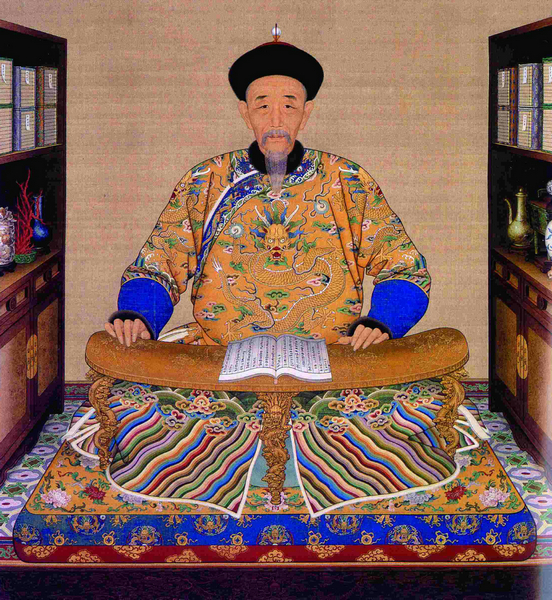
Portrait of Emperor Kangxi

  Since February 22nd, 26th year of Kangxi (April 3rd, 1687), Emperor Xuanye of Kangxi lived in Changchun Garden for the first time, he loved this beautiful imperial garden very much. I came to the park for 44 days that year. According to the statistics of relevant scholars, Xuanye has lived in Changchun Garden every year since then, with the least year being the thirty-fifth year of Kangxi (1696) and 29 days. The most is the forty-seven years of Kangxi, which lasted for 202 days. Most of him came to the suburban garden after handling the important ceremonial banquet in the first half of the first month, and he lived in Changchun Garden eight times on the second day of the first month. Usually, I have to stay in November or even late December before I leave the park and return to the palace. Among them, I left the park for eight times from the 25th to 28th of the twelfth lunar month. Of course, quite a lot of time was spent visiting Jiangsu and Zhejiang in the south, paying homage to the ancestral tombs in the east, visiting Wutai in the west and the paddock in the north, and not all of them lived in Dianyuan. Xuanye’s birthday is March 18th, and he spent the Wanshou Festival in Changchun Garden for 24 times. Until he died of illness in Qingxi Bookstore in Changchun Garden, he lived in Changchun Garden for 257 times in 36 years, totaling more than 3,870 days.

  The main content of Xuanye’s life in Changchun Garden is to avoid noise and listen to politics, to support himself and enjoy the scenery in summer. In addition, there are festivals to celebrate, banquets to give food, trees to spread the world, and parents to teach children.

  Avoid noise and listen to politics

  Daily government affairs include selecting officials, introducing people, reading and approving books, summoning ministers, and discussing orders. During his stay in Chang Chun Garden, Emperor Kangxi spent almost every day in Lian Ning’s residence listening to political directors and handling all kinds of government affairs. For example, Emperor Kangxi was stationed in Changchunyuan for the first time in the 26th year of Kangxi, and he went to the inner gate of Changchunyuan three times in nine days, that is, he took charge of the government inside and outside the Hall of Nine Classics and Three Events. Another example is: Around 30 to 36 years of Kangxi, many political affairs of personal expedition to Junggar were agreed in Changchun Garden. Another example is: I lived in the Imperial Garden for thirteen days from the first day to the thirteenth day of December in the fifty-fourth year of Kangxi (1715), and lived in the court for six days, and handled dozens of matters that needed to be decided. On the first day of junior high school, nine urgent problems were solved in succession. The last one is about Cao Yin and Li Xu’s debt to silver.

  And meet foreign envoys. For example, in the forty-fourth year of Emperor Kangxi (1705), Emperor Kangxi received the special envoy of the Holy See, Dorothy, in Changchun Garden, without kneeling and giving him a seat. He also ordered people to take gifts from the imperial court and go to Rome to answer for employment. On the Mid-Autumn Festival the following year, Kangxi called the Roman special envoy Doro into the garden to give food and watch the lights. Please invite Doro to visit Changchun Garden in five months. Another example is: In the fifty-ninth year of Kangxi (1720), the envoy of the Western countries (Portugal) Pei Lali came to the DPRK, and Xuanye received and gave tea in the Hall of the Nine Classics and Three Events. Another example is: In the month of December 59, Kangxi received Karoku, the special envoy of the Holy See, eight times in Qingxi Bookstore in Changchun Garden, and received gifts from the Pope and presented gifts to the Pope and the Portuguese king. In the meantime, Karoku was also given a sable gown, snuff bottle, sable crown, blue robe, enamel bowl and other things and given a banquet.

  And watch martial arts. Since the forty-fifth year of Kangxi (1706), Emperor Kangxi has been able to watch the martial arts players riding and shooting in the West Factory in Changchun Garden in October or November. Sometimes, a ceremony of biography is held in the park, and the first place of Jinshi, such as Wu Zhuangyuan, is promulgated. For example, in the fifty-fourth year of Kangxi (1715), from November 13th to 16th, Emperor Kangxi came to Changchunyuan West Factory to read the martial arts. Leading the guards’ ministers, reading officials, university students’ loose columns, etc., arranged in a row, and the emperor rose to sit down. Before the assistant minister of the Ministry of War Jue and others entered, 170 people, including Xu Slow, who played martial arts, were divided into 11 classes to test their riding and shooting. The emperor ordered the ministers to sit down. So read Xu Shu and others, ride and shoot in turn, and remember the best. After reading the test, the emperor ordered the princes to ride and shoot. The next day, I continued to read and try to shoot with steps, pull hard work, dance knives and throw stones. On the third day, we continued to test fire in the West Factory. Select 15 best candidates from the martial arts and repeat them, and divide them into different grades. Ministers will select the top three of the 15 people as A, the other 12 as Dimethyl and the rest as Top Three, and present the papers of 15 people.

  study science

  During the Ming and Qing Dynasties, it was the first climax of cultural exchanges between China and the West, also known as the first spread of Western learning to the East. During this period, Emperor Kangxi came into contact with some missionaries who were familiar with western science and technology, and he began to have a strong interest in western science and technology. Bai Jin, a French Jesuit, recalled in his book: "Kangxi studied western science with great interest, spending several hours with us every day, and spending more time on self-study during the day and night." At this time, Emperor Kangxi had dimly realized the importance of natural science. In order to cultivate talents specializing in astronomical observation and natural science and compile large-scale scientific and technological works, he set up a Mongolian-supported vegetarian and mathematical museum in Changchun Garden. This was called "Royal Academy of Sciences" by French missionaries.

  Emperor Kangxi studied very hard and had a wide range of knowledge. He dabbled in human geography, calendar, arithmetic, hundred schools of thought, medicine, natural science, Buddhism, Confucian classics and Taoist books, and was a generalist. There are three sources of knowledge in Kangxi: First, Manchu culture. As the emperor of Manchu, learning the culture of his own nation is a basic accomplishment. Kangxi followed the Manchu master to speak Manchu, learn Manchu and practice riding and shooting. The second is the Han culture. As a minority ruler who entered the Central Plains, in order to gain the recognition of the Han people, Kangxi studied Confucian classics with the Han master, read a lot of historical books, became familiar with the Confucian "study of emperors" and was influenced by Confucian culture. The third is western technology. European Catholic Jesuits came to China to preach, bringing advanced western science, technology and knowledge. Emperor Kangxi, with an open mind, invited Zhang Cheng, Bai Jin and others to Changchun Garden many times to teach western science: mathematics, astronomy, engineering, surveying, medicine and even human anatomy. For example, on the eighth day of March in the 28th year of Kangxi (1689), Emperor Kangxi called Zhang Cheng, a French missionary, to teach geometry at Qingxi Bookstore in Changchun Garden. Looking for Zhang Chengfu to teach in the park many times.

  The establishment time of Mengyangzhai Mathematics Museum was the second day of June in the fifty-second year of Kangxi (1713). It is clearly recorded in Records of the Holy Father of Qing Dynasty that in June, Ding Chou "ordered Prince Yin Zhi of Shuocheng to set up a museum in the palace". However, the research scope of Meng Yangzhai is not limited to mathematics, but also calendar and music. In September of the fifty-second year of Kangxi, Emperor Kangxi issued another decree: "Yu and Prince Yin Zhi of Shuocheng, etc., compiled books on the algorithm of Lu and Lv, wrote a library in Mengyangzhai, and tested the musical instruments in the temple and palace." In October of the 58th year of Kangxi (1719), Wang Lansheng, a juren from Mengyangzhai, was ordered to write "Positive Rhyme".

  Mengyangzhai Mathematics Museum has translated more than a dozen Manchu-Chinese mathematics books, such as Geometry Original, Proportion Solution, Usage of Measuring High Instruments, Eight-line Table Roots, Method of Pythagorean Seeking, Excerpt of Borrowing Roots Algorithm, Record of Western Mirrors, etc., and has also completed works such as The Origin of Laws and Calendars, and trained a number of people such as Mei Juecheng, Minggatu and He Guozong. It also promoted the almanac and geographical mapping of the whole country.

  As early as the first day of October in the fifty-first year of Kangxi (1712), Emperor Kangxi "instructed the third son of Emperor Huang and Prince Yin Zhi of Shuocheng, etc.: the height of the North Pole and the distance from Huang Chi are the most important in the calendar, and they should be measured daily after living in Lianning". And immediately got a few princes to play back. In November of the same year, Prince Ying Cheng invited him to send someone to Guangdong, Yunnan, Sichuan, Shaanxi, Henan, Jiangnan and Zhejiang provinces for surveying and mapping.

  Unfortunately, out of the need of rule, Emperor Kangxi only recruited students from the Mongolian Institute of Arithmetic in a small area such as the palace, which was not popularized among the people, and the advanced western science and technology failed to play its due role in the whole country. With the end of the Kangxi Dynasty, the study of Sino-Western communication also ended, and China missed a historical opportunity of innovation in science and technology.

  Editing and editing books

  Kangxi loved not only reading books, but also compiling books. It can be said that the compilation and publication of books is a major feature of Kangxi’s Wen Zhi, and Kangxi paid special attention to China’s traditional culture. When he lived in Jingxi Garden, he presided over or organized the compilation of many series of books, which made great contributions to the construction of Chinese traditional culture.

  Compile the hadith. On the 10th day of August in the 21st year of Kangxi (1682), when Kangxi was stationed in Yuquan Mountain, he approved the invitation of Dai Wangyu, an imperial historian of Fujian Road, to compile the sacred instruction of Emperor Taizong Gao, Emperor Taizong Wen and Emperor Sezuzhang, and thought: "The sacred instruction of Taizu, Taizong and Sezuzhang is of great significance and should be compiled." In the twenty-fifth and twenty-sixth years of Kangxi, four volumes of the Hadith of Emperor Taizong Gao, six volumes of the Hadith of Emperor Taizong Wen and six volumes of the Hadith of Emperor Shizuzhang were successively completed.

  Yuanjianzhai is the place where Emperor Kangxi advocated and guided the compilation of vast ancient books in Changchun Garden. Here, Emperor Kangxi ordered Xu Qianxue to compile and annotate Yuan Jian, and organized Zhang Ying, Wang Shi and others to compile a large-scale book, Yuan Jian Lei Han.

  Yuan Jian of Imperial Selection of Ancient Chinese Literature is an anthology of ancient Chinese literature. Among them, there are more than 1300 articles by nearly 800 authors from the Spring and Autumn Period to the Song Dynasty. Each article is printed on the top of the book, and the ministers are attached to it. The capital of each article has Xuanye’s royal approval, and each article has the emperor’s introduction and comments on the article. There is a preface written by Xuanye in front of the book.

  Yuan Jian lei Han is a kind of book that focuses on checking the rhetoric of articles. Zhang Ying, Wang Shi and others further expanded the scope of collection on the basis of the book Tang Lei Han in the Ming Dynasty, making the book more comprehensive and complete in time. The book, with 445 volumes, was published in 1710 by Xuanye himself.

  Peiwenzhai is the hall where Emperor Kangxi collects ancient and modern books and paintings, the painting and calligraphy room where he reads, appreciates paintings and calligraphy, learns books and practices calligraphy, and the workshop where he compiles books and paintings. Based on Peiwenzhai, Emperor Kangxi carried out a large-scale and continuous compilation of poetry, calligraphy and painting. Among them, the books with the title of "Pei Wenzhai" include Selected Poems about Objects of Pei Wenzhai, Prose of Guang Qun of Pei Wenzhai, Prose of Paintings and Calligraphy of Pei Wenzhai and Pei Wenyun House.

  Be nurtured by others

  Kangxi once said: "When I was in the womb, I told the Pope Prince that I was alert to the classics, diligent in raising my life, studying the classics every day, making me recite them, and reuniting with my relatives to explain them. I never stopped asking questions." Wang Shizhen’s "Continuation of Juyi" also records: "When I was in the palace, I taught the four books and five classics for the East Palace. Before I served the imperial gate every day, I had to recite and repeat the books I had given the day before, so that I could get through be adept at." It was not until June, the 26th year of Kangxi (1687) that Xuanye chose three masters for the princes: Shang Shu Da Hata, Tang Bin and Shao Zhan Shi Geng Jie, and obtained the approval and support of the scholars Mingzhu and Wang Xi. Xuanye’s selection of teachers is very strict, which requires both profound knowledge and noble morality. He also selected Brinton, Xiong Cilv, Li Guangdi, Xu Yuanmeng, Gu Eight Dynasties, Fahai and others as the master of the Prince, all of whom lived in Confucianism.

  On the seventh day of June, the 26th year of Kangxi, Xuanye summoned three masters, namely Dahata, Tang Bin and Geng Jie, while the Crown Prince and the Prince were on standby, and the ministers, guards and residence officials were left and right. The emperor issued a decree: "Since ancient times, emperors have always taken pre-education and saving two as the foundation of their country. I am afraid that the Crown Prince will not be knowledgeable, that is, he will not be able to understand the body, but will be diligent in teaching and training since childhood, so as not to make a day of leisure … The Crown Prince never knows anything but reading and playing. ….. You are well-known abroad, and we hereby order you to discipline the East Palace. " Regarding the subjects of study, he said: "I sincerely know the family precepts of my ancestors, and the civil and military affairs are in parallel, and I dare not neglect riding and shooting. Therefore, the crown prince and the prince are taught poetry books, and they are also taught to ride and shoot." Although Tang Bin repeatedly refused to say that he could not shoulder this heavy responsibility, he still failed to change the emperor’s decision.

  From the ninth day of the ninth lunar month, the Crown Prince and the princes began to study in Wuyizhai under the guidance of three masters. Degele and Peng Sunqi, officials of Juju Notes, wrote down the learning situation of the princes in Wuyizhai: In the early morning, the Crown Prince and the princes were studying in Wuyizhai, reading several sections and a chapter on the classics. Tang Bin held a book and listened to the Crown Prince recite it without leaving a word. Read a new book again. The crown prince wrote a piece of regular script, about hundreds of words. At dawn, the emperor arrived and rose to the throne. Ask the Juzhu official: How does the prince study? Yes, "the prince is rich in quality and profound in knowledge." Xuanye made a comment: "If you can’t read, you think you can read, you can’t talk, but you think you can talk. If this person is not human." After the emperor returned to the palace, the Crown Prince wrote another piece of regular script. After lunch, the Crown Prince wrote a piece of paper in full, that is, reviewed the Book of Rites and the classics, and read them one hundred and twenty times each. At this time, the emperor came to Wuyizhai again, and the Crown Prince Yun Wan, the eldest son Yun Wan, the third son Yun Zhi, the fourth son Yin Zhen, the fifth son Yun Qi, the seventh son Yun You and the eighth son Yun You? Stand by. The emperor took out ten Yu Ben from the case and handed it to Tang Bin, saying, "You can take it out by hand and let the princes read it." Tang Bin opened the scriptures, and Yun Zhi, Yin Zhen, Yun You, and Yun Yu went in first, and each reading was loud and clear. He also ordered me to explain the chapters of "Knowing the Things" and "The Analects of Confucius", which were word for word and integrated with the righteousness. The emperor ordered Yunqi to read a Manchu article with clear paragraphs and bright sentences. The emperor said: "I must study at the rate of 120 times when I was young. If I don’t cover it like this, I can’t be overwhelmed. Therefore, it is the same for teaching princes and princes to study." He also said,He often erases the words of the Crown Prince, adding few words and never adding circles. The emperor asked the master and the near minister to write, and the handwriting of Tang Bin and Geng Jie was very common. The emperor personally sprinkled Chen Han, and wrote a seven-character poem by Song Rucheng and a piece of paper with the words "Cun Cheng". The beautiful silk characters, vigorous Chinese characters, all have statutes, and all the ministers are full of praise. Later, the emperor led all the scholars to practice archery, and personally pulled the bow and arrow, and all the shots were successful; I also ordered the ministers and guards to learn to shoot. At this time, it was dusk, and the all-day study of the Crown Prince and the princes came to an end. The emperor also went back to Qingxi Bookstore. After such continuous study, the Crown Prince and the princes have a high level of culture and Manchu language and writing, and they are not only familiar with ancient China classics, but also have a high level of painting, calligraphy and riding. Later, the Crown Prince moved to the West Garden to live and study, and the princes also moved to No.4 Lotus Pond in the south of the West Garden.

  Planting rice for rain

  In the Qing dynasty, the rulers attached great importance to agricultural production, which was regarded as the foundation of national stability. Kangxi once planted imperial rice in Changchun Garden and promoted it vigorously. The rulers also paid special attention to the rainfall situation that directly affected agricultural output, and carried out rain-seeking activities in Haidian area.

  As a spring-rich place in the west of Beijing, Haidian has a long tradition of planting rice. In the early years of Kangxi, Prince Dan Zhen, the owner of the garden in tsinghua campus, changed the lotus pond in the garden into a paddy field, and the annual profit could reach hundreds of taels of silver. Kangxi’s earliest activity in the western suburbs was to watch the growth of rice in the west of Beijing. During the construction of Changchun Garden, Emperor Kangxi set aside a paddy field in the west wall of Changchun Garden to test and cultivate excellent rice seeds himself. From Wuyizhai Tushan to the north, until Daximen, located in the northwest of the garden, there are about hundreds of acres of fields, which is the "experimental field" for Kangxi to plant imperial rice. According to "Kangxi’s Collection of Leisure Things", rice seeds are early rice selected and cultivated by Kangxi himself, named "Imperial Rice". It is also called "rouge rice" because its rice awn is lavender, its rice grains are reddish and long, its smell is fragrant and its taste is poor, and it can be cooked twice a year. This is also the originator of "Jingxi Rice" in Haidian District.

  In the fifty-third year of Kangxi (1714), the imperial rice at the foot of Yuquan Mountain grew to 600 mu, plus Liulangzhuang, Wanquanzhuang, Heilongtan, Gaoliangqiao, Shijingshan and Nanyuan, totaling nearly 10,000 mu. The planting range of imperial rice has not only been further expanded, but also the area has increased several times, and it has become the main source of imperial rice in the court. In order to ensure the production of royal rice, in the same year, Fengchenyuan, the Ministry of Internal Affairs, set up a "rice field factory" in Qinglong Bridge to manage royal rice fields.

  There are sixty-four rice paddies, which are government offices, warehouses and mills. At the same time, there are two official places, one in Gongde Temple and the other in Liulangzhuang. "Yongxian Record" said: When Kangxi was in Kangxi, "it served imperial meals, saying that it served imperial rice and went out to the western hills of the capital", and Changping Prefecture produced rice everywhere, but Yuquan Mountain was better than Yuquan Spring, so rice was needed. The "Qing Hui Dian" also records: "The jade grains above are taken from the rice fields of Yuquan Mountain."

  In the later period of Kangxi’s rule, the society was stable and the population began to increase sharply. Kangxi was deeply worried about this population expansion: "Since the unification of the area, in 678 this year, all the people have enjoyed peace, and the fertility has increased day by day. Although the registered permanent residence has increased, the land has not increased. If one person’s property is used by several families, how can he make a living?" The rapid population growth and predatory development have brought great pressure to the surrounding environment of Gyeonggi. The ecological environment has become extremely fragile, and floods and droughts have started to break out frequently. Therefore, in the middle and late period of Kangxi’s rule, emperors were more concerned about sunny and rainy days, and more and more words were found in historical materials. For example, on June 25th, the 45th year of Kangxi (1706), during Emperor Kangxi’s tour to the north, Yin Zhi, the third son of Emperor Huang, invited the emperor to pay his respects, and made a special presentation on the rainy situation in the capital area: "There has been a lot of rain in the capital area, Changchun Garden, Cirja Camp and other places recently. Yu: There is enough rain here. " The feeling of concern is on the paper.

  The belief in praying for rain and sunshine by the dragon gods, which was valued by the rulers of past dynasties, was also maintained in the Kangxi Dynasty. As the most common measure to resist disasters, praying for rain was valued by Emperor Kangxi and included in the national sacrifice code. When Changchun Garden was built, Kangxi built the Longwang Temple in the garden as a special place to pray for rain. In case of drought, Kangxi often sent princes, county kings, Baylor, Beizi and ministers to the Longwang Temple to pray for rain. Each rain praying ceremony is very grand and has established procedures. For example, on May 13th, the forty-ninth year of Emperor Kangxi (1710), Yin Zhi, the third son of the Emperor, and others gave orders: At Longwang Temple in Changchun Garden, pray for rain as the twelve sons of the Emperor prayed for rain.

  The history of rice in the west of Beijing has a long history. According to historical records, Haidian, which is fertile and beautiful, began to build canals to grow rice during the Cao and Wei Dynasties in the Three Kingdoms, and it has a history of more than 1,700 years. According to the Records of the Three Kingdoms, in the second year of Cao Fangjiaping, the king of Wei Qi, Jing Liu stopped water to build a dam on the Luohe River (now Yongding River) and built a carriage canal. "Irrigation thistle (city) north and south, planting rice in the third night, and benefiting the border people." It was not until Guo Shoujing, a water conservancy scientist in Yuan Dynasty, opened Tonghui River, and sufficient water ensured the growth of rice, that farmers on both sides of the strait began to plant rice on a large scale.

  Kangxi was the emperor who really turned Jingxi rice into "Imperial Rice". Emperor Kangxi skillfully integrated the "pastoral scenery" shown by intensive cultivation into the garden landscape, which not only provided materials for life, but also created the artistic conception of pastoral life, so that garden dwellers could experience the seclusion interest of pro-farming. Emperor Kangxi attached great importance to agriculture, and with his support, the cultivation of rice in western Beijing was further developed. He also personally experimented, compared the rice between the north and the south, and cultivated excellent varieties as royal royal rice, and vigorously promoted planting. Even set up a rice field factory to manage these royal imperial rice.

  Kangxi once experimented with rice on the side of Fengze Garden in Zhongnanhai, Beijing, and sent people to plant a small experimental field under Yuquan Mountain, which was successful and later called "Jingxi Rice". In his poem "Early Imperial Rice", he wrote: "The purple awn is half a hectare of green and shady, and I love the early imperial rice. If you make the prescriptions more widely distributed, you may see the needles twice. " (Lu Qin’s Song of the Dragon-Poems of the Emperors in China) Here he expressed his heartfelt joy after watching the rice fields, and he longed for the rice area to expand constantly and strive to harvest twice a year.

  The whole story is like this: One day in June, when Kangxi was patrolling the rice fields in Fengzeyuan, he came across a rice that was "above the rice" and the grain was ripe. Originally, Yutian rice was planted here, and it will not mature until September of the lunar calendar, but this rice in front of us is two months ahead of schedule, which is beyond Kangxi’s expectation. He used it as a seed to try planting in the next year, and it really matured in June. This early-maturing new rice has reddish color and long grains, and tastes delicious. (See Kangxi’s Faulty Style) Because it was discovered and cultivated by Kangxi himself, it is called Imperial Rice. Later, people called it Jingdao.

  Kangxi’s poem "On the 11th of July when he was watching rice in Changchun Garden" also wrote: "In July, the purple mountain is fragrant with five miles, and the near-garden remains a species of Zhu Zhenxiang. Yan Fang and Saibei are all called Rui, and they are happy and happy. " July in the lunar calendar is equivalent to August in the solar calendar. Seeing the purple awn in the rice field is associated with the fragrance of a grain, which shows that he attaches great importance to rice. People in both the hot places in the south and the colder places in the north of Saibei praised the transplantation of this cereal crop as a good omen. In particular, it is a great wish to plant rice in the northern part of the Great Wall, which has become a reality through hard work.

  According to relevant documents, in the 42nd year of Kangxi, the Qing government built chengde mountain resort, and imperial rice seeds were first transplanted here, which was located in the north of the Great Wall. Generally, rice could not mature after the Millennium, but the imperial rice seeds matured before the Millennium, so the experiment was successful. So it opened a new record of planting rice north of the Great Wall. Kangxi once said: "The rice fields in the villa still have a surplus for summer use every year."

  Kangxi’s cultivation of rice can be said to be affectionate. Therefore, he has a specific description of the whole process of rice breeding, seedling pulling, transplanting, harvesting and ear picking, and all of them have persistent pursuit and deep desire. There is a detailed description in his group poem titled Farming Map:

  The first seedling: "A year’s farming is in the depth of spring, and the family is looking forward to the new year." I love the clear weather, and the green fields are thousands of hectares. " Pulling out the seedlings: "The green onions are full of water, and the transplanting of Xichou is even more furious. The order of the festival is shocking, and the seedlings must be divided into early summer days. " Transplanting: "There are thousands of beds in Shui Ze, and the competition for transplanting new seedlings is afraid of the future. The Asian brigade is happy to work together, and it is not too late to go home in the next month. " Harvesting: "Huang Yun is full of dew, and the waist sickle is blessed with rice. Children collect the ears everywhere, and every family in the village bears the burden. " Holding the ear: "Nanmu Qiu Lai celebrates Fucheng, but Qu Qu has not released the old peasants’ feelings. The frost rises from the neighborhood and listens to the sound of rice in the village. "

  Here is a series of scenes of farmers growing rice, with vivid language. Early seedling, describing farmers’ hard work in order to seize the farming season, "green fields are thousands of hectares", the scene is huge and quite imposing. Pull out the seedlings and describe the busy scene of rice transplanting. The paddy fields are full of thick green, showing a vibrant scene. Transplanting rice seedlings describes the scene of "Yalv" (small officials and village officials) working with farmers in the vast farmland, and the moon rises before returning home without complaint. The purpose of this hard work in Dai Yue is to get a good harvest. Harvesting depicts reaping with sickle, young and old doing their best, children picking up the ears of rice skillfully, and farmers returning with great strength, which sets off a jubilant atmosphere after a bumper harvest. Holding the ear outlines the scene of rice harvesting in the countryside, highlighting the feeling of hearing, and the joy of harvest is stirring everywhere in the village. Kangxi had personal experience in growing rice. His poems are not extraordinary masterpieces, but they are close to life and smell of earth. They are more lively and interesting than some literati who write poems by imagination in their study.

  In a word, Kangxi had a close relationship with Jingdao, which was unparalleled among hundreds of emperors in ancient China. His contribution is to promote the transplanting of rice to the north of the Great Wall and advocate the promotion of double-cropping rice in the south. The descendants of Kangxi, namely Yongzheng and Qianlong, also attached great importance to agricultural production. At the beginning of spring ploughing, Yongzheng and Qianlong held the ceremony of "borrowing farmland" in the small experimental field of "Fengzeyuan" successively, and demonstrated by themselves to help farmers. Yongzheng’s poem "Tillage" wrote: "Spring turns in Yuanji, and it is warm and comfortable in Jutz. The green dove cries for rain, and the yellow calf drives the plow at the beginning. There is no escape for every mu of people, and they dare to work hard. Care about the lessons and help the village market. " This poem expresses sincere desire for the hard work of farmers in the busy season of spring ploughing. There is a poem "Fengze Garden" in Qianlong: "After gardening, I will farm the fields, and the name of the garden is Fengze, Myanmar and Yaonian." Here, the layout of rice fields and vegetable gardens in Fengze Garden is described, and his concept of attaching importance to agriculture is expressed, which is quite meaningful to Sun Jizhu’s career.

  Dinner banquet

  In ancient China, a fine ethical concept of respecting the elderly and caring for the young was formed very early, and the older people are, the more respected they are by the society. Therefore, it often attracted the attention of feudal emperors in the past dynasties. In the "King System", there is a ritual system of respecting the elderly by emperors who "give sticks" to the elderly. Ren Fang (460-508), a famous litterateur in the Southern Dynasties, who was Cheng in the imperial history and the prefect of Yixing, once left a famous sentence: "Laojun still cares about his teeth, but he regrets this staff’s nostalgia" (see Answer to Jian ‘an Pay Staff). During the reign of Kangxi and Qianlong in the Qing Dynasty, the national strength was strong, which was called "the prosperous time of Kanggan" in history. The activities of respecting, respecting and loving the elderly were paid special attention to by Emperor Kangxi and Emperor Qianlong, so there were four grand and spectacular "thousand banquets" in history. In the fifty-second year of Kangxi, the sixty-first year of Kangxi, the fifty years of Qianlong and the first year of Jiaqing, respectively, two thousand banquets during the reign of Kangxi were held in Changchun Garden.

  In March of the fifty-second year of Kangxi (AD 1713), the 60th birthday of Emperor Kangxi, the holy ancestor of Qing Dynasty (also known as Wanshou Festival), he thought: "Since the Qin and Han Dynasties, there have been 190 emperors, and they have enjoyed a long time, and there is no one like me." Therefore, we decided to hold a grand and ostentatious celebration of Wanshou. (See Record of Kangxi, Volume 254) In Beijing, the colorful shed set up for the celebration extends from Xizhimen to Changchun Garden for 20 miles. The Ministry of Rites has made a special provision: "It is unusual to meet anniversary who is 60 years old this year." From the first day of March to the end of the month, Beijing officials have to wear embroidered robes and make up their gowns, breaking the routine of wearing only royal clothes for seven days. The most striking thing is that Emperor Kangxi announced that in aged person, people over 65 years old, regardless of government or people, can get to Beijing on time to attend the banquet in Changchun Garden.

  On March 25th, Emperor Kangxi hosted the first banquet for ministers, officials and scholars of Han nationality in front of the main gate of Changchun Garden. There were 33 people over 90 years old, 538 people over 80 years old, 1823 people over 70 years old and 1846 people over 65 years old. All the princes, grandchildren and descendants of the imperial clan who were over 10 years old and under 20 years old came out to toast the old people, distribute food, help the old people over 80 years old to drink in front of Emperor Kangxi to show their favor, and reward them with silver.

  On this day, the scene of the Imperial Palace was unusually solemn and grand. Under the eaves of the Imperial Palace, there is a display of Zhonghe Shaole; In Ningshou Gate, there is Dan Bi Da Le. Inside the temple, there are seats for princes and ministers. Under the temple, the envoys of North Korea and other vassal countries were arranged; The seats with the banquet are under the steps outside the temple.

  On March 27th, in front of the main entrance of Changchun Garden, a wine banquet was held to entertain ministers, officers and soldiers of the Eight Banners and idlers, including 7 people over 90 years old, 192 people over 80 years old, 1,394 people over 70 years old, and 1,012 people over 65 years old. On March 28th, in front of the Empress Dowager Palace in Changchun Garden, a banquet was held for the Eight Banners old women over 70 years old. Those over 90 years old were seated at the palace gate, those over 80 years old were seated at Xidan Gate, and the rest were outside the palace gate. More than 6,600 people attended the banquet in aged person, Manchu, and an unknown number of eight banners old women, certainly no less than 7,000 people, and its grand occasion was passed down as a much-told story.

  In the first lunar month of the sixty-first year of Kangxi (1722), Emperor Kangxi was 69 years old. In order to celebrate his 70th birthday, he held a second banquet in Ganqing Palace. At that time, 12-year-old Hongli attended the banquet as the emperor’s grandson. This year is the last year of Emperor Kangxi’s life journey.

  On the first day of the first month of the first month, the palace held a New Year’s gift to the DPRK. The old emperor, who had weathered the storm and was quite satisfied with his sixty-year imperial career, wrote the poem "Sixty-one Spring Fasting Book", which said: the nature is towering, and the classics assist the DPRK. Don’t do your best, don’t make the vulgar atmosphere noisy. Don’t miss farming and mulberry, you must be timid inside and outside. The wind is high and the birds are quiet, and the rain is enough and the road is clear. How can the inspection be hidden, and how can the loose-packed be shaken? Although it is dusk in Sang Yu, the pine and cypress wither with frost. Long-term cultivation of spring is prosperous, and it is lenient and strict. Tiredness should be unavoidable, and the more ashamed you are, the more obvious you are.

  The reason for this banquet is that the world is peaceful and the people’s livelihood is rich. On the second day of the first month, in front of the Forbidden City, a banquet was held to entertain 680 civil and military ministers, officials and officials of the Eight Banners, who were over 65 years old and retired. Kings and idle imperial clan members came out to confer titles on the old people to persuade them to drink and distribute food. On the fifth day of the fifth lunar month, another banquet was held for 340 ministers of civil and military affairs and officials of the Han nationality who were over 65 years old.

  Records in Zhang Cheng Diary

  On the 15th day of the first month of the 30th year of Kangxi (1691), Xuanye hosted a banquet for Zhang Cheng and other foreign teachers in the bedroom. The emperor ordered the imperial court to prepare horses, gave them a ride into Changchun Garden, and then was introduced to Qingxi Bookstore. They saw "cold dishes, fruits, pastries and sweets on the table". After the meal, Zhang Cheng also witnessed Xuanye’s banquet for the clan here. "Zhang Cheng Diary" recorded the grand banquet in detail: after we ate, the internal supervisor arranged for the emperor to have a banquet with 12 to 15 relatives in the imperial palace today. Tea and food used on the table are placed at the other end of the hall. There is a big square table in the center of the temple, covered with red lacquer and gold, and decorated with dragon flowers. Tatars and Han Chinese don’t use tablecloths and napkins. They only spread yellow satin embroidered with golden dragons on the table. There are two tables around the front of the table, and the edges are decorated with colored stone beads inlaid with silver wire. These are all made of ordinary stones with no luster. On both sides of the hall, a ruler is set for the pro-expensive ministers, and the cushions are placed on the floor. They took their seats here for dinner. There are pyramids of cold meat in the food, and cold dishes made of aspic, beans, cauliflower or Chinese cabbage. The imperial table is full of colorful flowers, and flowers and trees are planted in large porcelain pots or painted wooden barrels all winter, which are displayed in the emperor’s bedroom. This is the main decoration in his inner bedroom. Other than that, everything is plain. The corner of the hall is separated by a screen, and a band is set here. A group of 10-to 12-year-old eunuchs, dressed as clowns, performed various martial arts in front of the table. Two of them bent their heads backward, almost touching their heels, and then stood upright at the beginning, without moving their positions or using their hands or feet …

  On the Lantern Festival in the 30th year of Kangxi (1691), Xuanye invited his foreign teacher Zhang Cheng and others to watch the fireworks with him. Zhang Cheng Diary wrote: In the evening, we went to watch fireworks. The fire was set up opposite the queen’s bedroom. The emperor led the princes to watch in person. There are more than 20 pro-expensive ministers in the audience. Our seats are right next to them. There is nothing special about fireworks, only a string of lamps lit by artillery in series, which are soaring and dazzling, like many planets. The rest are just spray flowers, rain stars, tube explosions, rockets and so on. The first rocket was launched before the emperor arrived, and they said that he lit it himself. This rocket, like a sharp arrow off the bowstring, hit and ignited another fireworks 30 or 40 paces away. In this fireworks, a second rocket flew out, triggering a third fireworks and shooting a third rocket. Several fireworks are like a series of machines. The fireworks lasted for an hour.

  Kangxi died in Changchun Garden.

  Xuanye is a wise monarch, and he can handle a lot of difficult government affairs with ease, but the matter of abolishing the crown prince has caused him a lot of trouble and broken his heart, which seriously damaged his health. In the fifty-sixth year of Kangxi (1717), on November 21st, Xuanye, who was seriously ill, summoned the princes, Manchu and Han university students, etc.Palace of Heavenly PurityDongnuange, issued a long and sincere message. He claims that he has been ill recently, his mind is in a trance, and his body is very tired. It is difficult to get up and walk without support. He also said that he is now seriously ill and forgetful, and he is very afraid of doing things right and wrong and doing something wrong. In 1957, Xuanye said that when he got up a little early, he "shook his hands and looked indecent, or his face suddenly changed when his heart beat." In April, 1958, he said that his "qi and blood are gradually declining, his spirit is gradually decreasing, he feels tired in doing things, and his writing hands are trembling". In the spring of 1961, I visited Jidian, and the provincial party asked the customs and inspected the officials and the people; In the summer, I toured the northern part of the Great Wall. After returning to Beijing at the end of September, I was busy with various government affairs. His hard work is running out.

  On October 21, 61, Kangxi, Xuanye rushed to Nanyuan Hangwei again. Being tired for many days in a row, I feel even weaker, and it is the middle of winter, so I feel cold. On the seventh day of November, Xuanye returned to Changchun Garden to treat his illness. Traditionally, on the Winter Solstice Festival on November 15th, the emperor had to go to the southern suburbs to hold a ceremony to worship heaven. Because of illness, Yin Zhen, the fourth son of Emperor Yong, made sacrifices on his behalf and ordered him to fast in advance. On the 10th, 11th and 12th of this month, during his fast, Yin Zhen sent eunuchs and guards several times to greet his father’s illness, and Xuanye only replied casually: "I feel a little better." Late at night on the 12th, Xuanye’s condition deteriorated sharply. Just after midnight, Yin Zhen, the fourth son of the Emperor, was summoned to the lent house, and he was ordered to return to Changchun Garden quickly. The Southern Suburb Sacrifice Code was reassigned to Wu Erzhan. At the same time, we also called Prince Yun Zhi of the Third Son of the Emperor, Wang Yun You of the Seventh Son of the Emperor, Baylor Yun You of the Eighth Son of the Emperor, Bei Zi Yun You of the Ninth Son of the Emperor, and Wang Yun of the Tenth Son of the Emperor. The twelve sons of Emperor Bei Zi Yun, the thirteen sons of Emperor Yun Xiang, and the minister of Li Fan Yuan Long Keduo all came to the side of the royal couch of Qingxi Bookstore and announced the heir to the throne, saying, "The four sons of Emperor are noble in character, and they are deeply humble, so they will be able to form a unified system, and I will be the emperor after them." At that time, the emperor’s five sons allowed Qi to pay homage to Xiao Dongling on the winter solstice and failed to listen to the testamentary edict impromptu. Because of their age and status, the fifteenth son of the Emperor allowed disaster, the sixteenth son of the Emperor allowed Lu, the seventeenth son of the Emperor allowed Li and the twentieth son of the Emperor allowed Yi to wait outside the bedroom, so they could not go in for training. At this time, Yin Zhen, the fourth son of the Emperor, came from the den to greet him. Xuanye also reported his growing illness. Yin Zhen had to comfort the emperor’s father with tears in his eyes.

  Xuanye’s life has come to an end. On the same day (13th) night, this generation of British master died in Qingxi Bookstore in Changchun Garden at the age of 69.

  That night, under the strict guard of the emperors, the ministers of Li Fan Yuan, and the commander of Long Keduo, the emperor’s body was transported from Changchun Garden to Ganqing Palace in the Forbidden City, and later buried in the Qingling Mausoleum of Qing Dynasty. On November 20th, the Royal Hall of Supreme Harmony in Yin Zhen was crowned as the third emperor after the Qing Dynasty entered the customs-Yong Zhengdi.

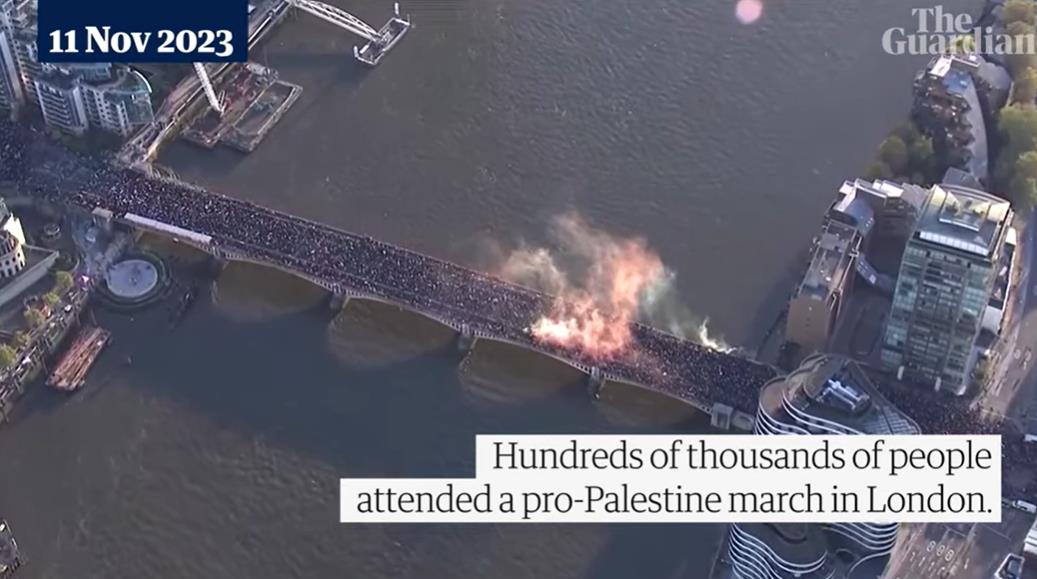
Foreign media: About 300,000 people participated in the pro-Palestinian March in London, and the British Prime Minister condemned "pro-Hamas people".

  [Global Network Report] According to foreign media reports such as CNN and The Guardian, the British capital London held a large-scale demonstration in support of Palestine on Saturday (11th). According to the statistics of the London police, about 300,000 people participated in the protest March. The Guardian said that the parade coincided with the "Memorial Day", and the organizers said it might be one of the largest parades in British history. It is worth noting that on the 11th, many places around the world, including Barcelona, Paris and Ankara, held rallies on the same day to support the Palestinians and call for a ceasefire in Gaza.

On the 11th local time, a video screenshot of a large-scale protest March in support of Palestine broke out in London, England. Source: The Guardian.

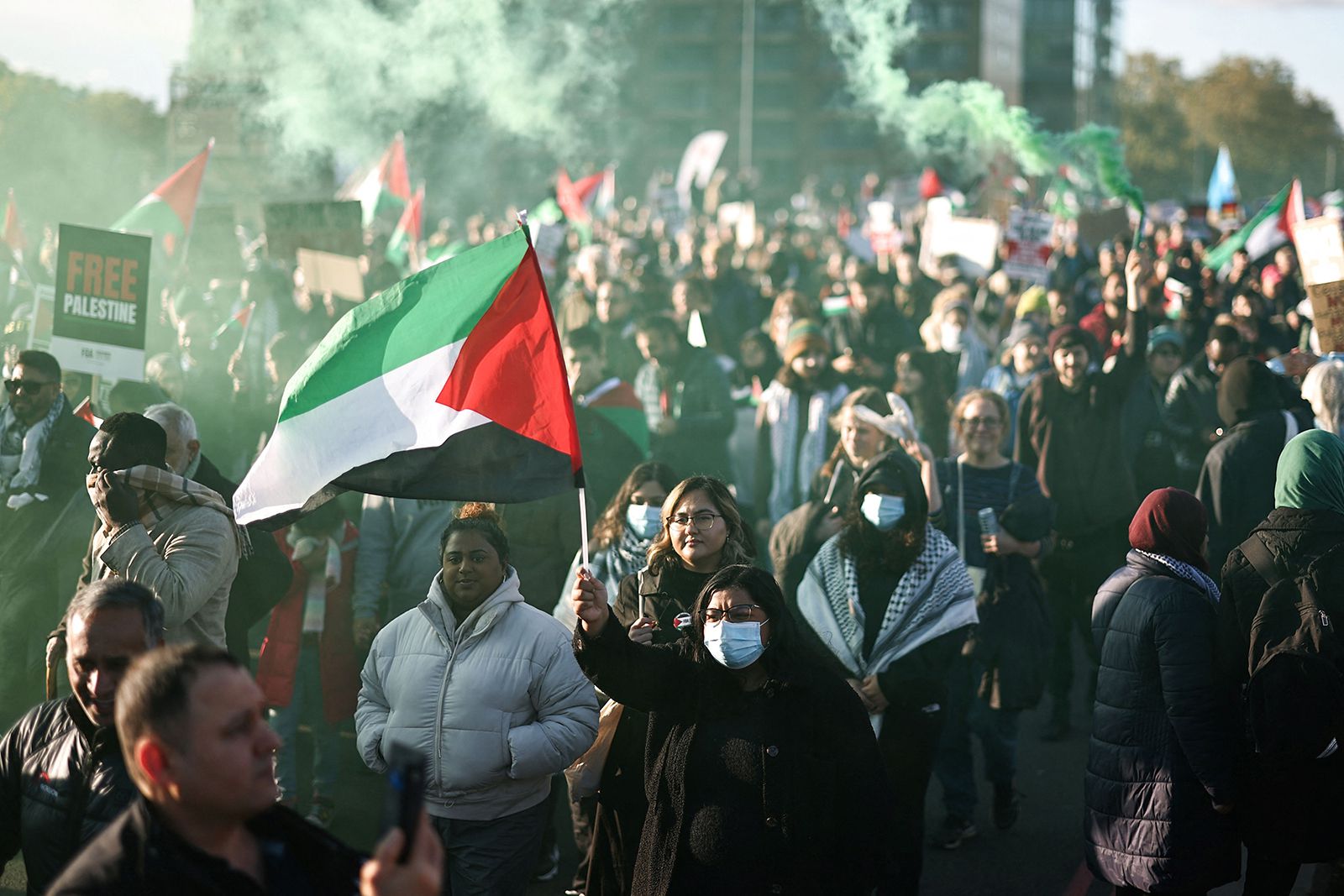
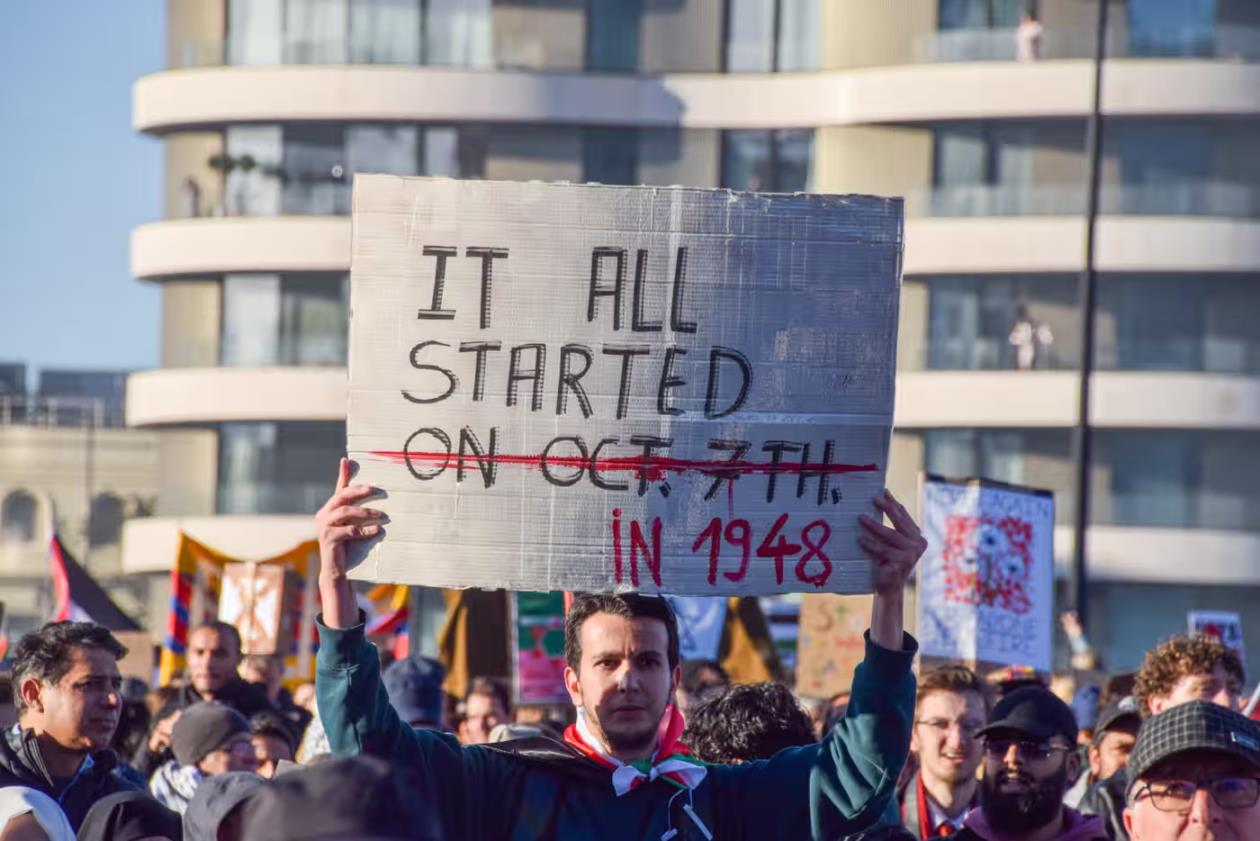
  According to CNN, on the 11th in London, protesters shouted "Liberation, Liberation of Palestine", "Cease fire immediately" and "From rivers to oceans, Palestine will be free!" Slogans, such as protests. The Guardian said that the London police said that 126 people have been arrested in the protests on the 11th.

  On the 11 th local time, people participated in supporting the Palestinian March in London. Source: Foreign media

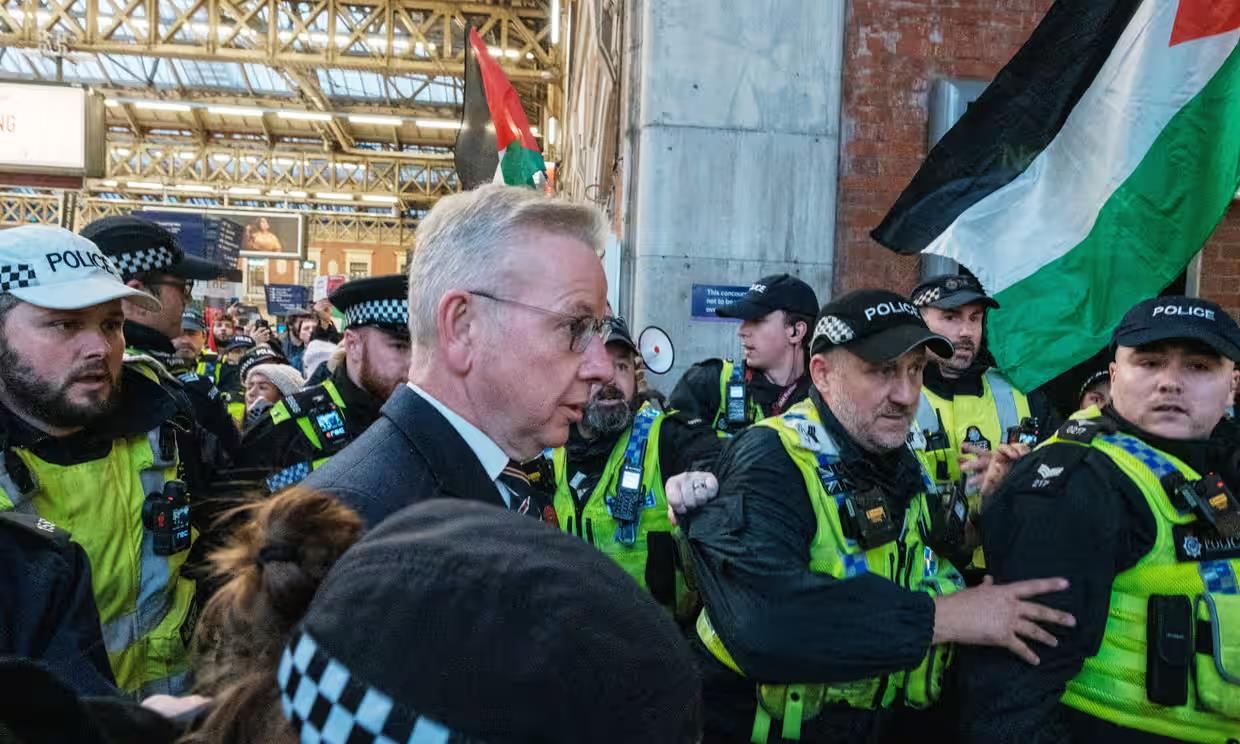
Regarding the scale of the protest in London, the Guardian specifically stated that British Cabinet Minister Michael Gove was once "besieged" by pro-Palestinian protesters at Victoria Station in London that day. In addition, in another video, when Goff was walking on the streets of London, protesters shouted "Shame on you" after him.

On the 11 th local time, at Victoria Station in London, British Cabinet Minister Michael Gove was escorted by protesters. Source: The Guardian.  

According to the Guardian, the protest March in London also alarmed British Prime Minister Sunak. Later on 11th, Sunak condemned the violence in the procession, criticized "pro-Hamas people" and those who sang anti-Semitic slogans, and added that "all criminal acts must be comprehensively and quickly cracked down by law".

  The Guardian also mentioned that on the same day that large-scale pro-Palestinian activities broke out in London, pro-Palestinian rallies were held in many places around the world on the 11th to protest against Israeli attacks on Gaza and call for a ceasefire, including Barcelona, Paris, Berlin, Ankara, and Sydney, Australia.

On the 11 th local time, people participated in a demonstration in support of Palestine in Barcelona, Spain. Source: Guardian

On the 11 th, local time, people participated in a demonstration in support of Palestine in Paris, France. Source: Guardian

On the 11 th local time, people participated in a demonstration in support of Palestine in Ankara, Turkey. Source: Guardian

On the 11 th local time, people participated in a demonstration in support of Palestine in Berlin, Germany. Source: Guardian  

A new round of Palestinian-Israeli conflict continues. According to media reports, on November 11, local time, this round of conflict entered the 36th day, and more than 12,400 people were killed in both Palestine and Israel. Among them, more than 11,000 Palestinians died, while Israel revised the death toll from about 1,400 to about 1,200. On the 11th, the Israeli military continued to carry out air strikes and ground operations in the Gaza Strip, claiming that the Palestinian Islamic Resistance Movement (Hamas) lost control of the northern Gaza Strip. The Kasang Brigade, an armed faction under Hamas, said that it continued to exchange fire with the Israeli army that day and destroyed several Israeli targets.

Synchronized swimming twins flower into beautiful scenery of the Olympic Games (photos)


China synchronized swimming Jiang sisters


Slovak kayak Hodgshuna brothers


Winklevoss brothers of America


New Zealand rowing Swindell sisters


Bryan brothers of America


  The most beautiful twins


  China synchronized swimming Jiang sisters


  Chongqing Evening News reported on August 19th.The biggest advantage of twin competition is that the tacit understanding is quite high, and Jiang Wenwen/Jiang Tingting of China Synchronized Swimming Team is the most typical example. They were born on September 25th, 1986. Their elder sister Jiang Wenwen was born half an hour earlier than her younger sister Jiang Tingting, but her height was one centimeter shorter than her younger sister.


  The flower-swimming sisters are like an inseparable union, and their every move is very similar in life. At the Olympic Games, their coach, Masaya Inomura, Japan’s "Flower Tour Godmother", arranged a beautiful and moving "Spirit of Sparrow" for them, which will become the "killer weapon" for the two sisters to attack the Olympic medals.


  China Olympic Corps is not only a pair of twins, Jiang Wenwen/Jiang Tingting, but also a pair of twin sisters, Zhang Wei/yu zhang of China women’s basketball team, both of whom are 1.84 meters tall, and both of them have been selected for the China women’s basketball team. In addition, Duan Junjie/Duan Junqing, a kayak group in China, are also twin brothers.


  On the afternoon of 18th, the synchronized swimming competition of Beijing Olympic Games ushered in the first competition day in the Water Cube. After the first round of synchronized technical optional movements, anastasia davydova/ermakova, the Olympic and World Champion of Russian team, ranked first with 49.334 points, while Jiang Wenwen/Jiang Tingting of China ranked fourth with 48.084 points.


  What is even more amazing is that on the first day of the competition, three teams sent "sister flowers" to participate. In addition to China’s twins Jiang Wenwen and Jiang Tingting, there are also two New Zealand sisters Nina, 26? Daniels and Lisa, 23? Daniels, and Bianca, a twin group in the Netherlands? Van der Feilden and Sonia? Van der Feilden.


  They look the same, they have the same heart, and they are also extraordinary. At the Beijing Olympic Games, in addition to the above synchronized swimming twins, there were pairs of twins, which built a beautiful scenery for the Olympic Games.


  The most golden twins


  Slovak kayak Hodgshuna brothers


  On the 15th, the two brothers won the gold medal in canoeing and slalom men’s double rowing in Beijing Olympic Games.


  As the Hodgshuna brothers have already won the gold medals in the Sydney and Athens Olympic Games, they have become the twins with the most gold medals in Olympic history. The Hodgshuna brothers were born on September 7, 1979, but from the outside, they are nothing like twins, because the elder brother is 10 centimeters taller than the younger brother and weighs 9 kilograms.


  Twins with the highest academic qualifications


  American rowing Winklevoss brothers


  Cameron, the 26-year-old twin brother of American rowing? Winklevoss and Taylor? Winklevoss, selected for the American rowing training team, will compete for the gold medal in men’s synchronized rowing at the Beijing Olympic Games. They won the World Championship trophy in 2004. What’s more commendable is that both brothers are graduates of Harvard University.


  The luckiest twins


  New Zealand rowing Swindell sisters


  On the 16 th, New Zealand twin sister Caroline? Swindell and Georgina? With a slight advantage of 0.01 second, Swindell thrillingly defended the women’s sculls champion in rowing. The sisters are also the world record holders of this project.


  Sister Swindell was born on October 10th, 1978. Sister Caroline was born four minutes earlier than sister Georgina. They have never missed the women’s synchronized sculls since 2002 until the 2007 World Championships. They won the Olympic gold medal in 2004, and now they have successfully defended their titles at the Beijing Olympic Games.


  The most famous twins


  American tennis Bryan brothers


  In the Olympic tennis men’s doubles competition that ended on the 16th, the Bryan brothers won the bronze medal. It is not easy to distinguish them from each other by their looks, but it is not difficult to distinguish the two brothers on the court, because the elder brother holds the racket with his right hand and the younger brother holds the racket with his left hand.


  The two brothers were born on April 29th, 1978. They not only have the same face, but also share the same e-mail address, the same bank account and the same coach. They not only won the men’s doubles championship in tennis Grand Slam for many times, but also shared the number one doubles ranking in the world.

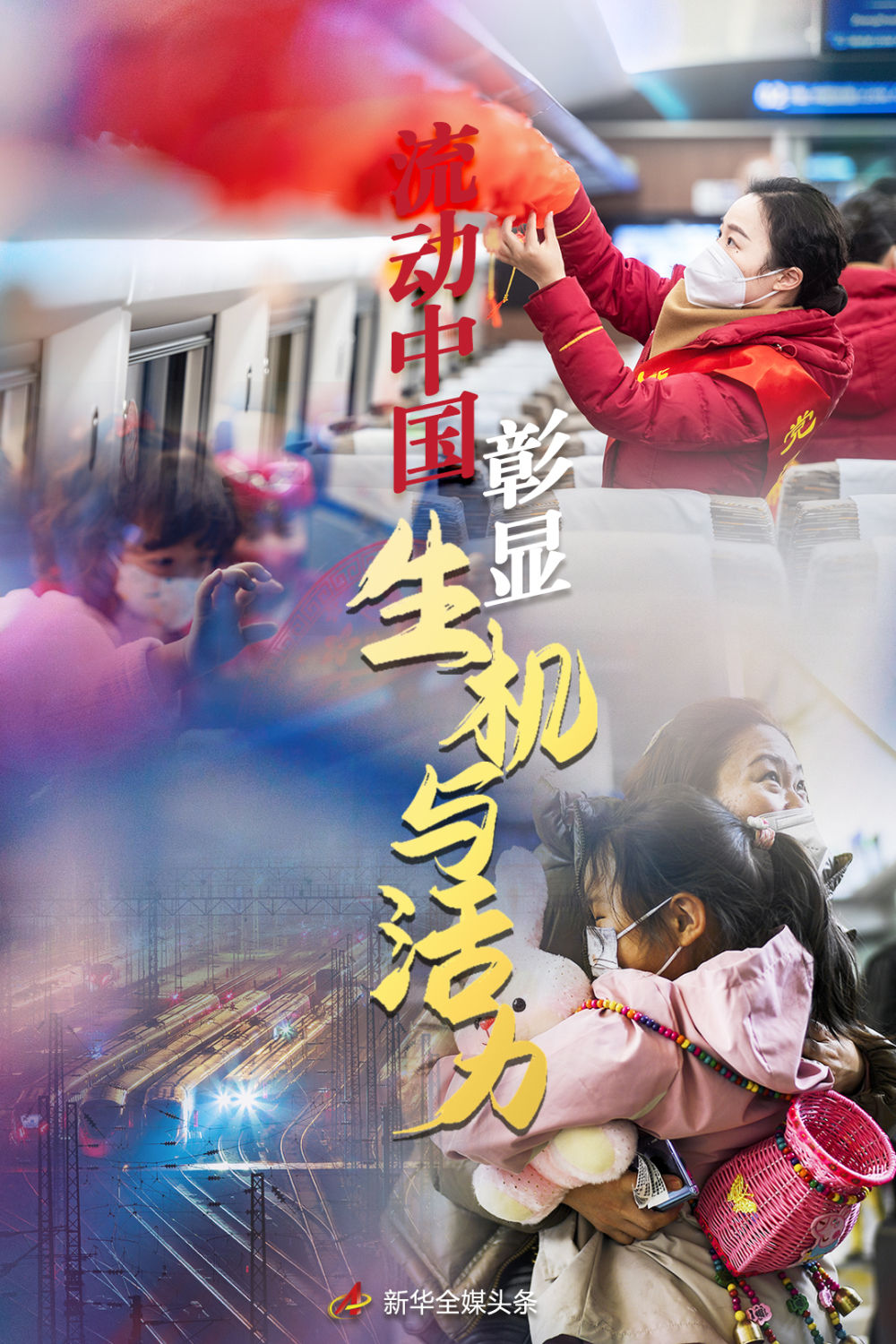
Flowing China Showing Vitality and Vigor Written at the Closing of Spring Festival travel rush in 2023

  On February 15th, 2023, Spring Festival travel rush officially closed. In 40 days, railways, highways, waterways and civil aviation have sent more than 1.5 billion passengers. People who packed their bags, with the blessings of their loved ones, rushed to the far and wide again, interwoven into a warm picture of China.

  The best time on earth is early spring. As the first Spring Festival travel rush after the epidemic prevention and control entered a new stage, people have realized their dream of reunion, and are also moving forward for the new goal and new atmosphere of the new year.

  The passenger flow is rising and the traffic is smooth, and the mobile China is full of vitality.

  On February 14th, 2023, Spring Festival travel rush is drawing to a close, but Asia’s largest railway passenger transport hub — — Beijing Fengtai Station is still busy. Travellers from the south to the north, dragging their luggage and carrying their hometown specialties, set foot on their way back to work and school under the guidance of the station staff.

  "This year, the passenger flow in Spring Festival travel rush has increased significantly, and our work has become more busy. However, seeing the normal flow of people in cities and stations, passengers’ faces are filled with happy smiles, and all our service guarantees are worthwhile. " Ling Chengcheng, chief of the comprehensive support section of the Beijing Fengtai Station District Management Office of the Beijing Key Station District Management Committee, said.

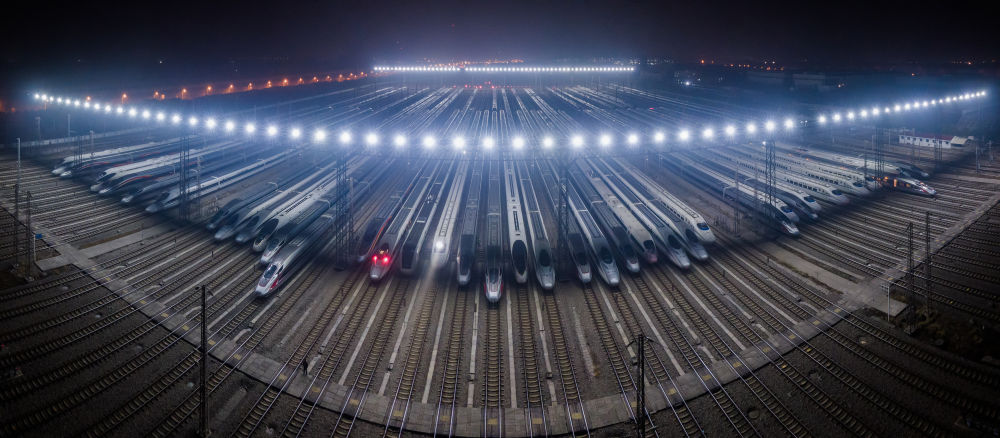
  The EMU train stops at the storage line of Wuhan EMU (photo taken on January 7, photo of unmanned aerial vehicle splicing). Xinhua News Agency reporter Wu Zhizun photo

  Compared with Spring Festival travel rush in previous years, during Spring Festival travel rush in 2023, the passenger flow of railway Spring Festival travel rush continued to rise. According to the data, since February, the national railways have sent more than 9 million passengers per day and operated more than 9,000 passenger trains, basically recovering to 90% of the same period in Spring Festival travel rush in 2019.

  As a popular means of transportation, railway bears the responsibility of ensuring the long-distance and large-scale flow of population. As the first choice for short-distance travel, road travel is also favored by the public in this year’s Spring Festival travel rush.

  "From Spring Festival travel rush to the fifteenth day of the first month, the service area appears almost every day ‘ Super busy ’ State, the passenger traffic in the 360 service areas under our jurisdiction increased by 2 to 4 times year-on-year, and the overall turnover also increased significantly compared with the same period of last year. " The relevant person in charge of Guangdong Tongyi Expressway Service Area Co., Ltd. said.

  According to the data from Didi Chuxing, from January 7 to February 14, Didi’s car and taxi order calls continued to grow, and they have recovered to more than 90% in the same period in 2019. Among them, Beijing, Shanghai and Guangdong recovered over 90%, and Shenzhen recovered nearly 90%. In addition, the demand for taxis in second-and third-tier cities such as Dalian, Yancheng, Nanchang and Mianyang has also increased significantly.

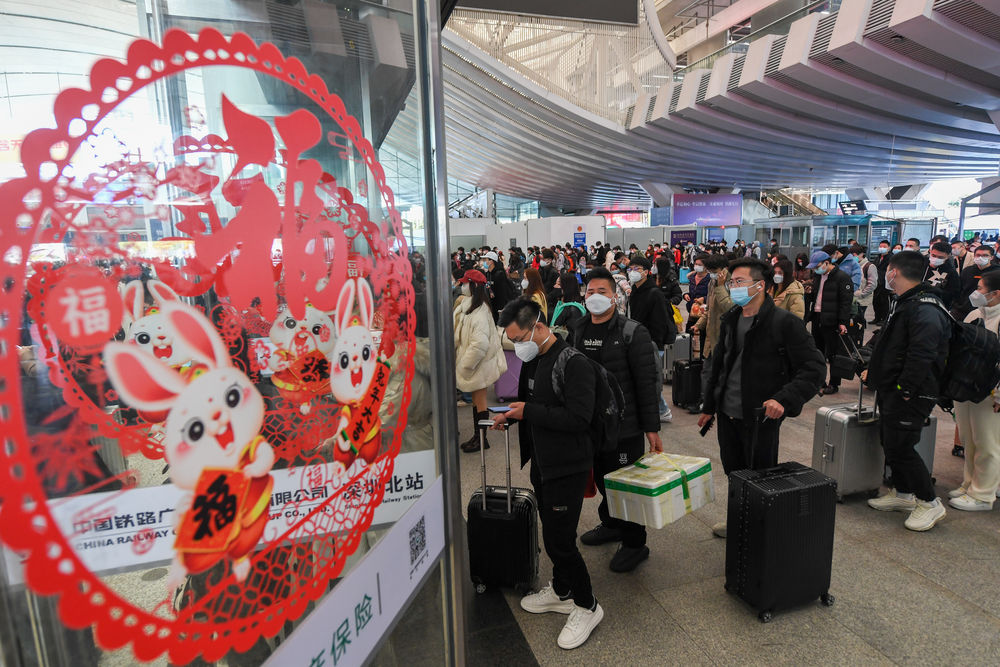
  Passengers lined up at the entrance of Shenzhen North Railway Station (photo taken on January 18). Xinhua News Agency reporter Mao Siqian photo

  The continuous growth of passenger flow and the orderly road in the busy schedule highlight the vitality and vigor of the mobile China — —

  After the Lantern Festival, in the Shanghai Railway Station of Shanghai Metro Line 1, people carrying big bags and small bags passed quickly and orderly under the guidance of staff and police. The bustling scene made many people feel that "the busy international city is back";

  During the Spring Festival, Sanya Air Traffic Control Station reached a new high, with a total of 3,024 flights in seven days, an increase of 5.8% over the same period in 2019. "Now the apron is full of planes, and the number of wide-body aircraft and business jets has increased significantly";

  In the second half of Spring Festival travel rush, the number of passengers carried by passenger ships under the jurisdiction of Shandong Weihai Maritime Safety Administration increased significantly, and the daily average number of passengers carried remained at around 20,000, an increase of 192% compared with the first half of the year & hellip; …

  "Overall, the operation of railways, highways, waterways and civil aviation in the country has remained stable, with adequate capacity allocation, orderly services and strong emergency support, and the national security situation is generally stable." Zhou Wei, deputy director of the Emergency Office of the Ministry of Transport, said.

  Excellent service and further upgrade will help Spring Festival travel rush to be safe and smooth.

  When Aunt Tang, who had never flown alone, entered the T3 terminal of Shenzhen Airport, Peng Yihan, an airport worker who had been waiting for a long time, was greeted: "Aunt Tang, your son applied through the airport hotline ‘ Whole-process assistance for elderly travelers ’ Love service, I will accompany you to the boarding gate. " Accompanied by the staff all the way, Aunt Tang successfully boarded the flight back to her hometown in Xi ‘an.

  In Spring Festival travel rush this year, "warm heart service" became one of the key words.

  A number of airports and airlines have upgraded the "first-time passenger service" in an all-round way, providing full-process services such as check-in, security check-in and waiting for flights for first-time passengers; 12306 Continue to improve the transfer plan, train operation and information related to "food, accommodation, travel and purchase" to make it more convenient for passengers to obtain information; The service of "Smooth Train" has covered more than 3,400 emus of 18 railway bureau group companies. Passengers can check the information of the train’s delay and running position by scanning the "Smooth Train" code on the armrest of the seat … …

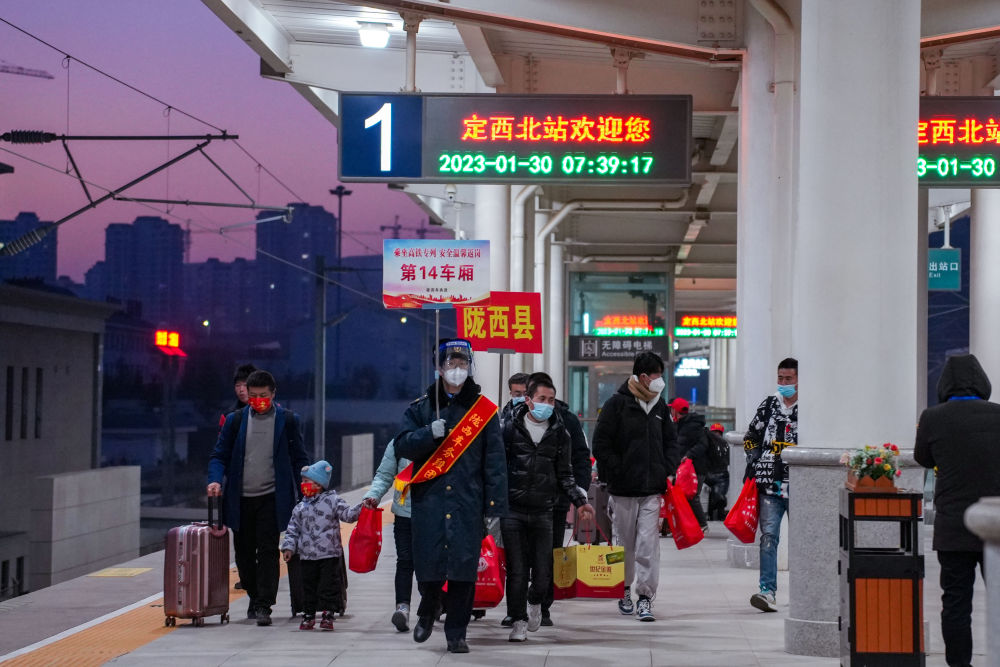
  On January 30th, 531 migrant workers from Dingxi, Gansu Province took the G1904 train from Dingxi North Station and went to Fuzhou, Fujian Province, more than 2,000 kilometers away, to start a new year’s migrant journey.

  Under the guidance of the staff of Dingxi North Station in Gansu Province, migrant workers are preparing to take the free high-speed train for returning to work to Fuzhou, Fujian Province (photo taken on January 30). Xinhua News Agency (photo by Wang Guanghui)

  "From Dingxi to Fuzhou, the ordinary train takes more than 30 hours, and this high-speed train only takes more than 13 hours." Shi Xuexia, who works in an automobile motor factory in Fuzhou, said that when she arrived in Fuzhou, there was a special car in the factory to pick her up for work.

  China Railway Chengdu Bureau Group Co., Ltd. took the initiative to find out the number of trips, and launched a total of 24 "point-to-point, one-stop" direct return trains, with a transportation capacity of 14,000 passengers; Yunnan has organized more than 1,460 "point-to-point" transportation services, such as "special buses for workers, special trains and charter flights", which have helped 49,300 rural laborers realize the transfer of employment … … Towards a struggle and a better life, cars, high-speed trains and planes continue to travel.

  Cyclists returning home rest at Spring Festival travel rush Qingwen Station at the east exit of Wuzhou City, Guangxi (photo taken on January 7). Xinhua News Agency reporter Huang Xiaobang photo

  Security is a constant theme in Spring Festival travel rush.

  In Hami, Xinjiang, in the extremely cold weather, the law enforcement officers of the Barkun Law Enforcement Brigade of Xinjiang Transportation Comprehensive Administrative Law Enforcement Bureau waded knee-deep in snow to find trapped vehicles, and guided the trapped people to rest in the nearby service area one by one, and provided meals and accommodation; At the same time, snow removal and deicing equipment such as snow removal vehicle, sweeper and snow melting agent distributor are used to ensure smooth roads.

  "During the period of Spring Festival travel rush, tens of thousands of cars went out of Xinjiang through the G7 Jingxin Expressway every day. What we are most worried about is the windy and snowy weather, which is likely to cause vehicle failures and frostbite." Tao Zhiliang, secretary of the Party branch of the Barkun Law Enforcement Brigade, said that the weather is getting warmer now, and the brigade will make preparations for preventing avalanches and flood control in spring.

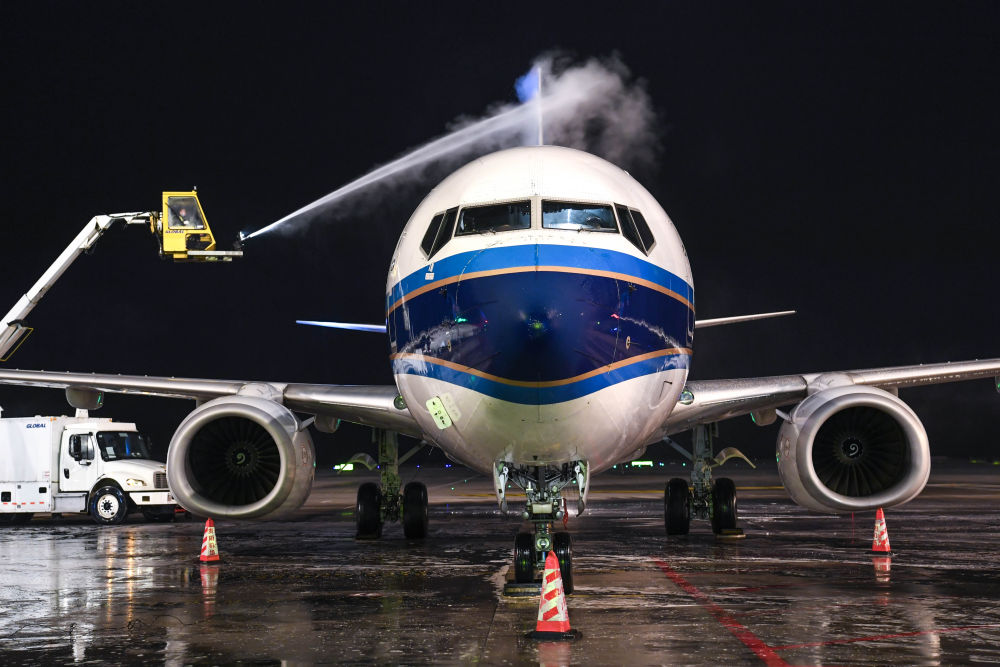
  The crew of China Southern Airlines carried out deicing and anti-icing operations at Longdongbao International Airport in Guiyang (photo taken on January 17). Xinhua News Agency reporter Yang Wenbin photo

  Ensure the prosperity of materials and freight, and run forward in the new year.

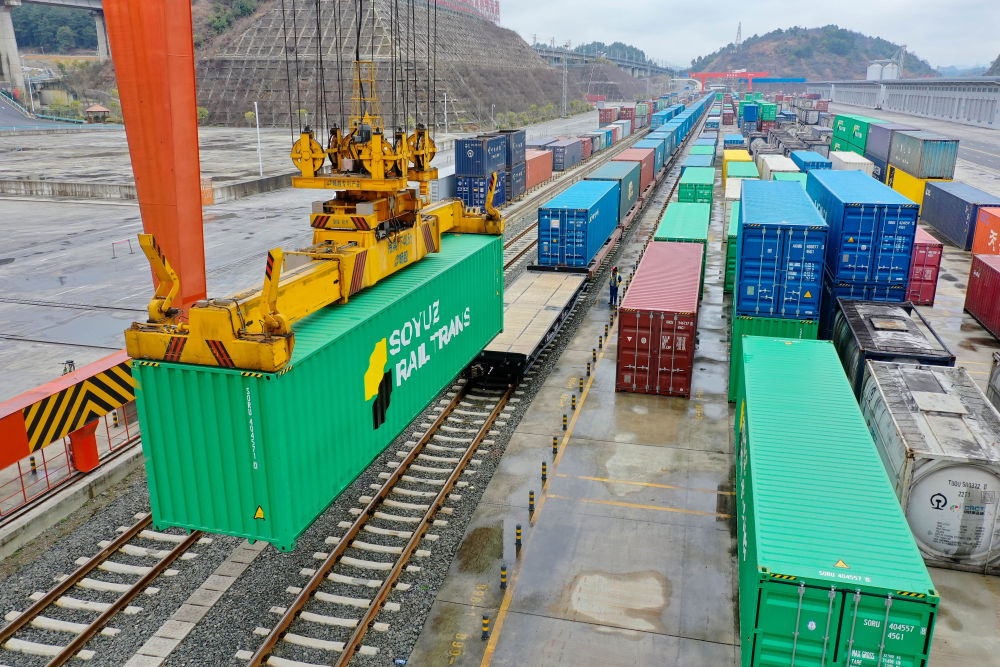
  Zhejiang, Yiwu West Railway Station, trucks enter and exit in an orderly manner, and gantry cranes load containers on the "Yixin Europe" Central European train. The "steel camel team" full of goods is ready to go, injecting strong vitality into China’s foreign trade and economic cooperation.

  Statistics show that in January this year, "Yixin Europe" China-Europe Yiwu platform operated 240 trains and sent 20,140 TEUs, with a year-on-year increase of 172.1%.

  “‘ Yixin Europe ’ The shipment volume of the China-Europe Yiwu platform has grown steadily, reflecting the strong resilience and great potential of China’s economy. " Bei Xudong, deputy director of Yiwu Municipal Market Development Committee, said that during Spring Festival travel rush, railways, ports and other relevant departments made scientific overall plans and coordinated in advance according to the transportation demand and supply organization of foreign trade enterprises to ensure the smooth running of trains during Spring Festival travel rush.

  The speeding trains reflect the steady economic recovery of China; The smooth road network weaves the people’s livelihood and well-being of all households in China.

  A Central European train loaded containers at Dulaying Station of Guiyang International Land Port (photo taken on February 9, photo of drone). Xinhua News Agency reporter Liu Xushe

  As dawn dawned, Master Gui, a truck driver in Shenzhen, came to the warehouse area to count the goods to be sent out that day with the store. "I am really happy to see that the merchants are busy!" Master Gui said that in the past two weeks, the merchants in the market have been busy, and the passenger flow has returned to 70% to 80% of the normal level before the epidemic.

  According to the platform data, the freight market in Shenzhen opened higher after the Spring Festival holiday. From January 31 to February 7, the freight order volume in Shenzhen increased by 117% compared with the same period of last year. On average, more than 6,000 drivers run on the road every day to take orders actively.

  Spring is not a mistake, and autumn is not. North and south of the river, farmland is busy.

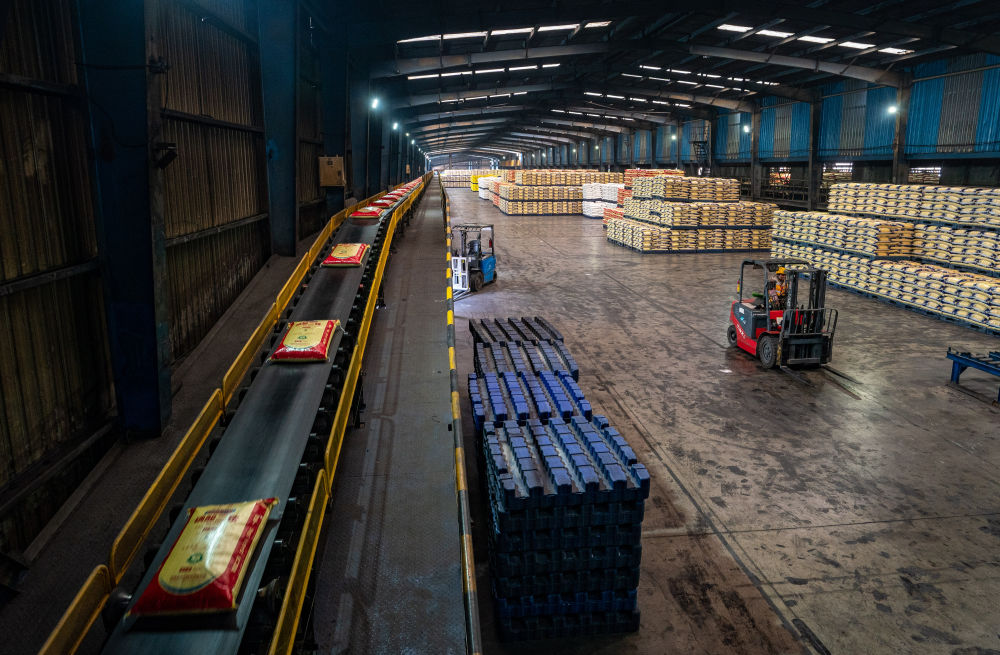
  On the outskirts of Kunming, Yunnan Province, Taohuacun Railway Station, 6 forklifts are working continuously. Within one hour, the staff loaded all 360 tons of chemical fertilizer into the carriage. Soon, these fertilizers will be transported to Shandong, Hebei and other places to provide nutrients for crop growth.

  In view of the obvious increase in the transportation demand of spring ploughing production materials, several railway stations in Kunming have strengthened communication and coordination with neighboring fertilizer production enterprises, helped enterprises to "tailor-made" fertilizer transportation plans, and implemented the "four priorities" service of giving priority to planning, giving priority to air distribution, giving priority to loading and giving priority to hanging.

  Workers carry out transportation operations on the production line of Tianan Chemical Phosphate Fertilizer Manufacturing Center of Yuntianhua Group in Anning City, Kunming, Yunnan Province (photo taken on February 8). Xinhua News Agency reporter Jiang Wenyao photo

  According to statistics, China Railway Kunming Bureau Group Co., Ltd. has transported more than 15,000 vehicles and 919,000 tons of spring ploughing materials in 2023, with a year-on-year increase of 16.6%. The cars passing through the mountains and tunnels are carrying the hope of a bumper harvest and reaching countless distant places.

  After 40 days and nights, Spring Festival travel rush came to an end and saw beautiful spring scenery. Spring Festival travel rush is the starting point for the revival of all industries. People are full of energy, confident and calm in the season full of hope, and strive for a brighter new year.

  Text reporters: Ye Haoming, Ruta, Wei Hongyi, Fan Xi.

  Poster design: Excellence

Old and new detectives gather! "detective chinatown" series exposed IP special edition

1905 movie network news The film, written and directed by Chen Sicheng and starring Wang Baoqiang and Haoran Liu, will be released on New Year’s Day in 2020, and the new detective tour of "Chinatown Detective Group" is highly anticipated by the audience. At the same time, another branch of "Exploring the Universe in Tang Dynasty", online drama, is about to be broadcast online.
On December 25th, an IP special of Tang Tan was exposed, revealing Chen Sicheng’s overall planning for the series of Tang Tan. The timeline of the online drama story will be seamlessly connected to the movie, and the old and new detectives are also inextricably linked. The linkage between movies and dramas is not only full of surprises, but also makes the pattern of "exploring the universe in Tang Dynasty" clearer.


Detective rankings are "new"

The joint efforts of film and network open a new stage of exploring the universe in Tang Dynasty

In this special series, Chen Sicheng appeared as the producer of the online drama detective chinatown. He frankly said that the original intention of the series "Tang Detective" was to create local output in China and become famous in the world. The "Crimaster list of world famous detectives", which frequently appears in movies and online dramas, is actually a carrier that allows these detectives to have a soil to survive. After three movies and an online drama, many impressive detective characters have appeared on this list.

Not only Tang Ren and Qin Feng, but also Noda Hao, Song Yi, KIKO, and the Thai detective Jack Jia who will appear in the movie "Tang Detective 3". The new detectives in the online drama also have their own characteristics, such as Lin Mo, who has a strong sense of smell, and the five Asian prodigies who appeared in a combined form. With the entry of more and more detectives, Tang’s exploration of the universe has become more and more colorful, opening a new stage of "multi-point flowering".

Shadow-net linkage digging pit and burying stalk

The detectives will assemble "Tang Detective 3"

It can be seen in the special edition that the production of online drama is of high standard with the escort of the original film production team. And Wang Baoqiang, Haoran Liu, Shawn and other important characters in the movie stories also made a surprise appearance. And the new detective Lin Mo, played by Roy Chiu, is Tang Ren’s apprentice. In the movie "Tang Detective 2", the detective’s name has already appeared in the "Crimaster world famous detective list".

All kinds of details worth digging deeply make movies and online dramas add interactive interest. This also stems from the preparation of online drama, which started long before Tang Detective 2. What’s more worth mentioning is that Roy Chiu and Zhang Junning, starring in the online drama, will also appear in the movie Detective Chinatown 3. This made Wang Baoqiang say, "Everyone is together again, still cordial". Shawn also said, "Tang Tan is more and more like a family".


Qingdao Mercedes-Benz EQE SUV is on sale, with a maximum discount of 145,000! There are plenty of cars.

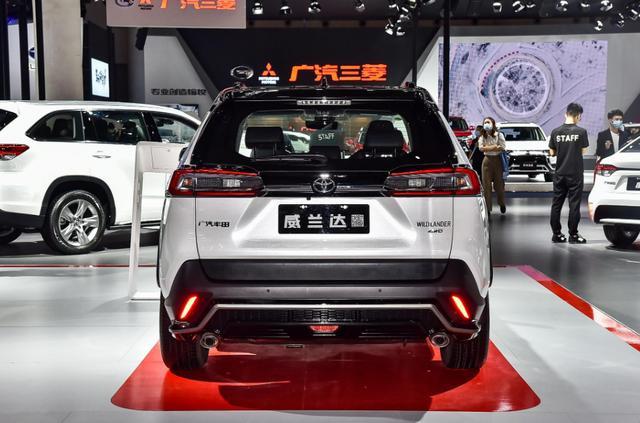
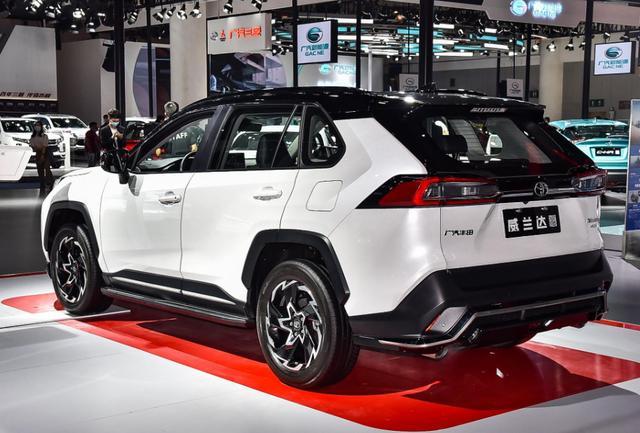
[car home Qingdao Preferential Promotion Channel] Recently, a large-scale preferential activity was ushered in in Qingdao, with the highest preferential range reaching 145,000 yuan and the lowest starting price dropping to 341,000 yuan. This preferential activity is under way, and consumers who want to buy can take the time to act in order to win higher discounts. Please click the "Check Car Price" button in the quotation form for more details.

青岛奔驰EQE

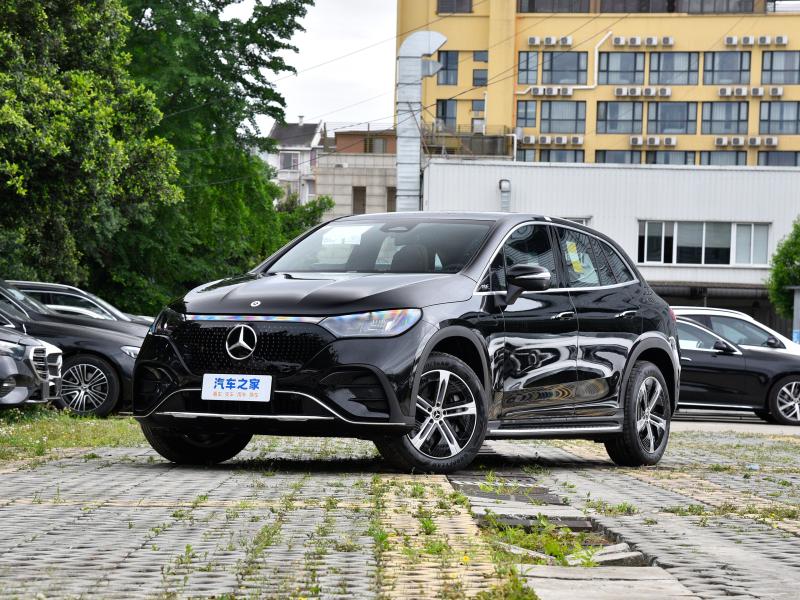
The design of Mercedes-Benz EQE SUV highlights the perfect combination of luxury and technology. The front face adopts the iconic design elements of Mercedes-Benz family, including closed air intake grille and unique LED headlight group, showing a strong sense of the future. The overall style is simple and atmospheric, and the body lines are smooth, which highlights the unique charm of electric vehicles.

青岛奔驰EQE

Mercedes-Benz EQE SUV performs well in size, with the length, width and height of 4880mm, 2032mm and 1679mm respectively, and the wheelbase of 3030mm, which provides ample support for the interior space. The side lines of the car are smooth and full of tension. The rim is designed in 19 inches, and the tyre size is 235/55 R19. No matter the front wheel or the rear wheel, the same specifications are maintained, ensuring the stability and handling of the car.

青岛奔驰EQE

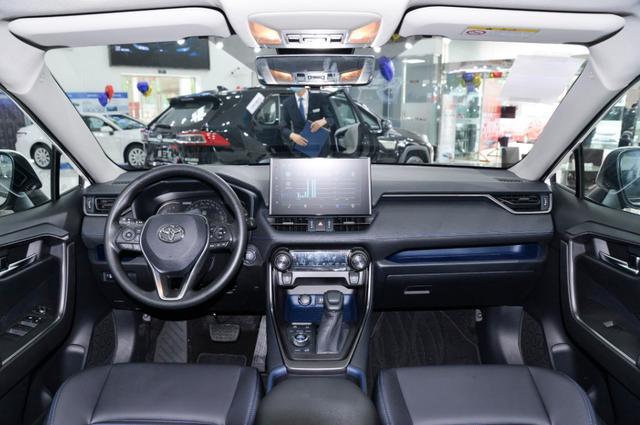
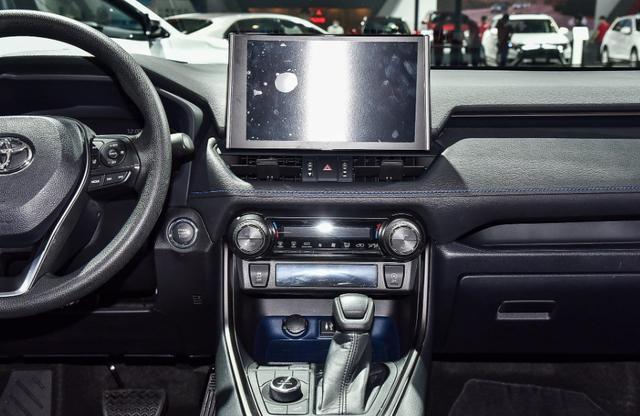
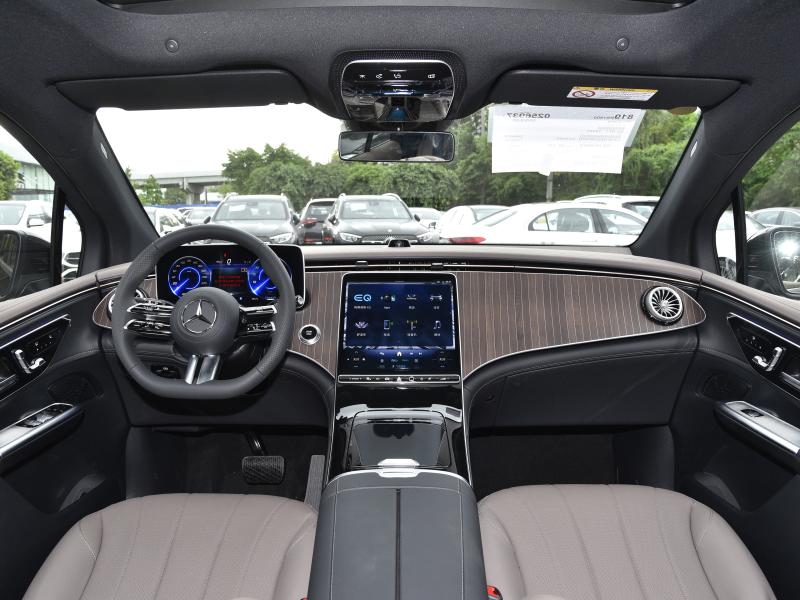
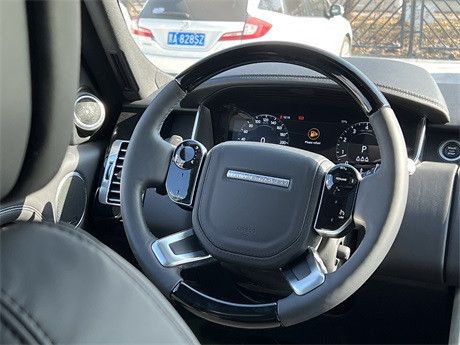
The interior design of Mercedes-Benz EQE SUV shows the perfect integration of luxury and technology. Its interior style is simple and exquisite, using high-quality materials, such as leather steering wheel and imitation leather seats, to bring comfortable and luxurious experience to drivers and passengers. The steering wheel adopts electric adjustment mode, which supports up and down and forward and backward adjustment, so that the driver can find the most suitable driving posture. The central control part is equipped with a 12.8-inch central control screen, which not only displays clearly and operates smoothly, but also integrates various functions such as multimedia system, navigation, telephone, air conditioner, skylight and so on, and supports voice recognition control, so that drivers can concentrate on driving and improve driving safety. In addition, the car also provides a rich multimedia interface and wireless charging function, which is convenient for passengers to charge electronic equipment at any time. The front seats have the functions of heating and ventilation, which improves the riding comfort, while the memory function of electric seats makes it more convenient for drivers and passengers to use the vehicle frequently. The rear seats can be laid down in proportion, providing passengers with flexible and diverse storage space. Generally speaking, the interior configuration of Mercedes-Benz EQE SUV is very rich, which meets the diverse needs of drivers and passengers.

青岛奔驰EQE

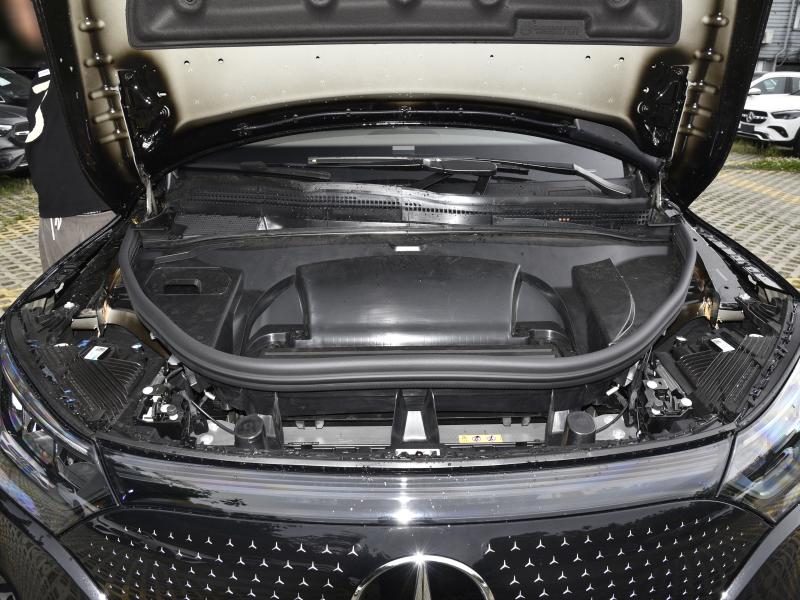
Mercedes-Benz EQE SUV is equipped with a high-performance engine with a maximum power of 300 kW and a peak torque of 858 Nm, which provides a strong power output and excellent driving experience for the vehicle.

The owner of car home said: "In terms of driving experience, the power is OK, and the low-profile car is not very flexible without rear wheel steering. The oil car is BMW 3 Series, and the control is still much worse. The body of the pit is much more swaying and too soft."

New characteristics of China’s economic development and transformation in the new era

  [Core Aspect] The report of the 19th National Congress of the Communist Party of China puts forward new requirements for China’s economic development in the future. The main contradiction in our society has been transformed into the contradiction between the people’s growing need for a better life and the unbalanced development. Based on this transformation, we should make clear the development focus and reform orientation of building a socialist modern power. At present, China’s economic development and transformation presents a series of new characteristics. Standing at a new starting point of development, we should adhere to quality first and benefit first, take supply-side structural reform as the main line, promote quality change, efficiency change and power change of economic development, and continuously enhance China’s economic innovation and competitiveness.

  From high-speed growth to high-quality development stage

  The report of the 19th National Congress of the Communist Party of China made the judgment that "China’s economy has shifted from a high-speed growth stage to a high-quality development stage", which is a new major judgment in view of the new changes in the international and domestic environment, especially the new changes in development conditions, after the economic development entered a new normal. In the past 40 years since the reform and opening up, China’s economy has maintained a high-speed growth of nearly 10%, accounting for an increasing proportion of the global economy. This is mainly because the reform and opening up has formed an institutional mechanism to effectively encourage market players and make full use of international and domestic market resources, so that the "dividend" of China’s rich labor resources and high savings rate can be fully brought into play through the continuous pull of domestic and foreign demand.

  With the continuous impact of the international financial crisis, the development environment and conditions at home and abroad have changed, and China’s economic development has entered a new normal. First, the recovery of the world economy is difficult and continues to be sluggish, and the pulling effect of external demand on China’s economy has obviously weakened; Second, the working-age population has continued to decline, and the relationship between labor supply and demand has changed. In the past 10 years, the wage level has been rising, and the cost advantage of manufacturing has rapidly weakened; Third, more emerging economies have accelerated the pace of industrialization, used their labor cost advantages to absorb manufacturing investment and joined the world market competition; Fourth, the upgrading of the domestic market demand structure has accelerated, consumers’ demand for high-quality agricultural products, manufactured goods and high-quality services has become more prominent, and the domestic supply side has not been able to meet the changes in the demand structure well, resulting in more and more high-end demand for high-quality agricultural products, high-end manufactured goods and high-quality services spilling over to overseas markets. More and more consumers in China go abroad to purchase consumer goods and high-quality food, and go abroad to study, travel and seek medical treatment.

  The above-mentioned changes in development conditions have made China’s original growth model, which mainly relies on factor input, external demand and scale expansion, more and more obviously restricted. We must change the mode of development, optimize the economic structure, change the driving force of growth and change to high-quality development in accordance with the requirements put forward in the report of the 19th National Congress of the Communist Party of China.

  First, the economic growth rate may gradually drop from the high-speed growth of about 9% in the past to about 6%. Mainstream research at home and abroad shows that the potential growth rate of China’s economy in the future is generally in the range of 6% to 7%. Considering that the proportion of China’s foreign trade in global trade has reached a high level, and the original low-cost competitive advantage is being lost, and considering the conditions such as the strengthening of ecological environment constraints, and the new kinetic energy formed by innovation is difficult to make an explosive breakthrough in a short period of time, it may be difficult for China’s economy to reproduce the high-speed growth in the past. It should be recognized that it is quite good to achieve a potential growth rate of 6% to 7%.

  The second is to change to a development model that pursues high quality and high efficiency. To realize the sustained and healthy development of China’s economy, the fundamental way out is to promote the quality change, efficiency change and power change of economic development, which needs to continuously improve the quality of products and services of enterprises and improve their operating efficiency from the micro level. It is necessary to take the supply-side structural reform as the main line, accelerate the upgrading of industrial structure and the transformation of traditional industries, accelerate the development of high-quality modern service industries, increase the supply of high-end products and services, and continuously improve added value and competitiveness. Promote the development of new technologies, new products and new formats through innovation, especially by promoting the deep integration of the Internet, big data, artificial intelligence and the real economy, and promote cross-border integration and innovation, so that the potential and new kinetic energy formed by innovation and entrepreneurship will become an inexhaustible driving force for China’s economic growth and continuously enhance the innovation and competitiveness of China’s economy.

  The third is to accelerate the market-oriented reform that is conducive to the market to play a decisive role in resource allocation. In pursuit of high quality and high efficiency, we must persist in giving full play to the decisive role of the market in resource allocation and reduce the government’s intervention in market resource allocation. It is necessary to further deepen the reform of the economic system, adhere to the orientation of marketization, speed up the construction of a market economic system with effective market mechanism, dynamic micro-subjects and moderate macro-control, give enterprises greater autonomy in investment and management decision-making, give full play to and stimulate the innovation power and creativity of market subjects, improve the efficiency of enterprise resource allocation from a micro perspective, and lay a foundation for improving the efficiency of resource allocation in the whole society from a macro perspective.

  Building a modern economic system is a strategic goal.

  According to the report of the 19th National Congress of the Communist Party of China, China’s economy has changed from a high-speed growth stage to a high-quality development stage, and it is in the key period of changing the development mode, optimizing the economic structure and transforming the growth momentum. Building a modern economic system is an urgent requirement for crossing the barrier and a strategic goal for China’s development. Building a modern economic system is a brand-new expression, and its main connotation is:

  First, adhere to quality first and benefit first, take supply-side structural reform as the main line, vigorously promote quality change, efficiency change and power change of economic development, and strive to improve total factor productivity. After nearly 40 years of reform and opening up, China’s GDP has ranked second in the world, and the production scale of more than 220 major industrial products ranks first in the world. However, the problems of low quality and efficiency and weak growth momentum have become increasingly prominent. To change this situation, we must aim at improving quality and competitiveness, give full play to the decisive role of the market in resource allocation, encourage scientific and technological innovation and entrepreneurial innovation more effectively, accelerate the upgrading and efficiency improvement of traditional industries, improve the quality of products and services on the supply side, better meet the upgrading of domestic consumption structure, and achieve a higher quality and level of dynamic balance between supply and demand.

  The second is to speed up the construction of an industrial system in which the real economy, scientific and technological innovation, modern finance and human resources develop in coordination. Accelerating the development of the real economy is an important task of building a modern economic system and the focus of economic development. We should focus on the real economy, accelerate the construction of a manufacturing power, and take the road of coordinated development and mutual support among the real economy, scientific and technological innovation, modern finance and human capital. In this process, it is necessary to strengthen the supporting role of scientific and technological innovation in the real economy, especially in advanced manufacturing, and give full play to the role of the state in basic research and applied basic research in technological innovation; Strengthen the service function of finance to the real economy, and provide efficient, convenient, reasonable and diverse financing services for the real economy, especially direct financing services such as venture capital and equity investment; Strengthen the cultivation of human capital and provide more labor with higher professional quality and skills for the upgrading of the real economy.

  The third is to speed up the construction of a market economic system with effective market mechanism, dynamic micro-subjects and moderate macro-control. Effective market mechanism is to improve the socialist market economic system, focus on improving the property rights protection system and the market-oriented allocation of factors, and achieve effective property rights incentives, free flow of factors, flexible price response, fair and orderly competition, and survival of the fittest. This is the necessary institutional guarantee for achieving high-quality and high-efficiency growth. The vitality of micro-subject means to respect the dominant position of enterprises, continue to deepen the reform of commercial system, fully implement the negative list system of market access, implement the autonomy of enterprise management decision-making, deepen the reform of state-owned enterprises, support the development of private economy, and cultivate more world-class enterprises with global competitiveness. The core of moderate macro-control is to innovate and improve macro-control, give play to the strategic guiding role of national development planning, and improve the coordination mechanism of financial, monetary, industrial and regional economic policies. When implementing macro-control, the government should conform to the laws of the market, grasp the boundaries and relations between the government and the market, and do not be absent or offside, so as to better play the role of the government.

  Deepening supply-side reform is the fundamental solution.

  Deepening the structural reform of supply side is the key task of building a modern economic system, which is the fundamental solution to the structural problems existing in the supply side of China’s economy.

  The contradiction between the irrational supply-side structure of China’s economy and the failure to meet the upgrading of domestic demand structure is more prominent. In recent years, the supply-side structural reform with the emphasis on de-capacity, de-inventory, de-leverage, cost reduction and short-boarding has achieved positive results, but overall, the supply of high-quality products and services in China still does not meet the requirements of demand upgrading and refinement, and the industrial competitiveness needs to be further improved. Therefore, we must focus on the real economy, especially the manufacturing industry, take improving the quality of the supply system as the main direction, continue to deepen the structural reform of the supply side, improve the quality of the stock supply, and expand the high-quality incremental supply.

  It is necessary to encourage all walks of life to carry out quality improvement actions and continuously enhance the quality advantage of the economy. Accelerate the development of advanced manufacturing and modern service industries, cultivate a number of world-class advanced manufacturing clusters, and promote China’s industries to move towards the middle and high end of the global value chain. Focusing on the middle and high-end consumer demand, we will cultivate new growth points and form new kinetic energy in the fields of innovation-led, green and low-carbon, sharing economy, modern supply chain and human capital services, promote the deep integration of the Internet and the real economy, and give better play to the integration and innovation effects of big data, cloud computing, artificial intelligence and the real economy. Support the optimization and upgrading of traditional industries, aim at international advanced standards to improve product technology, process equipment, energy efficiency and environmental protection, improve product quality and added value of traditional industries, especially strengthen high-end manufacturing capabilities in the fields of basic processes, basic materials and basic components. In addition, we will continue to strengthen the construction of infrastructure networks such as water conservancy, railways, highways, water transport, aviation, pipelines, power grids, information, logistics, etc., strengthen the interconnection and convergence between infrastructure networks, and give full play to the integrated service effect and support for the real economy.

  We must continue to adhere to de-capacity, de-inventory, de-leverage, reduce costs, make up shortcomings, optimize the allocation of stock resources, and expand high-quality incremental supply. It is necessary to improve the real estate control measures and optimize the supply structure of the real estate market. Further measures should be taken to reduce the overall debt leverage ratio, especially to effectively control the debt risk of local governments. In terms of making up the shortcomings, it is necessary to strengthen the prevention and control of the discharge of important pollutants in key areas and focus on solving outstanding environmental problems. Further improve the long-term mechanism for poverty alleviation, adhere to precise poverty alleviation and precise poverty alleviation, complete the poverty alleviation goals and tasks that have been clearly defined, and achieve poverty alleviation and poverty alleviation. In addition, based on the long-term, we should strengthen the short-board construction, including insufficient innovation ability, inefficient financial services, imperfect social security system, insufficient maintenance of unified market and insufficient accumulation of human capital, invest resources, improve systems and mechanisms, and prevent short-board from becoming a constraint to sustained and healthy economic development.

  Entrepreneurs are the main force to promote supply-side structural reform, revitalize the real economy, and also promote innovation and development. We should better stimulate and protect entrepreneurship, stabilize entrepreneurs’ long-term expectations, and support entrepreneurs to innovate and start businesses, so that they can be rooted in the long-term development of China’s economy. High-quality development is inseparable from high-quality workers. It is necessary to increase the cultivation of human capital, build an army of knowledge-based, skilled and innovative workers, promote the spirit of model workers and craftsmen in the whole society, form a glorious social fashion of labor and a professional atmosphere of Excellence, and improve the economic and social status of ordinary workers. (The author is Xu Lin, director of China City and Small Town Reform and Development Center)

22 Land Rover Range Rover Executive Eurocode P400 Tianjin Port 1.28 million

  The appearance of 22 executive cars is sharp and sharp, and all of them show unparalleled leadership temperament. The coordination and design of headlights, bumpers and aluminum decorative parts make tough straight lines glow the whole body.

  22 Range Rover Executive 3.0 Gasoline P400 Plus Edition Color: Black/Black 1.268 million

  Configuration: HSE, all-in-one black, visual aid, head-up display, driver’s aid package, 360-ring car image, radar ranging, 825W audio, front seat massage, front and rear seat ventilation and heating, four-wheel drive air conditioning, air purification, refrigerator, second-generation terrain feedback, windshield heating, 22-inch diamond wheel hub, black piano wood interior, mahogany steering wheel and trailer package.

  The overall interior of 22 Land Rover Range Rover Executive 3.0T gasoline is close to the direction of "luxury", which combines the characteristics of SUV and the essence of luxury car. Everything that can be touched and touched in the car reflects Land Rover’s perfect pursuit of details, and the personalized interior design echoes the appearance, which makes the body exude a confident, calm and poised king temperament.

  The rear row of the 2 Land Rover Range Rover Executive 3.0T gasoline is basically unchanged, with ample seating space and no problem for four adults at the same time. The whole vehicle seat is wrapped in top-grade leather, but instead of using high-grade Oxford perforated leather like the old one, it is replaced with perforated Windsor leather, adopting a new seat style, and the whole interior will bring you a brand-new feeling, and the padding is also sufficient, so the seat is very comfortable and supportive.

  The 22 Land Rover Range Rover Executive Edition is equipped with a V6 3.0T engine with 400 horsepower L6 and an 8-speed automatic manual transmission. The body size is 5020*2073*1868mm, the maximum speed is 225, the acceleration per 100 kilometers is 6.5s, the comprehensive fuel consumption is 8.8L, the wheelbase is 3120mm, the fuel tank volume is 104L, the maximum power is 294, and the maximum power speed is 5500-6500.

  Our company promises: We won’t make the lowest price in the market, the lowest price is not guaranteed, the highest price is not guaranteed, and the highest price is unfeeling. We only earn what we should earn, pay what we should, do things seriously, and win-win cooperation. If we cooperate with you, we can’t guarantee that you will spend the least money. I can guarantee that you will save the greatest heart and get the situation of quality, efficiency, interests and win-win. We look forward to the cooperation of every new and old customer! Serve with your heart and pass on trust! I am willing to cooperate with you for a long time!

  Cao Yi’s telephone number is 15122436666 with WeChat.

  Disclaimer: The above car purchase preferential information is provided by the comprehensive dealers of this website, and the price fluctuates greatly due to market factors, which is only for car purchase reference; The distributor is responsible for its authenticity, accuracy and legality, and this website does not provide any guarantee or assume any legal responsibility.

5G, big data, Internet of Things and artificial intelligence are widely used, and cities have become more "smart"

  [spotlight]

  5G, big data, Internet of Things and artificial intelligence are widely used — —

  Cities become more "smart"

  Guangming Daily reporter Liu Kun

  Enterprise employees work in the cloud, brainstorm in video conferences, residents show their health codes when they enter the community and visit the supermarket, and doctors use 5G and artificial intelligence for remote consultation and treatment … … Since the outbreak of the COVID-19 epidemic, many new changes have taken place in our lives, and our city has become more "intelligent".

  Nowadays, new technologies such as 5G, big data, Internet of Things and artificial intelligence are developing continuously, which are widely used in the process of building new smart cities in China, giving birth to a new digital, networked and intelligent public service model and a new concept of urban governance, bringing many conveniences to people’s production and life. In the future, how to better promote the construction of new smart cities?

  The staff monitors the tourism situation in real time through the smart tourism big data platform. Xinhua news agency

  Health codes and information platforms are of great use.

  During the epidemic period, the "e Longyan" platform in Longyan City, Fujian Province developed and launched the COVID-19 prevention and control information service program, and launched a number of related services, so that citizens can quickly query information, conduct online free clinics, and report epidemic clues in time. The questions reflected by the citizens are uniformly summarized on the 12345 platform. If the platform can reply, it will give an immediate reply. If the professional questions cannot be answered, it will be transferred to the relevant departments for processing in time.

  At 19: 20 on June 30, Ms. Yang, who lives in Daxing, Beijing, returned to the community after work and was showing the Beijing health code to the property security personnel. After confirming that "nothing unusual", she was allowed to enter. "I have to show my health code four or five times a day now, which is very convenient to use and conducive to epidemic prevention and control." She said.

  On April 8, Wuhan, which was closed for 76 days, reopened the passage from Han to Hubei. In the early morning of that day, many passengers came to Wuhan Railway Station. They wore masks and took the Hubei health code "Green Code" and took the high-speed train one after another to all parts of the country. For them, "green code" means "passport" to return to work. Since the beginning of this year, health codes, epidemic prevention maps, information platforms, intelligent temperature screening and early warning systems, etc. have become a powerful means to fight the epidemic.

  Wang Yukai, a professor at the Central Party School (National School of Administration) and a member of the National Informationization Expert Advisory Committee, said that China has made great strategic achievements in epidemic prevention and control, which is closely related to China’s promotion of smart city construction in recent years. Since the outbreak, local governments have released information to the public in a timely manner through the government information platform, releasing local epidemics, so that the public can know the situation in time and improve their preventive ability.

  Wang Yukai said that in the construction of smart cities, we have established a strong data base, which was of great use during the epidemic. The government has a large number of public data, such as population database and geographic information database. Telecom operators master a large amount of data through mobile phone real-name registration system; Internet companies also have massive data by providing market services and social services. These different types of data provide support for the traceability of the epidemic, the tracking of the transmission chain, and the group prevention and control.

  "If there is no smart city construction, we can’t hold so many video conferences today, there can’t be tens of millions of enterprises working online, and there can’t be hundreds of millions of students taking classes online." Gao Xinmin, a member of the National Informatization Expert Advisory Committee, believes that during the epidemic, the information sharing and service platform created by the government played an important role. Internet companies provided a lot of intelligent services around the normal operation of the city and the living needs of the people, which increased the flexibility of economic and social operation and improved the city’s impact resistance.

  At present, what is the current situation of smart city construction in China? According to some studies, the construction of smart cities in China has generally gone through four stages: the first stage is the exploration and practice period. From the end of 2008 when the concept of "smart city" was put forward to August 2014, various departments and localities promoted the construction of smart cities according to their own understanding, which was relatively scattered and disorderly; The second stage is the normative adjustment period. From August 2014 to December 2015, the Inter-Ministerial Coordination Working Group for Promoting the Healthy Development of Smart Cities was established at the national level. All departments stopped working alone and began to coordinate and guide the construction of local smart cities. The third stage is the strategic attack period. From December 2015 to December 2017, the concept of a new smart city was put forward and upgraded to a national strategy, focusing on promoting the integration and sharing of government information systems, breaking information islands and data segmentation; The fourth stage is the period of all-round development. Since the 19th National Congress of the Communist Party of China was held, the construction of new smart cities in various places has been accelerated, and the construction achievements have gradually extended to districts, counties and rural areas.

  Experts said that at present, the construction of smart cities in China has achieved positive results. According to statistics, all cities above the sub-provincial level and more than 89% cities above the prefecture level have proposed to build smart cities. While releasing the overall action plan for implementing smart cities, all provinces and cities are constantly promoting the practice in specific fields such as "smart education", "smart medical care" and "smart transportation", and exploring the key points and development paths suitable for the construction of local smart cities. After years of construction and innovative development, a number of innovative applications such as "urban brain" and Internet hospital have emerged, which have provided a model for the construction of global smart cities in some fields.

  In Tianjin Haier washing machine interconnection factory, the staff are checking the parts. Xinhua news agency

  Data islands and fragmentation still exist.

  Experts said that on the whole, China’s new smart city construction has achieved positive results, but it also faces problems such as weak top-level design, insufficient linkage between urban data integration and governance, uneven development between urban and rural areas, and the formation of smart city development ecology, which needs to be targeted. Make improvements.

  Where does the "wisdom" of the city come from? From the data.

  The essence of the new smart city is to use the new generation of information technology to reshape and rebuild the city, and use the attributes of smooth flow and open sharing of data resources to force the unreasonable management system, governance structure, service model and industrial layout of the city to become more reasonable, optimized, transparent and efficient. At present, in the process of building smart cities in China, data islands and fragmentation still exist.

  "In response to the epidemic, in some places, data can’t be shared and departments are fragmented. Some business systems we have built lack collaborative functions. These problems have exposed many shortcomings in the construction of new smart cities in China." Wang Yukai said, how to make further efforts in these areas, so that smart cities can better serve the people and truly embody people-centered, is the direction of our future efforts.

  "Smart cities have developed to today, paying more and more attention to the role of data and data value chain." Gao Xinmin said that the essence of the "urban brain" is to gather data from all aspects of the city, and make intelligent decisions through artificial intelligence analysis and calculation. At present, the biggest bottleneck in the construction of "urban brain" lies in the data convergence. The standards and interfaces of multi-source and inter-departmental data in different information systems are different, and the data circulation mechanism is unclear and the process is not smooth.

  Gao Xinmin suggested that to realize data sharing, first of all, there should be a technical framework that can realize data interoperability, and on this basis, there should be rules and system design. Under the principle of respecting security, sovereignty and demand orientation, once there is demand, a data resource pool can be built quickly, supporting specific applications in time and at low cost, and maximizing data value.

  Shao Guoan, deputy director of the Information Collaborative Innovation Committee of China Informatization Promotion Alliance, said that in the process of building a new smart city, data standardization is necessary. The data should be classified and managed. For example, key sensitive data such as citizen’s ID number, mobile phone number, name and home address should be encrypted and stored, and other data such as location information can be partially opened and managed as needed.

  In the future, we should pay equal attention to technological and institutional innovation.

  Recently, Digital China Holdings Limited signed the Weihai Smart City Project. "We will work hard in Weihai." Guo Zhengli, chief operating officer of Shenzhou Holdings, said that it is planned to build Weihai Smart City Operation Integrated Management Center and Weihai "Urban Brain" with "number" and "intelligence" as the core and make full use of emerging technologies such as Internet of Things, big data and artificial intelligence in three years to promote intelligent transformation in transportation, medical care, cultural tourism and education.

  "Better city, better life", and beauty is inseparable from wisdom.

  Someone once looked forward to the future life like this: driverless cars move forward smoothly under the guidance of intelligent transportation systems; After ordering online, drones and logistics robots will deliver express delivery in time; Before leaving work, the smart home system will turn on the air conditioner and air purifier in advance, and prepare a suitable and fresh home environment … … Experts believe that in the future, in a new smart city, these scenarios will become commonplace.

  Zhang Yansheng, chief researcher of China International Economic Exchange Center, believes that in the future, smart city construction should be deeply integrated with the development of productive services, life services and public services to gather global talents; It is deeply integrated with digital technology, digital format and digital innovation to promote the intelligent, automated and networked development of the real economy. At the same time, we should pay attention to the international situation and turn crisis into safety and opportunity in the great changes; We must make up our minds to build and improve the development ecology with independent intellectual property rights, brands and modern industrial systems.

  "The driving force for the development of smart cities comes largely from the needs of the new generation." Zhang Yansheng said, from "Millennials" to "Generation Z" to "α Generation ",their different needs for a better life will push the construction of smart cities to a new level; At the same time, they will also become a new force to promote the high-quality development of smart cities. At the same time, we can’t ignore the vulnerable groups who are easily marginalized in the construction of smart cities. We should respond to their concerns in time and guarantee their rights and equal development opportunities.

  Experts suggest that in the long run, to promote the development of new smart cities in China, we must pay equal attention to technological and institutional innovation. Strengthen the top-level design of smart cities, and introduce the overall planning or construction guidance of new smart cities at the national level as soon as possible; We will improve the new digital infrastructure, vigorously develop smart pipe networks and smart water services, promote the application of smart lampposts and smart manhole covers, promote the intelligentization of municipal facilities, accelerate the establishment of an Internet of Things perception system for urban components, and improve the digital level of cities.

  At the same time, promote the fairness and inclusiveness of public services, establish a public service information system with cross-departmental and cross-regional business collaboration, joint construction and sharing, and explore innovative service models for education, employment, social security, pension, medical care and culture; Deepen the application of urban data fusion, and build an efficient and intelligent urban hub and transparent government; Optimize the ecology of new smart cities and release the vitality of urban data elements through institutional and institutional innovation.

Geely Star Wish real car exposure, with Aegis short knife battery, listed in the second half of the year

With the release of the new MIIT declaration information, we have also seen the figure of a new car from Geely. The new car is named Xingyuan, which is a new pure electric small car. The new car uses a new pure electric platform, and the new design also makes it look more fashionable and interesting. It is understood that Geely Xingyuan will use lithium iron phosphate batteries, and also has an independent suspension design. The new car is expected to be launched in the third and fourth quarters of this year.

From the announcement picture, Geely Xingyuan adopts a new design language, with smooth and smooth body lines. It can be said that in the field of small pure electric cars, more youthful design ideas are integrated, and the golden body ratio of the new car creates a full and tense dynamic beauty. In addition, in terms of details, the new car adopts a closed front grille, and both sides are also equipped with headlights similar to rounded polygons and double C-shaped diversion grooves on both sides, which further strengthen the sporty characteristics. The size of the new car body is 4135 × 1805 × 1570mm, and the wheelbase is 2650mm.

Looking at the side of the car, Star Wish has front and rear raised eyebrow lines, hidden door handles, low wind resistance wheels, and a two-color body design, making the overall look very young. In the rear design, the new car also uses a tail light set similar to a rounded triangle, which echoes the front of the car very well.

According to relevant information, Geely Star is built on a new pure electric platform. In terms of power, the car is equipped with a lithium iron phosphate power battery, and the electric motor has two powers, 58kW and 85kW respectively. And for further information on the new car, we will continue to pay attention.