Heavy! Who suddenly announced: the state of emergency continues! Orders will exceed 5.5 trillion yuan, detonating the new energy market? The performance of the 800 billion giants has exploded, and it
The heavy news of the new energy track continues.
First of all, a piece of data from South Korea’s new energy market has sparked heated discussions. According to media reports, South Korea’s three major power battery manufacturers: LG New Energy, Samsung SDI and SK On, will have more than 1,000 trillion won (about 5.5 trillion yuan) in hand this year. In order to meet the market demand, Korean power battery giants are frantically expanding their production capacity around the world.
At the same time, the performance forecast of another new energy leader has also been thoroughly screened in the A-share market. On the evening of January 30th, BYD, with a total market value of over 800 billion yuan, disclosed its performance forecast for 2022. It is estimated that its operating income will exceed 420 billion yuan in 2022, and its net profit will reach 16 billion to 17 billion yuan, up by 425.42%-458.26% year-on-year. This performance forecast exceeded market expectations.
A recent statement by WHO has also attracted market attention. On January 30th, local time, official website, WHO issued the latest statement, and Director-General Tedros Adhanom Ghebreyesus agreed with the recommendations made by the committee, confirming that COVID-19 pandemic will continue to constitute a public health emergency (PHEIC) of international concern. This means that the global emergency in COVID-19 has not yet come to an end. In addition, according to the latest report of the Associated Press, US President Biden plans to announce the end of the COVID-19 epidemic emergency on May 11th, local time.
On January 30th, BusinessKorea, a Korean commercial media, reported that the orders of three major power battery manufacturers in Korea: LG New Energy, Samsung SDI and SK On will exceed 1,000 trillion won (about 5.5 trillion yuan) this year.
According to SNE Research, a specialized market research company for electric vehicles and batteries, as of September 2022, the backlog of orders from three battery companies in South Korea was 700 trillion won, which is expected to exceed 1,000 trillion won this year. It is expected that these orders will be digested before 2030.
In addition, BusinessKorea estimates that with the growth of the power battery market, the total operating profit of the above three power battery giants this year is expected to exceed 5 trillion won. It is estimated that the operating profit of LG New Energy will increase by 94% to 2.3606 trillion won; Samsung SDI’s operating profit will increase by 30% to 2.4321 trillion won; The operating profit of SK On, which lost money last year, is expected to reach about 100 billion won.
Faced with a large number of orders in hand, South Korean power battery giants are frantically expanding their production capacity around the world. Among them, LG New Energy’s action is particularly radical, and it has successively established joint ventures with GM, Stellantis, Honda and other car companies and set up factories.
LG New Energy expects the total production capacity to reach 540 GWh by 2025, while the annual production capacity in 2022 is only 200 GWh.
In addition, Samsung SDI also set up a factory in the United States and strengthened cooperation with BMW; SK On is cooperating with Hyundai Motor and Ford Motor, and plans to jointly build a joint venture factory.
The crazy expansion of Korean power battery manufacturers in the North American market may not be good news for China power battery giant Contemporary Amperex Technology Co., Limited.
Because from the perspective of the global market, the market for electric batteries in Contemporary Amperex Technology Co., LimitedoccupyThe rate far exceeds LG new energy, but a large part of it comes from the domestic market. If the domestic market is excluded, the gap between LG New Energy and "Ningwang" power battery installed capacity is not too big.
In addition, the demand for power batteries in the US market is growing rapidly. According to the data reported by BusinessKorea, it is estimated that by 2025, the annual demand for electric vehicle batteries in the US market will increase from 64 GWh to 453 GWh.
However, comparing their financial data, Contemporary Amperex Technology Co., Limited still completely crushed LG New Energy. According to Contemporary Amperex Technology Co., Limited’s performance forecast, the net profit in 2022 is about 29.1 billion yuan to 31.5 billion yuan, an increase of 83%-98% year-on-year; In 2022, LG New Energy’s consolidated revenue was 25.6 trillion won (about 140.8 billion yuan) and its operating profit was 1.2 trillion won (about 6.6 billion yuan), up 43.4% and 57.9% respectively.
At the same time, the performance forecast of another new energy leader has also been thoroughly screened in the A-share market.
On the evening of January 30th, BYD disclosed its performance forecast for 2022, in which it is predicted that its operating income will exceed 420 billion yuan in 2022, and its net profit attributable to shareholders of listed companies will reach 16 billion to 17 billion yuan, up by 425.42% to 458.26% year-on-year.

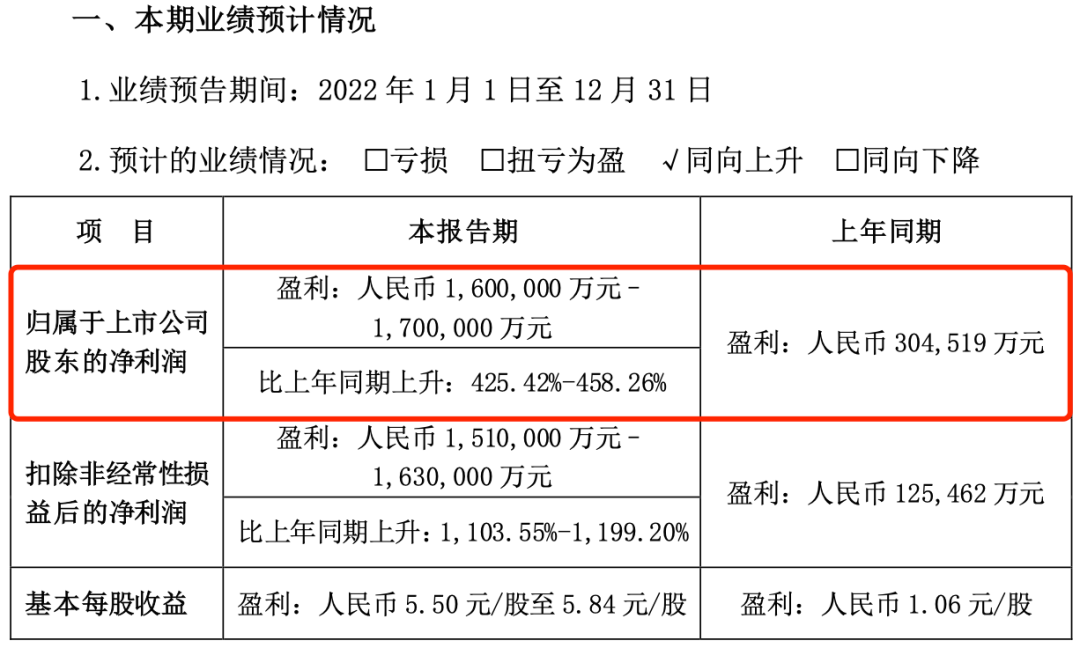
According to the third quarterly report of 2022 disclosed by BYD, the net profit in the third quarter was 5.716 billion yuan. According to this calculation, BYD’s net profit in the fourth quarter is expected to be 6.689 billion yuan-7.689 billion yuan, an increase of 17%-34.52% from the previous month, and the net profit in a single quarter may hit a record high.
This performance forecast also exceeded market expectations. In the past six months, a total of 42 institutions predicted BYD’s 2022 annual performance, of which the estimated average net profit of returning to the mother was 14.496 billion yuan.
As for the reasons for the sharp increase in performance, BYD said in the announcement that the new energy vehicle industry continued to grow explosively. As a leading enterprise in the new energy vehicle industry, the company overcame the complex and severe external environment and the impact of many unexpected factors, and the sales of new energy vehicles achieved strong growth year-on-year, winning the first place in the global sales of new energy vehicles, promoting a substantial improvement in profits and effectively alleviating the cost pressure brought about by the rising prices of upstream raw materials.
It is worth mentioning that BYD’s total sales volume in 2022 was 1,863,500 vehicles, up by 208.64% year-on-year, and it was the first time that domestic vehicles surpassed joint venture vehicles to become the sales champion in China automobile market.
At the same time, BYD’s overall production capacity continues to expand. At the beginning of 2023, it was reported that Wang Chuanfu proposed that the sales volume in 2023 should be 3 million to 4 million units, an increase of 61%-115% compared with 1.86 million units last year. Although BYD officially responded that there are uncertainties in the market, consumer demand and supply chain system, it is not good to finally judge the sales target in 2023, but there is no doubt that BYD will still grow at a high speed.
Back to the market level, the current enthusiasm of funds for the automobile industry chain is rapidly heating up. On the first trading day of the Lunar New Year, the A-share automobile industry chain such as lithium batteries and auto parts staged a daily limit, with more than 20 stocks such as Wencan, Top Group, Xusheng Group, Guangdong Hongtu and Mingke Jingji having daily limit; In addition, Contemporary Amperex Technology Co., Limited and BYD both rose more than 4%.
A recent statement by WHO has also attracted market attention.
On January 30th, official website, the World Health Organization (WHO) issued a statement on the COVID-19 (Covid-19) pandemic at the 14th meeting of the Emergency Committee of the International Health Regulations (2005). Tedros Adhanom Ghebreyesus, Director-General of WHO, agreed with the recommendations made by the Committee, and determined that the COVID-19 pandemic would continue to constitute a public health emergency (PHEIC) of international concern. This means that the global emergency in COVID-19 has not yet come to an end.
It is reported that on January 27th, local time, the WHO Emergency Committee held its 14th meeting to discuss whether the COVID-19 epidemic continues to constitute a "public health emergency of international concern".
The statement said that Tedros Adhanom Ghebreyesus agreed with the Committee that the COVID-19 epidemic was at a turning point. The Committee recommends that this transitional period be carefully managed and the potential negative impact be mitigated.
The Committee agreed that although the public believed that the COVID-19 pandemic had ended in some parts of the world, it was still a public health event, which continued to have a negative and strong impact on the health of the world population, and there was still the risk that new mutations would aggravate the sustained health impact.
Therefore, it is necessary to continue to coordinate international response measures to reliably assess the health impact of COVID-19 pandemic, monitor and evaluate the evolution of the virus and the impact of future variants, strengthen efforts to ensure safe and effective countermeasures, and strengthen targeted risk communication and community participation activities.
The Committee believes that the epidemic situation in COVID-19 is still dynamic and needs to be reassessed frequently, and the "public health emergencies of international concern" should be ended as safely as possible. To this end, the Committee requested the WHO secretariat to provide additional assessment and analysis for the intersessional discussions to further support the Committee’s deliberations. The Committee also recommends that the potential negative consequences of ending "public health emergencies of international concern" be examined.
The Committee believes that in view of the current situation, many countries have reduced the burden of disease in COVID-19, but at the same time, there are inequalities in access to life-saving interventions and uncertainties in the development of the epidemic.
As Covid-19 still exists, the Committee’s interim recommendation calls for strengthening attention to three key priorities: strengthening comprehensive monitoring and achieving vaccination targets for high-risk groups; Continue to develop strategies to increase access to affordable treatment; Strengthen the pandemic prevention plan, while continuing to protect high-risk groups.